
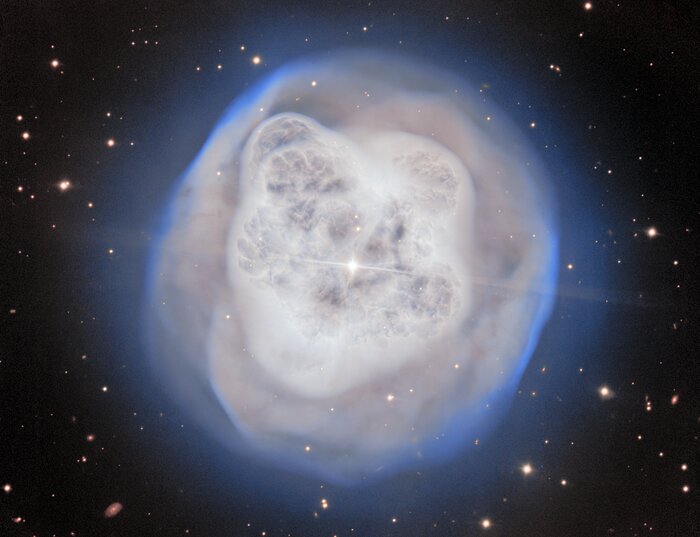
This week’s image is from the Gemini North telescope located on the summit of Maunakea in Hawaii. NGC 1514, or the Crystal Ball Nebula, is about 1,500 light-years away. It was first discovered in 1790 by German–British astronomer William Herschel, who classified it as a planetary nebula.
Here is a little more about the nebula from NOIRLab:
Planetary nebulae form when a low- or intermediate-mass star ejects its outer layers near the end of its life, forming a somewhat spherical cloud of gas. They typically have smoother, spherical shapes, making the Crystal Ball Nebula unique for its bumpy shells of gas. As the central star casts away this gas, its inner core is exposed. Radiation from the core energizes the gas, giving it a scorching temperature and chromatic glow…While it may appear in this image as if there is a single shining light source at the heart of the Crystal Ball Nebula, as Herschel saw, it actually contains two stars. These two stars orbit each other with a period of around nine years — the longest known for any binary pair within a planetary nebula. Scientists believe that one of these stars, which was once several times more massive than our Sun, released its outer layers while in the throes of death. As the progenitor star and its binary companion orbit each other, they mold the expanding shell of gas with their strong, asymmetrical winds, forming the lumpy layers we see today.
 Our Awesome Universe