
Here are some recent space-related stories of interest.
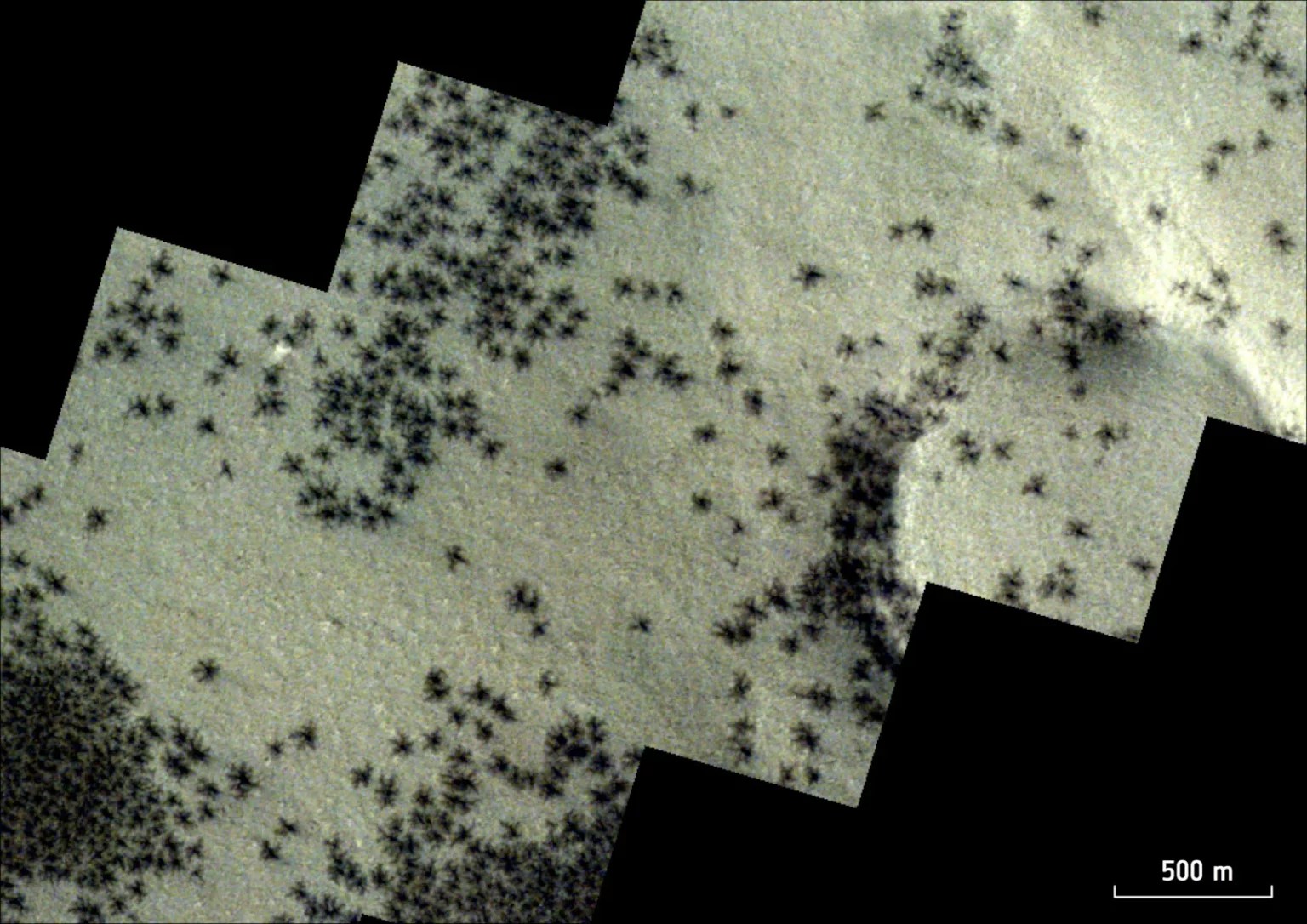
—ZME Science: “NASA Finally Figured Out What’s Up With Those “Mars Spiders”“
For years, satellites around Mars kept finding mysterious, spider-like geological structures. Mars spiders, scientifically known as araneiform terrain, are unique geological formations predominantly found in the southern hemisphere of Mars. They appear as branching, spider-like channels etched into the Martian surface, sometimes spanning over a kilometer in length. In 2024, NASA-led lab experiments pinned down the likeliest way these “spiders” form: seasonal CO₂ ice. Now, a 2026 follow-up showed that the soil beneath the ice can make or break the process, and that these structures could hold clues to Mars’ wet past.
—Earth.com News: “Why Do Astronauts Get Constipated in Space? Scientists Have a New Clue“
Astronauts have complained about constipation for as long as people have flown to space. Nobody could say exactly why. Researchers have long suspected that living without gravity changes how quickly food moves through the gut. Blood drawn from crew members on long stays aboard the International Space Station now points to an answer. Giorgia La Barbera, a joint first author of the study and an associate professor at the University of Copenhagen’s Department of Nutrition, Exercise and Sports, led the work with NASA. “We see changes in astronauts’ blood samples that indicate that the gut bacteria begin to ferment protein to a greater extent than usual within weeks after the astronauts arrive in space, and this change continues until they are back on Earth,” La Barbera said.
—CNN: “Chinese Rocket Carrying Satellite Explodes Seconds After Launch“
A Chinese rocket set to launch a satellite into orbit blew-up seconds after liftoff Monday, marking the relatively rare failure for a rocket considered a workhorse of Beijing’s space program. The Long March 7A rocket erupted into a massive fireball just 85 seconds after blasting off from the Wenchang Space Launch Site on the island of Hainan on Monday night, video showed. Unlike other successful launches, the incident appears to have been downplayed on China’s state media with scant mention of the explosion.
Note: Here is the podcast version of this post.

