Space Stories: A New Wind Tunnel, Names in Deep Space, and the First Exomoon Detected

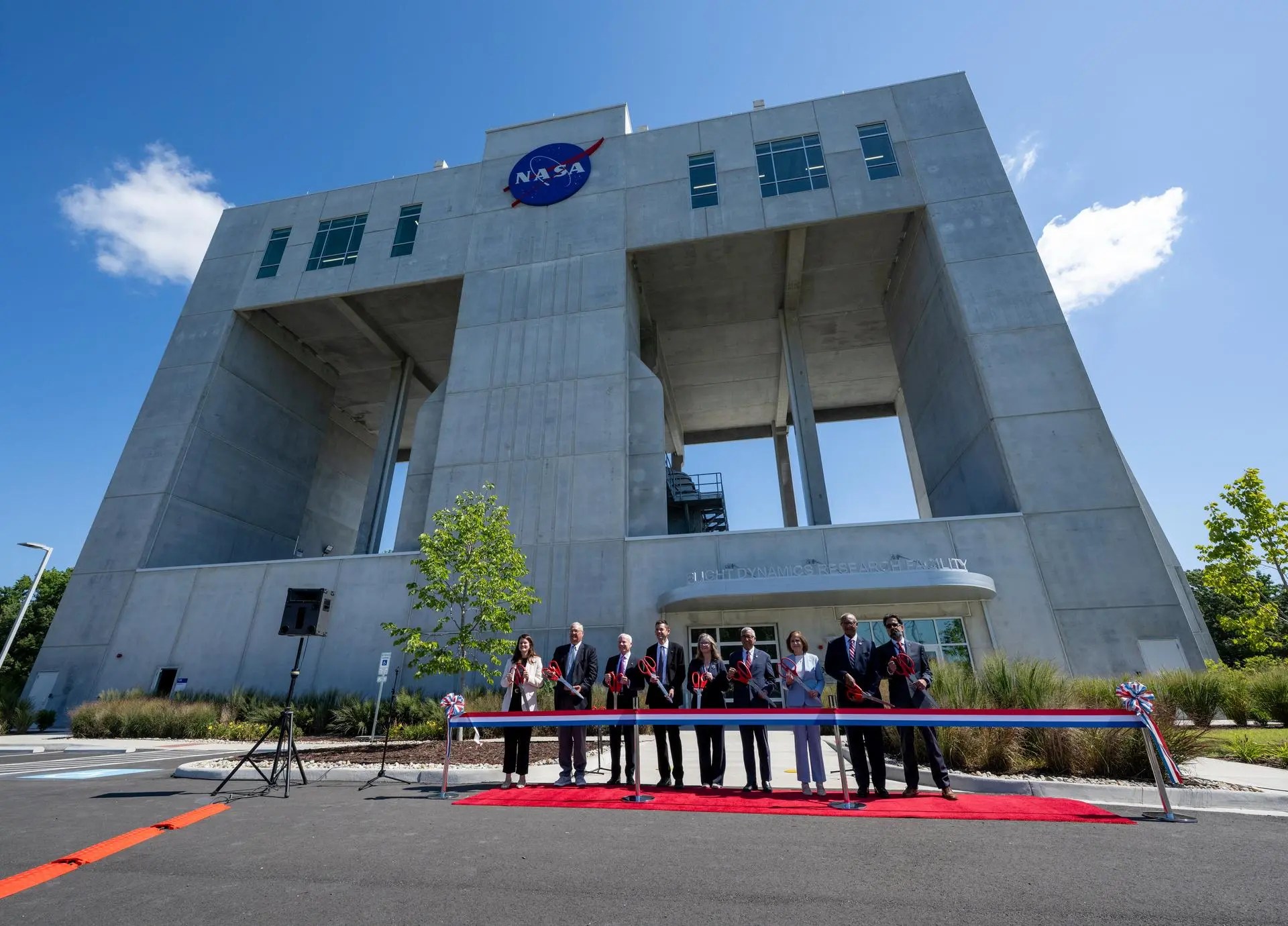
Image (Credit): On July 31, 2026, NASA officials and others pose for a photo before cutting the ribbon to open the Flight Dynamics Research Facility at NASA’s Langley Research Center in Hampton, Virginia. (NASA/Keegan Barber)

Here are some recent space-related stories of interest.

WTOP News: NASA Opens its First Wind Tunnel in 40 Years at Langley Research Center

Friday was a historic day for NASA’s Langley Research Center in Hampton, Virginia. A stellar lineup of VIPs from NASA, GSA, Congress, Virginia and Langley employees celebrated the ribbon-cutting ceremony for NASA’s newest and most advanced wind tunnel: the Flight Dynamics Research Facility. The $53 million, 25,000-square-foot FDRF, built by BL Harbert International, is the first wind tunnel added to NASA’s wind tunnel assets in 40 years. The project was started in June 2022, with construction completed in March 2026.

NASA: “NASA’s Roman Telescope to Carry 1.35 Million Names to Deep Space

On July 27, technicians at NASA’s Kennedy Space Center in Florida installed a memory card containing 1,350,144 names as part of a commemorative plaque on the Nancy Grace Roman Space Telescope. The names were submitted by people globally, including astronauts from Artemis II and Artemis III. The memory card will travel with the Roman observatory to the Sun-Earth Lagrange point 2, or L2, about one million miles from Earth, where the Sun’s and Earth’s gravity balance out.

Wired: Astronomers Have Detected an Exomoon for the First Time

An international research team has discovered evidence of a moonlike body. It marks the first time such an object has been detected outside our solar system—though just how close it comes to being a moon is a question researchers are still grappling with. Although more than 6,000 exoplanets have been discovered to date, there’s been a lack of definitive evidence of moons in other planetary systems. The new findings challenge that by focusing on an object orbiting the brown dwarf CD-35 2722 B in a system 73 light-years away.

Note: Here is the podcast version of this post.

Space Quote: AI is Ready to Run a Telescope

Credit: Image by Alexandra_Koch from Pixabay

“It is exciting to see ideas from AI and reinforcement learning brought to telescope scheduling, where every decision must balance changing conditions and scarce observing time…Developing intelligent scheduling systems for astronomical surveys also raises fascinating new machine learning problems, and we are excited to continue exploring them through this project.”

-Statement by Northwestern University’s Aravindan Vijayaraghavan, who co-led the AI telescope project with Drlica-Wagner, as quoted by NOIRLab. The AI program planned and managed observations on a national facility for the first time. It is hoped that the involvement of AI could add efficiencies to the process, thereby allowing astronomers to have more time for their science.

A Hopeful Study on Solar Flares

Image (Credit): A graphic showing how space weather can impact eveyday technology. (National Oceanic and Atmospheric Administration)

Now that we know solar flares can be worse than anticipated (per the study cited in the prior post), let me add some good news about another study that may have a solution.

The recent study, Terrestrial Space Weather Protection Through Human-Produced Mass-Loading, has a plain language summary, fortunately, that explains one possible solution to the damaging effects of solar flares:

The study presents a new way to protect Earth from harmful space weather caused by storms from the sun that can disrupt technology and power grids. The study shows humans can actively reduce the impact by releasing neutral gas from orbiting satellites. Once released, this gas turns into plasma and drifts to the edge of Earth’s magnetic field where it softens the effects of solar storms. Computer simulations show this method could reduce the strength of a major solar storm by more than half, potentially saving lives and technology. The proposed approach uses existing technology and materials, making it a practical future defense against space weather risks.

What we really have here is a draw, with the first study saying the impact from solar flares may be twice as bad as previously thought and the second study saying the impact can be cut in half. So we are back to where we started assuming we launch a new batch of satellites.

Maybe future studies will bring us closer to even better defense mechanisms, but it is good to know that new solutions are being proposed.