
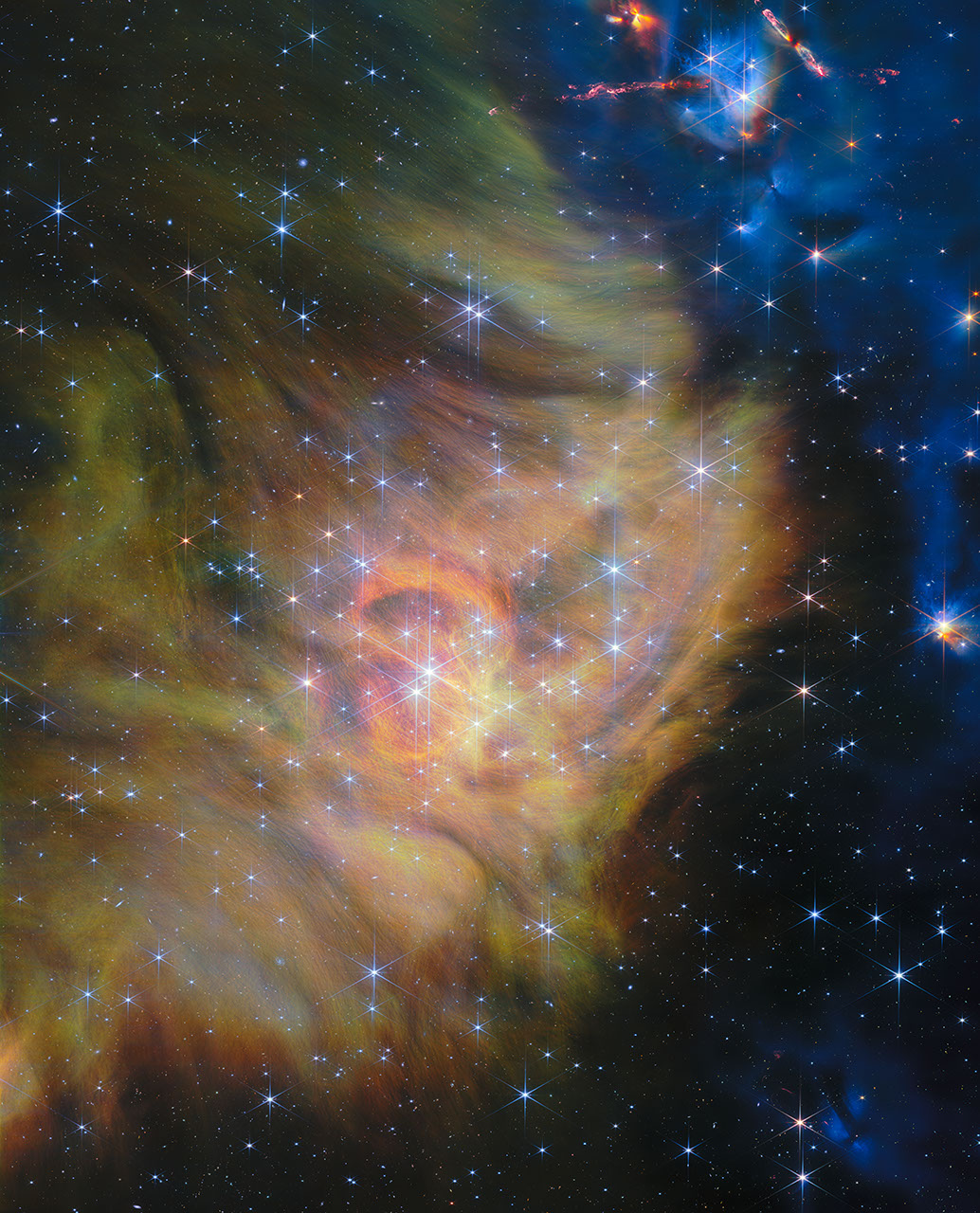
This week’s image is from the James Webb Space Telescope (JWST). With its sharp, amazing colors you would not think it is real, yet you are looking at a star-forming region about 1,000 light-years away called IC 348.
Here is NASA’s description of what you are seeing:
In regions like IC 348, cold clouds of molecular hydrogen gas collapse to form new stars, creating glowing, sculpted scenes like this one. The star-formation process can create widely varied objects, from massive stars that expire after only a few million years in core-collapse supernova explosions to the smallest and most common stars, which are long lived and produce powerful stellar storms.The smallest stars weigh in at around 8 percent of the Sun’s mass. Below this mass lies a strange class of objects called brown dwarfs. Brown dwarfs form in the same way stars do, through the collapse of molecular clouds. However, unlike stars, the cores of brown dwarfs never become hot enough to fuse ordinary hydrogen into helium (though many briefly fuse deuterium, or heavy hydrogen, early in their lives).

