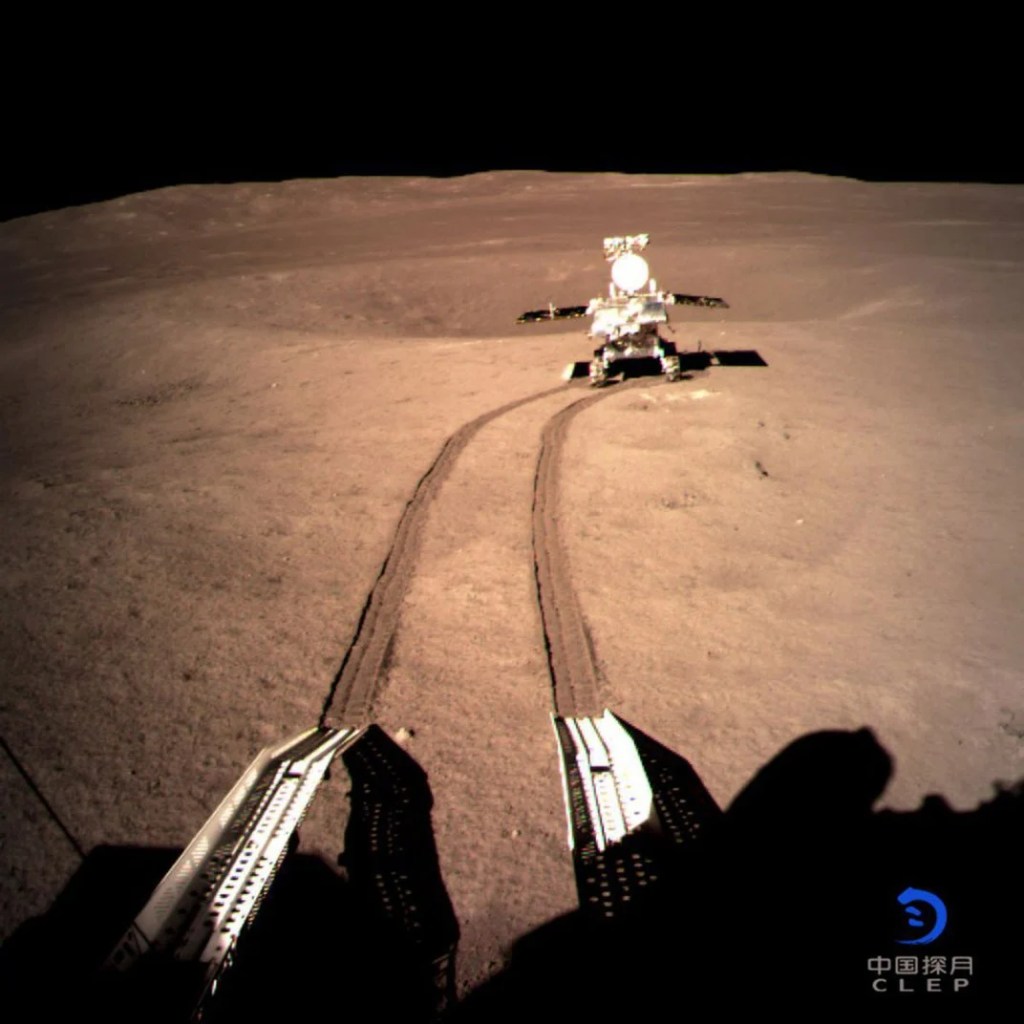
Image (Credit): China’s Yutu 2 rover explores the far side of the moon shortly after its Jan. 2, 2019, touchdown. (China National Space Administration)
“As two scholars who study space security and China’s space program, we believe that neither China nor any other nation is likely to take over the Moon in the near future. It is not only illegal, it is also technologically daunting – the costs of such an endeavor would be extremely high, while the potential payoffs would be uncertain.”
-Statement by Svetla Ben-Itzhak, Assistant Professor of Space and International Relations, Air University and R. Lincoln Hines, Assistant Professor, West Space Seminar, Air University in the Astronomy magazine article “Why China is unlikely to claim the Moon anytime soon.” It follows an earlier statement by NASA Administrator Bill Nelson, who said, “We must be very concerned that China is landing on the Moon and saying: ‘It’s ours now and you stay out.‘”
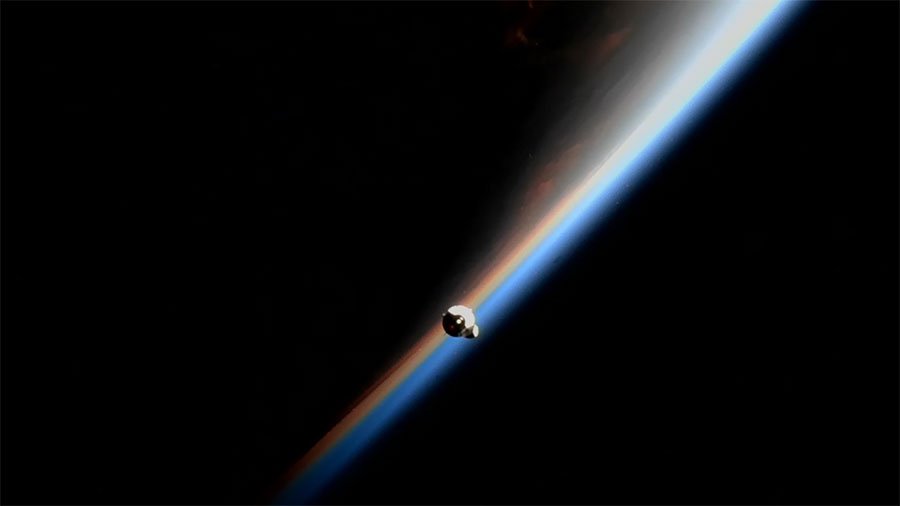
Image (Credit): SpaceX Dragon capsule approaching the ISS. (NASA)
This week’s image is from the International Space Station (ISS) as it awaits incoming cargo from an uncrewed SpaceX Dragon capsule approaching the station on July 16th. NASA noted that what we are seeing is an orbital sunrise above the Pacific Ocean.
NASA also highlighted the various experiments aboard the Dragon that will be added to the station, including one on extraterrestrial concrete:
Biopolymer Research for In-Situ Capabilities looks at how microgravity affects the process of creating a concrete alternative made with an organic material and on-site materials, such as lunar or Martian dust, known as a biopolymer soil composite. Using resources available where construction takes place makes it possible to increase the amount of shielding.
Image (Credit): Neil Armstrong outside the Eagle lunar module on the surface of the Moon. (NASA)
On this day in 1969, two Apollo 11 crew members – commander Neil Armstrong and pilot Buzz Aldrin – became the first men to walk on the Moon. The two landed in NASA’s Eagle lunar module in the Sea of Tranquility and remained on the Moon’s surface for about 21 hours and 36 minutes collecting samples, placing scientific equipment, and photographing/filming the terrain. The astronauts also spoke with President Nixon while on the Moon.
You can rewatch the ABC News video feed here showing Neil Armstrong as he steps on the surface of the Moon and famously states, “That’s one small step for man, one giant leap for mankind.”
You can read more about the Apollo 11 mission here.
Image (Credit): Recent JWST analysis of exoplanet WASP-96 b. (NASA, ESA, CSA, and STScI)
The recent James Webb Space Telescope (JWST) images included hot gas giant exoplanet WASP-96 b, with NASA noting that the space telescope “…has captured the distinct signature of water, along with evidence for clouds and haze, in the atmosphere surrounding a hot, puffy gas giant planet orbiting a distant Sun-like star.”
The same NASA article also noted that the Hubble Space Telescope had found the first evidence of water on a exoplanet back in 2013. So I thought I would dig out that earlier from the European Space Agency, titled “Hubble Finds Water Vapour on Habitable-Zone Exoplanet for the First Time“:
With data from the NASA/ESA Hubble Space Telescope, water vapour has been detected in the atmosphere of a super-Earth within the habitable zone by University College London (UCL) researchers in a world first. K2-18b, which is eight times the mass of Earth, is now the only planet orbiting a star outside the Solar System, or exoplanet, known to have both water and temperatures that could support life.
The parent star, K2-18, is 110 light years from Earth in the constellation of Leo. Maybe we can convince the ESA and others to take another look with the JWST, assuming it is not already on the list of many upcoming projects.
Image (Credit): Stephan’s Quintet, representing a grouping of five galaxies, as captured by the JWST. (NASA, ESA, CSA, and STScI)
I think we are all eager for more amazing photos from the James Webb Space Telescope, but we need to remember that the space telescope has a long list of priorities and these were not simply random images. An international committee with representatives from NASA, the European Space Agency (ESA), the Canadian Space Agency (CSA), and the Space Telescope Science Institute (STScI) decided on the future work of the space telescope.
The committee has shared these five missions represented by the images already released to the public, indicating the JWST has been pretty busy already:
Carina Nebula: The Carina Nebula is one of the largest and brightest nebulae in the sky, located approximately 7,600 light-years away in the southern constellation Carina. Nebulae are stellar nurseries where stars form. The Carina Nebula is home to many massive stars several times larger than the Sun.
WASP-96b (spectrum): WASP-96b is a giant planet outside our solar system, composed mainly of gas. The planet, located nearly 1,150 light-years from Earth, orbits its star every 3.4 days. It has about half the mass of Jupiter, and its discovery was announced in 2014.
Southern Ring Nebula: The Southern Ring, or “Eight-Burst” nebula, is a planetary nebula – an expanding cloud of gas surrounding a dying star. It is nearly half a light-year in diameter and is located approximately 2,000 light-years away from Earth.
Stephan’s Quintet: About 290 million light-years away, Stephan’s Quintet is located in the constellation Pegasus. It is notable for being the first compact galaxy group ever discovered in 1787. Four of the five galaxies within the quintet are locked in a cosmic dance of repeated close encounters.
SMACS 0723: Massive foreground galaxy clusters magnify and distort the light of objects behind them, permitting a deep field view into both the extremely distant and intrinsically faint galaxy populations.
So what else is planned? NASA believes the JWST can stay in operation for the next 5 to 10 years, so it has a fair amount of time to allocate to scientists. This link takes you to the 266 approved projects for the telescope’s first year, representing approximately 6,000 hours of JWST prime time and up to 1,231 hours of parallel time. For instance, during the first year you have “Exoplanets and Disks” projects such as:
Icy Kuiper Belts in Exoplanetary Systems;
Unlocking the Mysteries of the Archetype Sub-Neptune GJ1214b with a Full-Orbit Phase Curve;
A Search for the Giant Planets that Drive White Dwarf Accretion;
Tell Me How I’m Supposed To Breathe With No Air: Measuring the Prevalence and Diversity of M-Dwarf Planet Atmospheres; and
Diamonds are Forever: Probing the Carbon Budget and Formation History of the Ultra-Puffy Hot Jupiter WASP-127b.
That is just a sample, but you can see from some of that titles that the scientists are having fun. Expect hundreds of new discoveries this year resulting from these observations.