
Here are some recent space-related stories.
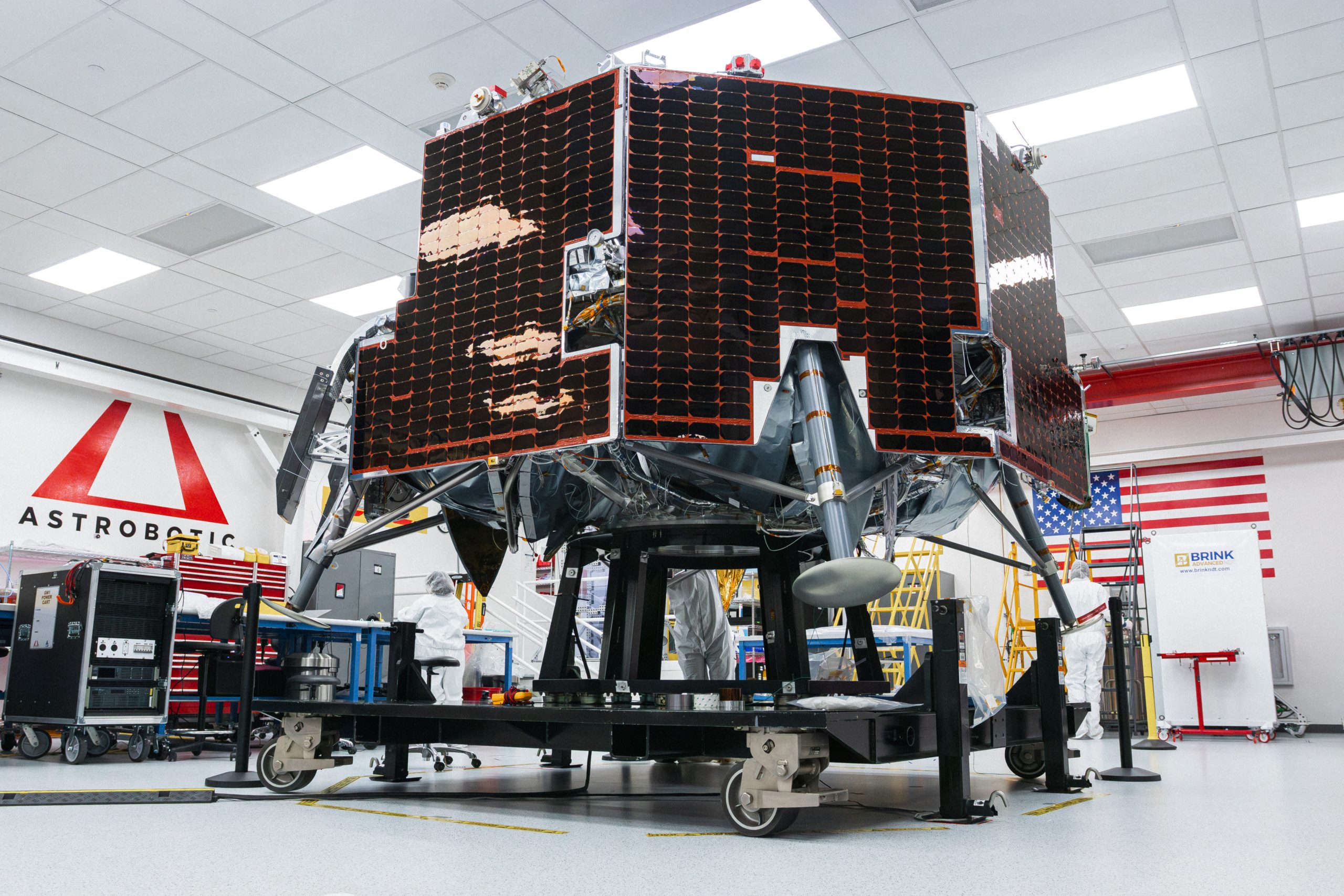
—Satnews: “Pittsburgh’s Moonshot: Astrobotic Unveils Griffin-1 Lander Ahead of Historic NASA ‘Moon Base II’ Mission“
Emerging as a powerful symbol of regional industrial pride and the rapid privatization of deep-space logistics, Astrobotic Technology has officially unveiled its massive Griffin-1 lunar lander. The vehicle, which has been formally designated by NASA as the primary infrastructure vehicle for the Moon Base II task order under the Commercial Lunar Payload Services (CLPS) program, represents a critical stepping stone toward establishing a permanent, self-sustaining human presence on the lunar surface. Unlike smaller, first-generation commercial scouts, the Griffin platform is an “infrastructure-class” logistics vehicle engineered to transport heavy industrial cargo. Boasting a massive 625 to 650-kilogram payload capacity, the stout aluminum isogrid lander is designed to ferry bulky machinery, scientific sensor arrays, and alternative energy installations directly to the rugged, hazardous terrain of the lunar south pole.
—Newser: “Giant Nevada Project Could Transform Astronomy“
Caltech has approved the final design for the Deep Synoptic Array, a $200 million radio telescope project that will blanket a chunk of desert with 1,650 dishes over roughly 120 square miles—an array designed to scan the sky about 100 times faster than any existing telescope. Backed in part by Schmidt Sciences, the philanthropic effort of former Google CEO Eric Schmidt and his wife Wendy, the project is slated to be finished by 2029 and will be powered by a supercomputer that turns torrents of radio signals into sharp images on the fly.
—W.M. Keck Observatory: “Astronomers Discover Third Galaxy Without Dark Matter“
Astronomers using W. M. Keck Observatory on Maunakea, Hawaiʻi Island, have discovered the third known galaxy apparently lacking dark matter, part of a strange linear structure that may have formed during a violent collision between galaxies. The discovery strengthens evidence for a rare and previously unseen process in which ordinary matter becomes separated from dark matter, offering astronomers a powerful new way to study one of the universe’s greatest mysteries.
Note: Here is the podcast version of this post.

