Image (Credit): June 26, 2023 Starship engine test viewed from above. (SpaceX)
The image above shows the SpaceX Ship 25 rocket from above as it tested it engines on June 26, 2023. Presumably, Elon Musk was tweeting out this and other such shots, but given the restrictions placed on Twitter these days, you may not be able to acquire this on your own without an account.
As far as the next Starship launch, the exact date has yet to be shared. However, NASA is already talking about delaying the Artemis III lunar mission, which will use the Starship, from 2025 to 2026.
Image (Credit): Artist’s rending of the Blue Origin lander on the Moon’s surface. (Blue Origin).
While SpaceX is building the lunar lander for the Artemis III mission, Blue Origin is back in the game building the next lunar lander for a follow-up human landing at the Moon’s southern polar region as part of Artemis V. The NASA contract with Blue Origin for this second mission is $3.4 billion.
Blue Origin’s partners in this venture include Lockheed Martin, Draper, Boeing, Astrobotic, and Honeybee Robotics. All of this is good news for the space program in that its expands the knowledge and risk related to a lunar landing among even more companies. Such redundancy will increase resilience.
NASA Administrator Bill Nelson welcomed Blue Origin to the team with this statement:
Today we are excited to announce Blue Origin will build a human landing system as NASA’s second provider to deliver Artemis astronauts to the lunar surface…We are in a golden age of human spaceflight, which is made possible by NASA’s commercial and international partnerships. Together, we are making an investment in the infrastructure that will pave the way to land the first astronauts on Mars.
Note: I am glad to hear that Mr. Bezos is still plugging away with his space company Blue Origin and not spending all of his money on play things, such as his $500 million yacht. The commercial space industry is party one run by billionaire playboys, which may not be the most stable foundation. Yet all the same, if part of their money is going to public projects, that is a good thing. Just as Andrew Carnegie invested in public libraries and Bill Gates fighting disease and poverty in Africa, we can all benefit from the money going into the space arena. Mind you, it is not charity, but it is starter funds for critical projects to keep the US in the space race.
Russia said Wednesday it planned to use the International Space Station until 2028, an apparent reversal of an earlier announcement to quit the orbiting laboratory after 2024. On Wednesday, the head of Russian space agency Roscosmos, Yuri Borisov, said Moscow’s participation in the international space project had been extended. “By the decision of the government, the operation of the International Space Station has been extended until 2028,” Borisov told President Vladimir Putin during a televised meeting, referring to the Russian segment.
The Czech Republic became the 24th country to sign the Artemis Accords May 3, growing Europe’s presence in the U.S.-led agreement. In a brief ceremony at NASA Headquarters, Jan Lipavský, minister of foreign affairs for the Czech Republic, formally signed the accords in the presence of officials from NASA and the U.S. State Department. Representatives of several other countries who previously signed the Artemis Accords also attended…Neither U.S. nor Czech officials announced specific plans to cooperate on the Artemis lunar exploration campaign as a result of signing the accords, but suggested the signing opened the door for future discussions.
China will attempt to collect the first samples from the far side of the moon next year with its Chang’e 6 mission. The complex, four-spacecraft mission will launch on a Long March 5 rocket from Wenchang in May 2024, according to Wu Yanhua, chief designer of China’s Deep Space Exploration Major Project, speaking at a deep-space exploration conference on April 25 in the Chinese city of Hefei.
Image (Credit): Newly-announced Artemis astronauts Commander Reid Wisemam, Pilot Victor Glover, Mission Specialist Jeremy Hansen, and Mission Specialist Christina Hammock Koch. (NASA)
Another step was taken today to get us closer to a Moon landing. Earlier today NASA announced the names of the four astronauts on the next Artemis II mission:
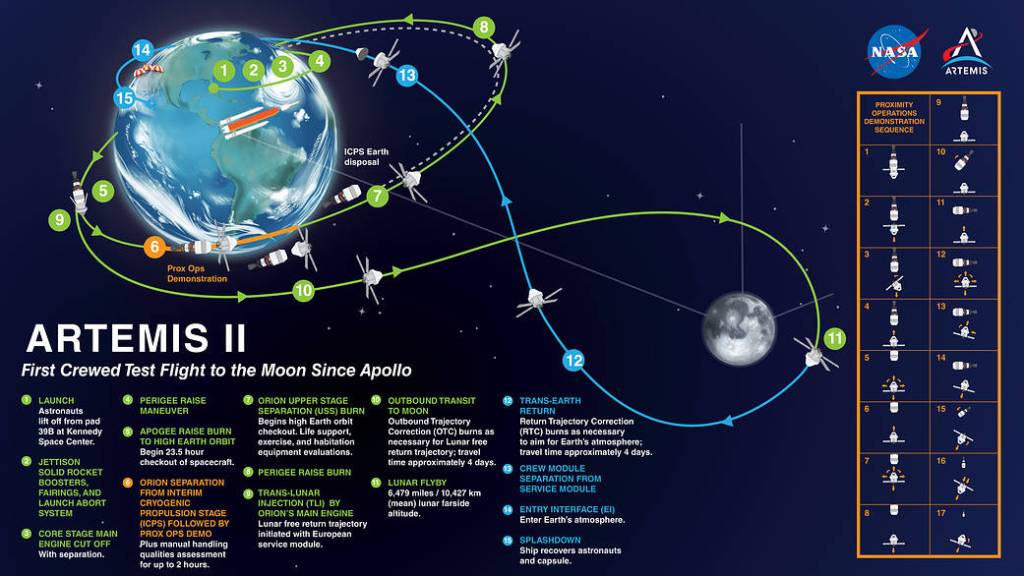
The Artemis II mission will require the four astronauts to take an Orion capsule around the Moon to test a variety of systems and ensure the safety of a later Moon landing as part of Artemis III. You can see a graphic of the Artemis II mission below.
At today’s ceremony announcing the crew, NASA Administrator Bill Nelson stated:
The Artemis II crew represents thousands of people working tirelessly to bring us to the stars. This is their crew, this is our crew, this is humanity’s crew…NASA astronauts Reid Wiseman, Victor Glover, and Christina Hammock Koch, and CSA astronaut Jeremy Hansen, each has their own story, but, together, they represent our creed: E pluribus unum – out of many, one. Together, we are ushering in a new era of exploration for a new generation of star sailors and dreamers – the Artemis Generation.
You can also watch NASA’s full announcement of the new crew here.
I was looking through audit reports from the Government Accountability Office and NASA’s Office of Inspector General (OIG) to see what was being said about NASA’s programs. The only report of interest so far pertained to the Artemis mission and the need for greater coordination among the various partners. Audit reports often make these same recommendations over and over again, yet it does make sense that NASA’s largest outreach program since the International Space Station (ISS) should have all the pieces in place, yet it does not.
Interest in the Artemis campaign is high across the international space community, as evidenced by NASA’s 54 Artemis-related international instruments and the 23 signatories to the Artemis Accords. However, the Agency lacks an overarching strategy to coordinate Artemis contributions from international space agencies and entities. Except for the Gateway Program, the Artemis campaign does not have comprehensive forums—boards, panels, and working groups— for its international partners to routinely discuss topics such as flight and mission planning, safety, and research integration. In contrast, the ISS Program–seen as a model of long-term international space cooperation–employs these forums as well as on-site representation from partner agencies.
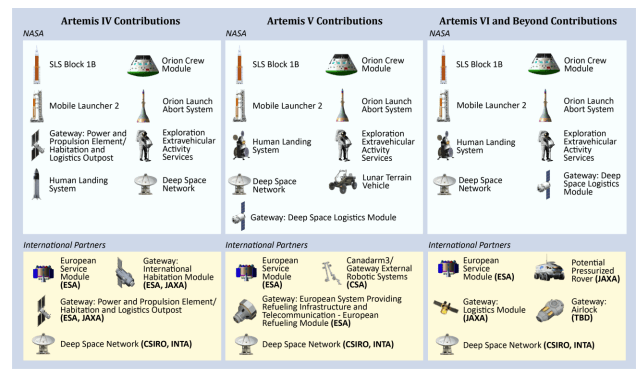
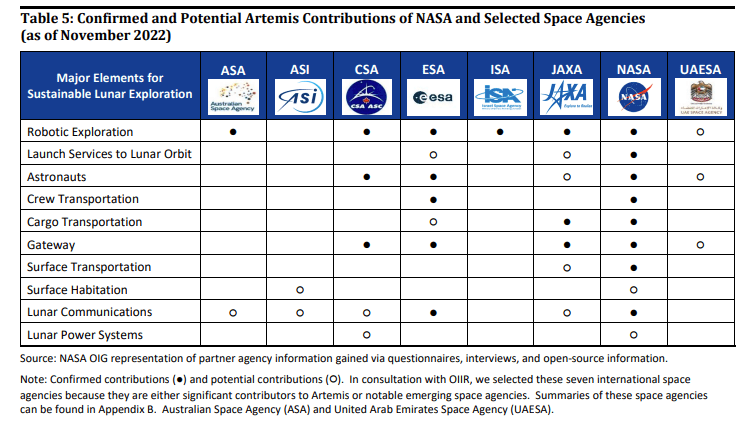
The OIG report makes a number of recommendations related to this issue and other identified by auditors. The report also includes some helpful graphics and tables that illustrate all of the pieces going into the three Artemis missions as well as the parties contributing those pieces. This looks significantly more complex than the ISS, so I would think good coordination would be even more critical.
Image (Credit): Contributions to the Artemis Program by NASA and partners. (NASA OIG)
Image (Credit): A table from the NASA OIG report IG-23-004. (NASA OIG)