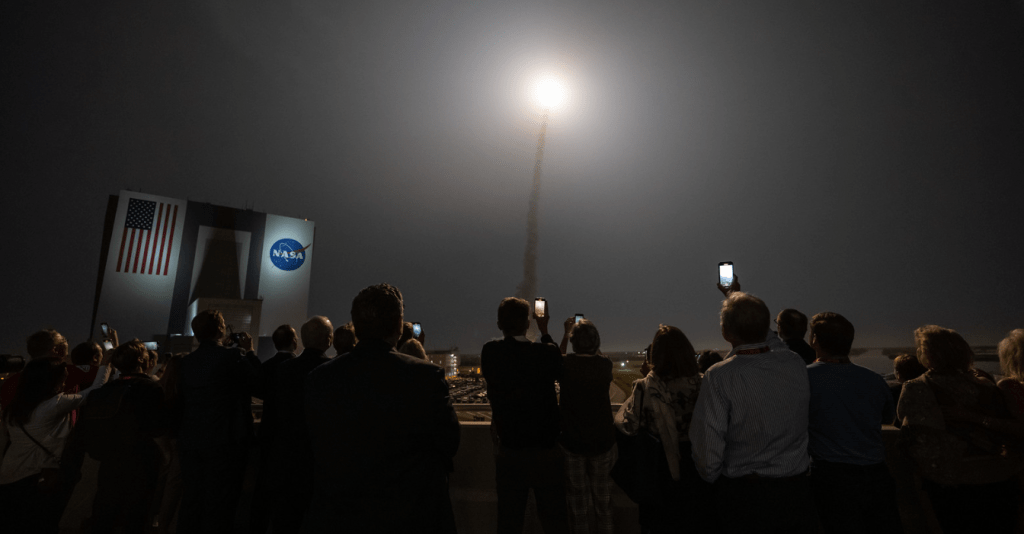
One of the Artemis Rocket Launches

Image (Credit): June 28th launch of CAPSTONE aboard Rocket Lab’s Electron rocket from the Rocket Lab Launch Complex 1 on the Mahia Peninsula of New Zealand. (Rocket Lab)

While we are awaiting the launch of the uncrewed Artemis phase-one rocket later this summer to test the waters for a crewed mission, other related missions are ongoing. NASA’s Cislunar Autonomous Positioning System Technology Operations and Navigation Experiment (CAPSTONE) was launched earlier in the week from New Zealand and will take about four months before it orbits the Moon for another six months. The miniaturized satellite, or CubeSat, is designed to test the future lunar orbit of Gateway, a lunar space station being planned by NASA and its commercial and international partners to support NASA’s Artemis program, including astronaut missions.

Here are CAPSTONE’s mission objectives:

  • Verify the characteristics of a cis-lunar near rectilinear halo orbit for future spacecraft;
  • Demonstrate entering and maintaining this unique orbit that provides a highly-efficient path to the Moon’s surface and back;
  • Demonstrate spacecraft-to-spacecraft navigation services that allow future spacecraft to determine their location relative to the Moon without relying exclusively on tracking from Earth;
  • Lay a foundation for commercial support of future lunar operations; and
  • Gain experience with small dedicated launches of CubeSats beyond low-Earth orbit, to the Moon, and beyond.

In a press release, Elwood Agasid, project manager for CAPSTONE at NASA’s Ames Research Center in California’s Silicon Valley, stated:

CAPSTONE is a pathfinder in many ways, and it will demonstrate several technology capabilities during its mission timeframe while navigating a never-before-flown orbit around the Moon…CAPSTONE is laying a foundation for Artemis, Gateway, and commercial support for future lunar operations.

We forget about all of the smaller missions (literally, in this case) that make the full mission possible. CAPSTONE is a key mission to test some ideas and reduce risk for future astronauts.

Image (Credit): Artist’s impression of CAPSTONE in orbit near the Moon. (Illustration by NASA/Daniel Rutter)

Artemis Rocket Launch Planned for August

Image (Credit): NASA’s Space Launch System rocket. (NASA)

NASA said it is ready for a real test of the Space Launch System (SLS) and Orion capsule after multiple dry-runs. Of course, the tests were not perfect, but NASA said it is ready for the next phase. The latest test was on June 20th. Following that, Tom Whitmeyer, deputy associate administrator for common exploration systems at NASA Headquarters, stated:

During the wet dress rehearsal activities, we have incrementally added to our knowledge about how the rocket and the ground systems work together, and our teams have become proficient in launch procedures across multiple sites. We have completed the rehearsal phase, and everything we’ve learned will help improve our ability to lift off during the target launch window…The team is now ready to take the next step and prepare for launch.

The uncrewed launch itself could be as early as late August. Under this phase of the project, called Artemis 1, the rocket, capsule, and ground control will get a rigorous test. As NASA explains:

During this flight, the spacecraft will launch on the most powerful rocket in the world and fly farther than any spacecraft built for humans has ever flown. It will travel 280,000 miles from Earth, thousands of miles beyond the Moon over the course of about a four to six-week mission. Orion will stay in space longer than any ship for astronauts has done without docking to a space station and return home faster and hotter than ever before.

NASA has come a long way to get this this step. The various problems along the way is why you have such tests. And now the first phase is about ready. Fingers crossed…

Image (Credit): Artemis 1 mission map. (NASA)

More Studies of the Moon – This Time Volcanoes

Image (Credit): The beautiful Gruithuisen Domes on the surface of the Moon. (NASA/GSFC/Arizona State University)

Earlier this month, NASA announced plans to to study volcanoes on the Moon as part of the Artemis Program. The mission, called the Lunar Vulkan Imaging and Spectroscopy Explorer (Lunar-VISE) investigation, will involve a stationary lander and mobile rover.

The mission will entail a 10-day survey of the summit of one of the Gruithuisen Domes to learn more about how these domes were formed without water or plate tectonics and how they evolved over time. The results will feed into future planning regarding robotic and human missions to the lunar surface.

Speaking of volcanoes on the Moon, you may have already read about the potential benefits of placing humans below the lunar surface in lava tubes. Such benefits include avoiding extreme temperature swings, radiation, and meteorite impacts. This NASA video, “Lava Tubes: Science Beneath the Surface of the Moon,” provides more background on NASA’s efforts to learn more about the Moon’s surface and the role of lava tubes.

This lava tube idea is also being pursued for a Martian habitat as well. I am not sure if people want to travel to a distant world only to hide underground, but given the dangers of surface habitation it seems this might be our best chance for long-term survival. Yes, a new race of extraterrestrial groundhogs.

Space Quote: NASA and ESA Cooperation

Image (Credit): European Space Agency (ESA) headquarters in Paris. (ESA)

“From understanding our changing planet to exploring Mars, I hugely value the cooperation we have with NASA…By contributing key European hardware and services to exciting programmes such as Artemis and Mars Sample Return, we are building Europe’s autonomy while also being a reliable partner.”

-Statement by ESA’s Director General Josef Aschbacher as part of the June 14-15 ESA Council meeting. See the press release, “N° 30–2022: From the Earth to the Moon and on to Mars – ESA and NASA take decisions and plan for the future.” for more on the meeting. The document also discusses plans to place a European astronaut on the Moon.

A New Suit for the Moon Mission

Image (Credit): Space suits in the television series Lost in Space. (Netflix)

U.S. companies Axiom Space and Collins Aerospace have been tasked to build new suits for NASA’s astronauts. The suits will be worn as part of the Artemis Program returning astronauts to the Moon. First, the new suits will be tested and used on the International Space Station (ISS).

While both companies are still in the early stages of developing the next space suite, the $3.5 billion Extravehicular Activity Services (xEVAS) Contract will support this development and production.

In a press release, Mark Kirasich, deputy associate administrator of NASA’s Artemis Campaign Development Division, stated:

Our commercial partnerships will help realize our human exploration goals…We look forward to using these services for NASA’s continued presence in low-Earth orbit and our upcoming achievement of returning American astronauts to the Moon’s surface. We are confident our collaboration with industry and leveraging NASA’s expertise gained through over 60 years of space exploration will enable us to achieve these goals together.

You may recognize the name Axiom Space. It was the company that worked with SpaceX to put private citizens on the ISS with its Axiom Mission 1 (Ax-1). It is also developing the world’s first commercial space station, the Axiom Station.

Collins Aerospace, part of Raytheon Technologies, has plenty of experience with space suits. The company designed the spacesuit used by the Apollo mission astronauts who landed on the moon. It also designed the space suits currently in use for missions outside the ISS.