NASA’s FY 2023 Budget Request

Credit: NASA

So what else did NASA Administrator Bill Nelson share with the Senate Committee on Appropriations last week (beyond his comments about the International Space Station)? In his prepared statement regarding NASA’s $26 billion budget request, he highlighted a number of priorities for his agency, including:

  • the Artemis Program to bring astronauts back to the Moon and related exploration costs – $7.5 billion;
  • continued support for the ISS – $4.3 billion;
  • the space technology research and development portfolio for the Moon, Mars, and other areas, such as sending the CAPSTONE CubeSat to the Moon as a pathfinder for the Artemis program – $1.44 billion;
  • greater science funding for projects such as exploring solutions for bringing the samples of Martian rock and soil collected by the Perseverance rover to Earth through the Mars Sample Return mission – $8 billion; and
  • supporting the civil aviation manufacturing sector with test flights on its Low Boom Flight Demonstrator, which will enable environmentally and socially acceptable supersonic passenger flights, as well as continued work on the X-57 Maxwell, an all-electric aircraft – $971 million.

NASA certainly has a lot on its place, and I did not even highlight the focus on Earth iteself, such as the planned Earth System Observatory, which is an array of satellites, instruments, and missions designed to generate a 3D, holistic view of the entire planet.

We just provided a $40 billion aid package to Ukraine so that it can defend itself and have a better future. This $26 billion will take us out of the realm of Earth-bound conflicts and allow us to find our future in the stars, or at least the solar system. It is money well spent.

KSC: Upcoming Launch Schedule & More

Image (Credit): The John F. Kennedy Space Center in Florida. (NASA)

If you are interested in what is being launched from the Kennedy Space Center (KSC), you can easily view this information at this website. For example, on May 19th, the Boeing CST-100 Starliner will be tested in orbit as it becomes another candidate to resupply the International Space Station. The site also highlights other interesting events and anniversaries, such as the December 7th 50th anniversary of the Apollo 17th launch.

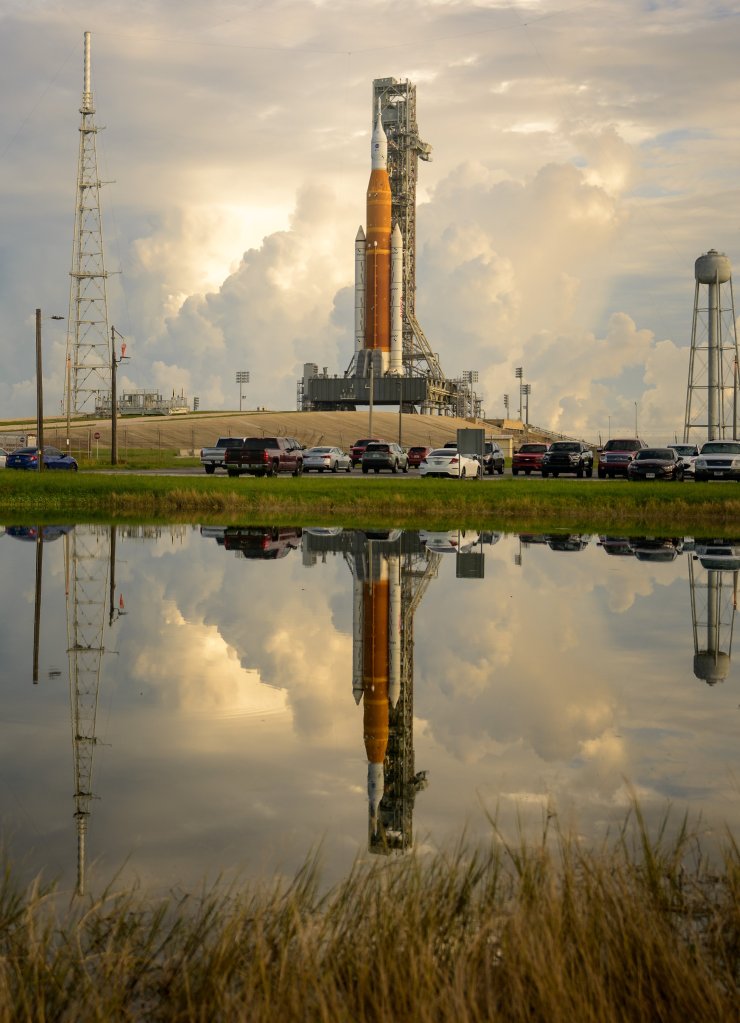
One place holder on the KSC schedule with no clear date is the inaugural launch of NASA’s Space Launch System (SLS) rocket, the first phase of the Artemis Program. In a recent press release, NASA outlined the parameters for such a launch as well as the remaining days in 2022 that would satisfy these parameters. The four parameters are:

  1. The Moon’s position in its lunar cycle;
  2. A trajectory so Orion is not in darkness for more than 90 minutes at a time so that the solar array wings can receive and convert sunlight to electricity and the spacecraft can maintain an optimal temperature range;
  3. A trajectory that allows for the skip entry technique planned during Orion’s return to Earth; and
  4. Daylight conditions for Orion’s splashdown to initially assist recovery personnel when they locate, secure, and retrieve the spacecraft from the Pacific Ocean.  

The calendar still has plenty of possible dates. The question now is whether NASA can get all of the pieces together in time to make this happen in 2022.

Credit: NASA

Growing Options in Moon Dust

Image (Credit): Placing a plant grown during the experiment in a vial for eventual genetic analysis. (UF/IFAS photo by Tyler Jones)

Speaking of moon dust, it seems scientists have found that they can grow plants in lunar soil. This is quite a surprise given the nature of moon dust. It would seem to be an even greater feat than growing plants in Martian soil.

NASA has reported that scientists at the University of Florida have successfully grown plants in actual lunar soil from the Apollo 11, 12, and 17 missions. Only water and a nutrient solution were added to the soil before seeds were planted. Plants started to sprout in two days. After 20 days the plants were harvested and studied before they had started to flower. While the lunar soil plants were somewhat stunted and stressed, the experiment was a success.

NASA noted:

This research opens the door not only to someday growing plants in habitats on the Moon, but to a wide range of additional questions. Can understanding which genes plants need to adjust to growing in regolith help us understand how to reduce the stressful nature of lunar soil? Are materials from different areas of the Moon more conducive to growing plants than others? Could studying lunar regolith help us understand more about the Mars regolith and potentially growing plants in that material as well? All of these are questions that the team hopes to study next, in support of the future astronauts traveling to the Moon.

This is a fascinating finding if it will allow us to use the lunar surface to feed astronauts rather than bringing more material from the Earth. It is also very timely as NASA is preparing the way for human habitation on the Moon under the Artemis Program.

We wanted to learn from the Moon before pushing onto Mars. This is a clear sign that we are doing so.

Space Quote: A Mature Rocket Market?

Image (Credit): Space Launch System rocket. (NASA)

“The launch industry is at a point where the technology is so mature that it may not be necessary to have the U.S. government invest in it… It may be we’re at a tipping point with this rocket.”

-Statement by Dan Goldin, a former NASA administrator, regarding NASA’s expenditures on the Space Launch System (SLS) in a Wall Street Journal article, “NASA Is Building Moon Rockets, Maybe for the Last Time.” The SLS and Orion spacecraft are part of NASA’s Artemis Program to return astronauts to the Moon.

Female Dummies in Space?

Image (Credit): The Helga manikin to be used on the Orion capsule to the Moon. (German Aerospace Center)

No, it is not a new television show or a rude comment, but rather a real plan to test the effects of space radiation on manikins that simulate the female body. The test is in preparation for future Artemis missions to the Moon. NASA is concerned about the effects of radiation on female astronauts since their anatomy is different than that of males and may be more prone to certain types of cancer.

As reported by Phys.org, the two manikins – Helga and Zohar – will fly aboard the Orion capsule for about six weeks as part of his first uncrewed flight to the Moon. While Helga will fly in the Orion capsule unprotected, Zohar will be wearing a radiation protection vest. In this way, scientists can study the full effect of the vest.

The experiment was designed by the German Aerospace Center (hence the German manikin names), which has conducted similar studies aboard the International Space Station (ISS). However, the radiation levels for a lunar mission will be much higher than that found on the ISS.

The Artemis mission will be the first time a female leaves low-Earth orbit , so it is essential that we know the potential impact of this trip on females. We wish the best to both Helga and Zohar.