Space Stories: A Dead Galaxy, Newly Discovered Cloud-9, and Preparing for Artemis II

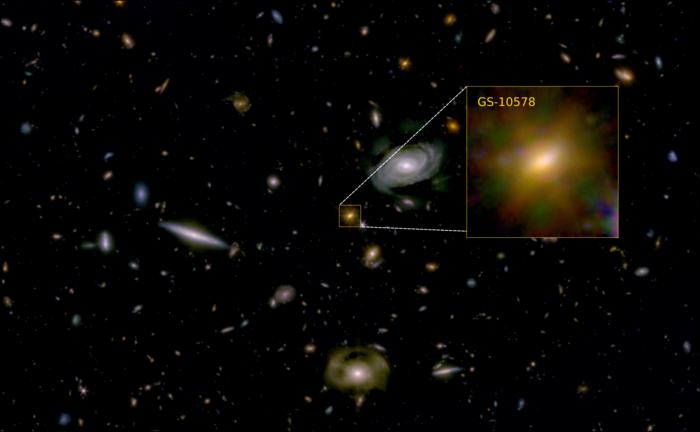
Image (Credit): GS-10578, also called Pablo’s Galaxy. (JADES Collaboration)

Here are some recent space-related stories of interest.

—innovation News Network: “Astronomers Discover Ancient “Dead Galaxy” Starved by its Supermassive Black Hole“

Using observations from the James Webb Space Telescope (JWST) and the Atacama Large Millimeter Array (ALMA), researchers found that a growing supermassive black hole can slowly starve a galaxy rather than destroy it outright. The galaxy, catalogued as GS-10578 and nicknamed Pablo’s Galaxy, existed just three billion years after the Big Bang. Despite this early stage in cosmic history, it is enormous – around 200 billion times the mass of the Sun. Most of its stars formed between 12.5 and 11.5 billion years ago, indicating a rapid burst of star formation before the galaxy suddenly shut down.

—CNN: “‘Cloud-9’ is a Newly Discovered Celestial Object. It Could Help Solve a Cosmic Mystery“

Astronomers may have discovered a previously unknown type of astronomical object, nicknamed “Cloud-9,” that could shed light on dark matter, one of the biggest mysteries in the universe. …Cloud-9 is thought to be a dark matter cloud that could be a remnant of galaxy formation from the early days of the universe, according to new research published Monday in The Astrophysical Journal Letters.

—Space.com: “NASA to Roll Out Rocket for Artemis 2 Moon Mission on Jan. 17“

The first crewed moon mission in more than 50 years remains on track to launch as soon as Feb. 6. NASA announced on Friday evening (Jan. 9) that it plans to roll the Space Launch System (SLS) rocket and Orion spacecraft that will fly the Artemis 2 moon mission out to the pad for prelaunch checks on Jan. 17, weather and technical readiness permitting.

Pandora and Friends Start New Missions

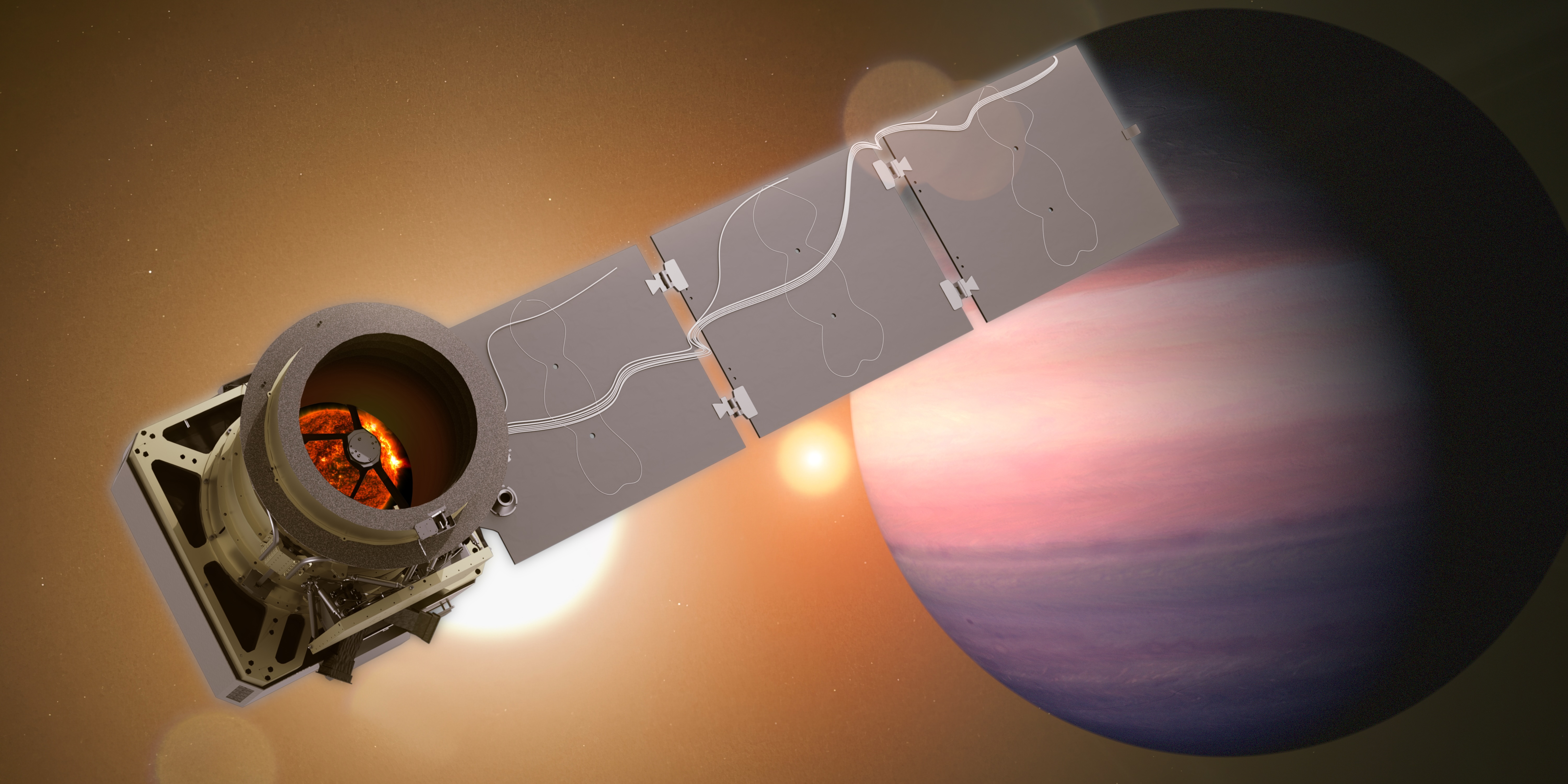
Image (Credit): An artist’s rendering of NASA’s Pandora mission. (NASA)

Earlier today, NASA’s Pandora mission got its start aboard a SpaceX rocket launched from California’s Vandenberg Space Force Base.

The Pandora satellite, once fully operational, will view exoplanet atmospheres and their host stars to learn more about these exotic worlds. In its first year, the satellite will focus on approximately 20 known exoplanets. This NASA video describes the process.

The 716-pound Pandora satellite is much smaller than the 14,300-pound James Webb Space Telescope (JWST). Of course, the JWST has a much larger mission that expands over a much longer time period.

If you are looking for something small, you might be interested in the two CubeSats launched with Pandora. One is called the Star-Planet Activity Research CubeSat (SPARCS), which will study coronal mass ejections on small stars, while the second is named the Black Hole Coded Aperture Telescope (BlackCAT) with the mission of observing X-ray flares from active galaxies with supermassive black holes as well as gamma-ray bursts.

It was a successful Sunday for NASA and space enthusiasts everywhere.

Space Stories: Black Hole Stars, Globe-Trotting Student Astronomers, and Verifying Hawking’s Theorem

Credit: Image by Johnson Martin from Pixabay.

Here are some recent space-related stories of interest.

—HotHardware: “Astronomers Baffled, Universe Weirder Than Ever Imagined On Strange Red Dot Discovery“

A team of Pennsylvania State University researchers has a unique take on mysterious red dots first observed by the James Webb Space Telescope. Initially thought to be tiny, crimson galaxies, the red dots are now proposed to be a new and exotic class of celestial object: a hybrid of a black hole and a star, which researchers have dubbed “black hole stars.”

—University of Virginia: “Astronomy Students Travel the World to Peer Deep into Space“

The University of Virginia Occultation Group, astronomy undergraduates who observe and track asteroids and small planets, make most of their observations locally. But they also travel around the country and the world to catch glimpses of heavenly objects, from high-priority asteroid/minor planets and the dwarf planet Pluto to the distant Kuiper Belt object Arrokoth. They observe stellar occultations, which occur when asteroids and minor planets pass in front of distant stars, via telescope. The Group studies some asteroids that later will be studied by close spacecraft fly-bys, and seek out asteroids that may pose a threat to the planet.

—Cornell University: “On 10th Anniversary, LIGO Verifies Hawking’s Theorem“

Since September 14, 2015, when the Laser Interferometer Gravitational-Wave Observatory (LIGO) made the first-ever direct detection of gravitational waves, the observatory has been making history. Cornell astrophysicists Saul Teukolsky and Larry Kidder earned a share in the 2016 Special Breakthrough Prize in Fundamental Physics – a $3 million award – for their contributions to the project. Now, on the 10th anniversary of LIGO’s first discovery, the LIGO-VIRGO-KAGRA team has announced a black hole merger similar to its first detection. However, thanks to a decade’s worth of technological advances improving the detector sensitivity, the signal is dramatically clearer, allowing unprecedented tests of General Relativity to be performed.

Space Stories: Planning Commercial Space Stations, Sloppy Black Holes, and Happy Birthday Voyager I

Image (Credit): Artist’s earlier rendering of a commercial space station called Orbital Reef envisioned by Blue Origin and  Sierra Space. (Blue Origin)

Here are some recent space-related stories of interest.

—Space News: “NASA Releases Details on Revised Next Phase of Commercial Space Station Development“

NASA expects to spend up to $1.5 billion to support at least two companies to demonstrate crew-tended space stations as part of the agency’s revised approach to transition from the International Space Station. NASA released Sept. 5 a draft version of an announcement for partnership proposal, or AFPP, for the second phase of its Commercial Low Earth Orbit Development Program. NASA is seeking comments on the draft through Sept. 12. The draft reflects a new approach for supporting development of commercial space stations outlined in a July 31 policy directive by Acting Administrator Sean Duffy. Rather than award fixed-price contracts to cover certification of commercial space stations for use by NASA astronauts, it called for the use of funded Space Act Agreements for continued support of the design and development of such stations.

—University of Michigan News: “Small Black Holes are Surprisingly Sloppy Eaters“

When stellar-mass black holes—”small” black holes that are still a few times more massive than the sun—are actively gobbling up matter, they’re even more of a hot mess than scientists expected. That’s according to an international research team, led by Jon Miller of the University of Michigan, that uncovered this surprise that could have galactic implications. What researchers learn from stellar-mass black holes can help them better understand supermassive black holes, the behemoths that steer the evolution of galaxies like our Milky Way.

—USA Today: “Voyager 1 Marks 48 Years in Space. Here’s What to Know About Ramous NASA Mission“

For nearly five decades, NASA’s twin Voyager probes have plumbed the cosmos in search of answers to some of astronomy’s most perplexing mysteries about our solar system and its place in the wider universe. And now, both of the pioneering spacecraft – which launched two weeks apart in the late-1970s into space – have officially turned 48 years old. Voyager 2 was the first to have its birthday in August, followed now by Voyager 1, which marked its anniversary early in September.

Space Stories: Aliens Using Black Holes, Fire Approaches JPL, and New Approaches for the Mars Sample

Credit: Image by Gerd Altmann from Pixabay

Here are some recent stories of interest.

—Universe Today: “Scientists Propose New Method to Detect Alien Civilizations via Black Holes“

A new paper looks at another way we might be able to detect advanced civilizations, and at its center is the need for energy. The more advanced a civilization becomes, the greater their need for energy and one of the most efficient ways, according to current theories, is to harness the energy from an actively feeding black hole. The paper suggests a civilization feeding matter into a black hole could harvest energy from it; more excitingly perhaps, the process could be detectable within 17,000 light years.

—LA Times: “Firefighters Battle to Protect NASA’s Jet Propulsion Laboratory, Mt. Wilson“

Officials said they are making progress in protecting two key institutions from the Eaton fire. Don Fregulia, an operations section chief for the California Department of Forestry and Fire Protection, which has joined in the Eaton fire response, said that efforts to protect Mt. Wilson had proved successful and he expected that to remain the case. “We’re actively engaged there, and so far, no loss to any values at risk at Mt. Wilson,” Fregulia said. “We’re feeling good about what we have to do up there tonight to keep that site secure.” He said the fire had also spread close to NASA’s Jet Propulsion Laboratory, but he said that’s a priority and crews were “making good progress there as well.”

—NASA: “NASA to Explore Two Landing Options for Returning Samples from Mars“

To maximize chances of successfully bringing the first Martian rock and sediment samples to Earth for the benefit of humanity, NASA announced Tuesday a new approach to its Mars Sample Return Program. The agency will simultaneously pursue two landing architectures, or strategic plans, during formulation, encouraging competition and innovation, as well as cost and schedule savings. NASA plans to later select a single path forward for the program, which aims to better understand the mysteries of the universe, and to help determine whether the Red Planet ever hosted life. NASA is expected to confirm the program – and its design – in the second half of 2026.