Space Stories: Robot Trains on the Moon, Commercial Space Stations, and Russian Lunar Reactors

Image (Credit): Artist’s rendering of the Flexible Levitation on a Track system on the lunar surface with planet Earth on the horizon. (NASA/Ethan Schaler)

Here are some recent stories of interest.

—NDTV: “NASA Announces Plans To Build First Railway System On Moon“

As the National Aeronautics and Space Administration (NASA) readies to return astronauts to the moon, it has announced its plans to build a levitating robot train on the lunar surface. In a blog post, the American space agency provided details about the project called “Flexible Levitation on a Track (FLOAT)”, which aims to provide a “robotic transport system” to support future lunar activities of astronauts visiting the moon. The transport system will be critical to the daily operation of a sustainable lunar base in the 2030s, NASA said in a statement. 

—IEEE Spectrum: “Commercial Space Stations Approach Launch Phase“

A changing of the guard in space stations is on the horizon as private companies work toward providing new opportunities for science, commerce, and tourism in outer space. Blue Origin is one of a number of private-sector actors aiming to harbor commercial activities in low Earth orbit (LEO) as the creaking and leaking International Space Station (ISS) approaches its drawdown. Partners in Blue Origin’s Orbital Reef program, including firms Redwire, Sierra Space, and Boeing, are each reporting progress in their respective components of the program. The collaboration itself may not be on such strong ground. Such endeavors may also end up slowed and controlled by regulation so far absent from many new, commercial areas of space.

—Newsweek: “Russia Reveals New China Nuclear Moon Base Details“

Details about joint plans between Moscow and Beijing to put a lunar nuclear reactor within the next decade have been revealed by the head of Russia’s space agency. In March, Roscosmos announced plans to work with China to build an automated nuclear reactor to power a proposed lunar base that the two countries would operate together within the next decade. To construct the site, Roscosmos director general Yury Borisov said two months ago it was looking at using nuclear-powered rockets to transfer cargo to the moon, but had not yet figured out how to build these spacecraft safely. In an article published Wednesday by state news outlet RIA Novosti, Borisov said that development of the plant was underway and the countries were working on creating experimental and research facilities as part of the project.

Boeing Needs Just One More Day

Image (Credit): Starliner autonomous uncrewed flight test to the ISS in May 2022. (NASA)

Today was supposed to be the day that Boeing launched a crewed capsule to the International Space Station (ISS), but things did not go according to plan (again). Two hours before the planned launch a valve issue on the Atlas V rocket’s second stage put everything on hold. A launch as early as tomorrow is still possible if the matter can be resolved.

The two astronauts aboard the Starliner capsule, Suni Williams and Butch Wilmore, will need to come back another day to lead this historic mission. The Starliner will be the second commercial vehicle contracted by NASA to bring and return astronauts from the station. SpaceX has been performing this task since its first successful crewed test flight in 2020.

Boeing needs this win after so many bad stories over the years, and not just the stories associated with the Starliner mission. Serious aircraft woes has put a spotlight on the company. A successful launch will not erase the past, but it would be much needed positive press.

Update: Okay, Boeing will need at least until May 17 to inspect the problem valve and prepare for a new launch. Not a great start, but at least the are still expecting a May launch.

Space Quote: Preparing for the Boeing Starliner’s Crewed Mission

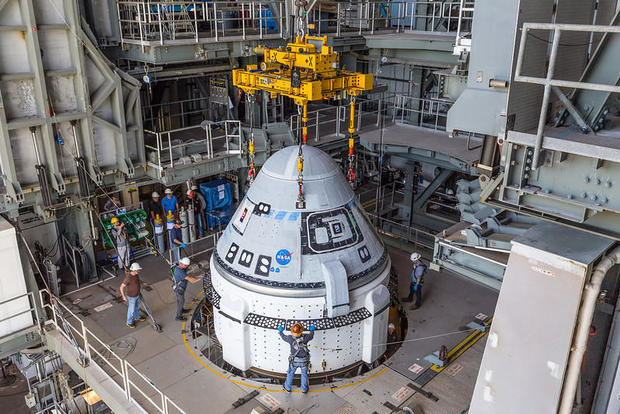
Image (Credit): Boeing’s Starliner spacecraft being placed atop an Atlas 5 rocket at the Cape Canaveral Space Force Station. (United Launch Alliance)

“Today was a was a huge day for our Commercial Crew Program…All the (international) partners and then our whole team polled ‘go’ to proceed to the launch on May 6. Not only that, but we (signed) what we call an interim human rating for Starliner for this crewed flight test. … It was a was a huge deal for NASA and our entire team.”

-Statement by Steve Stich, manager of the Commercial Crew Program for NASA, as quoted by CBS News. After numerous delays, the Starliner’s first Crew Flight Test will take place on May 6. If successful, the Starliner will start bringing astronauts to the International Space Station (ISS) in 2025. This will provide NASA with greater redundancy in its ISS resupply runs.

Space Stories: Voyager 1 Gibberish, Lunar Rovers Underway, and the Largest Digital Camera

Image (Credit): Artist’s rendering of the Voyager 1 spacecraft. (NASA)

Here are some recent stories of interest.

—ScienceAlert: “NASA Has Finally Identified The Reason Behind Voyager 1’s Gibberish“

For months now, the most distant spacecraft to Earth – Voyager 1 – has been talking gibberish on the interplanetary ‘radio’. The repetitive jumble of 1s and 0s it’s sending back to our planet, 24 billion kilometers (15 billion miles) away, has made no sense to scientists until now. Turns out, officials at NASA just needed to give the oh-so-distant craft a bit of a ‘poke’ to ask it how it was feeling. The system returned a software readout to Earth that scientists have now used to confirm about 3 percent of its memory is corrupted. Which is why turning the FDS on and off didn’t resolve the issue back in November of 2023.

—CBS News: “3 Companies Win NASA Contracts to Develop New Artemis Moon Rover Designs“

Along with funding the commercial development of new rockets, Artemis moon landers and new spacesuits, NASA is pressing ahead with plans to buy an unpressurized moon rover that can carry astronauts, science payloads — or both — across the rugged terrain of the lunar south pole, officials said Wednesday. The agency announced contract awards to three companies to develop competing designs for a Lunar Terrain Vehicle, or LTV, similar in concept to the rovers that carried the last three Apollo crews across the moon’s surface more than 50 years ago.

—NOIRLab: “Construction of Largest Digital Camera Ever Built for Astronomy Completed“

After two decades of work, scientists and engineers at the Department of Energy’s SLAC National Accelerator Laboratory and their collaborators are celebrating the completion of the LSST Camera. Once mounted on Vera C. Observatory’s Simonyi Survey Telescope, the 3200-megapixel camera will help researchers observe our Universe in unprecedented detail. During its ten-year Legacy Survey of Space and Time, the LSST Camera will generate an enormous trove of data on the southern night sky that researchers will mine for new insights into dark energy, dark matter, the changing night sky, the Milky Way and our Solar System.

Have You Heard of Orbital Drug Factories?

Credit: Varda Space Industries

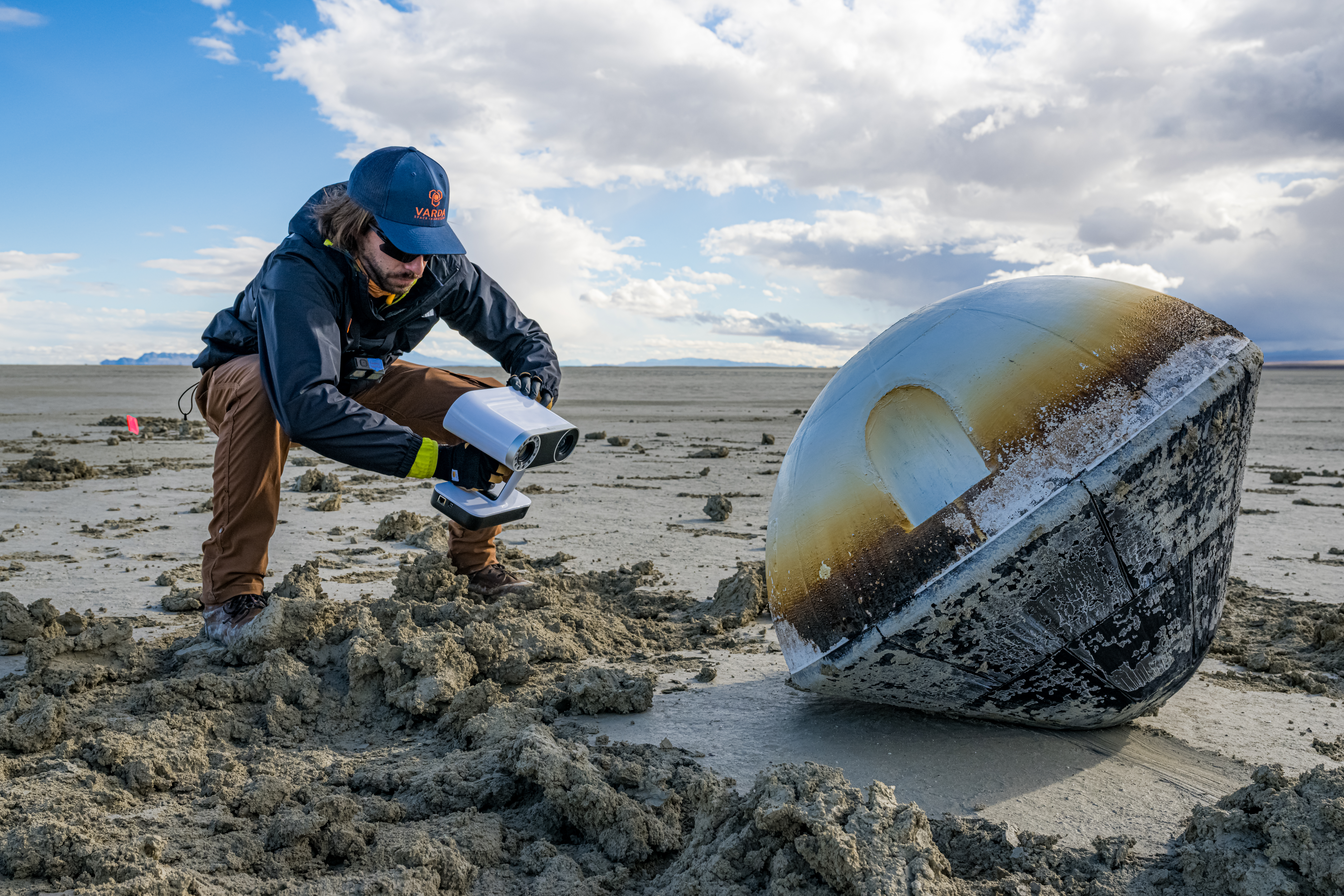
The International Space Station is not the only orbiting platform for experiments. Varda Space Industries has its own orbiting facility, or at least it had one in orbit for 10 months until it returned to Earth in February (shown below). And now the company has another $90 million in funding to continue to develop its capsules.

Varda, founded in 2020, represents the next phase of the space industry, where lower cost launches allow companies to be creative with their own spacecraft. In this case, biopharma is being asked to consider the advantages of a launches that remove gravity from the equation:

While gravitational forces do not directly impact thermodynamic properties of systems, they do significantly impact kinetic and hydrodynamic processes. Microgravity suppresses convection and sedimentation, resulting in more uniform supersaturation, as well as diffusion-driven transport. The resulting environment enables crystallization outcomes that lead to improvements in bioavailability, enhanced physicochemical properties, differentiated intellectual property, and new routes of administration — all realized by conducting research in microgravity.

While Varda is taking advantage of the lower launch costs made available by reusable rockets, it too wants to have reusable capsules down the line to reduce costs even further. Of course, it is not as glamorous as a permanently manned space station, but these crewless capsules should be sufficient for the needs of many if not most companies.

Note: Varda is also the name of a dwarf planet, which took its name from JRR Tolkien’s Middle Earth.

Image (Credit): The W-1 capsule after landing in the Utah desert. (Varda Space Industries/John Kraus)