Prepare for Thousands More LEO Satellites

Image (Credit): Launch vehicles for Amazon’s Project Kuiper. (Amazon)

Watch out SpaceX, Amazon is getting into the Internet satellite business as well. More importantly, beware astronomers and orbiting spacecraft, because the skies are going to be really crazy, and China has not even started with its massive program.

This week, Amazon announced plans to more forward with Project Kuiper, which will involve about 83 rocket launches involving Arianespace, Blue Origin, and United Launch Alliance. The Project will place 3,236 satellites into low Earth orbit (LEO) over a five-year period.

This is how Amazon describes Project Kuiper:

Project Kuiper aims to provide high-speed, low-latency broadband to a wide range of customers, including individual households, schools, hospitals, businesses, government agencies, disaster relief operations, mobile operators, and other organizations working in places without reliable internet connectivity. Amazon is designing and developing the entire system in-house, combining a constellation of advanced LEO satellites with small, affordable customer terminals and a secure, resilient ground-based communications network. 

Of course, this is what SpaceX’s Starlink is already doing as it aims for 42,000 such satellites. In addition, Oneweb aims for about 600 such satellites (to be launched by SpaceX of all firms). And China is considering a similar system of 10,000 LEO satellites. This is just the list to date, which is quite a cluster of problems already.

So let me get this straight. We can get Dish TV cable services to every spot in the US using only 9 satellites, but we will need thousands and thousands of competing satellites crowding LEO and jeopardizing our space stations, weather and intelligence satellites, and astronomy efforts all for Internet services?

Why does it appear we are going backwards. I understand that the Dish satellites are about 22,000 miles away in geosynchronous orbits, but why can’t that be the model going forward rather than the billions of satellites that Mr. Musk thinks is possible? It strikes me as crazy to go down this path. All we need is one bad collision, and the cascading impact of that collision, to doom all of LEO.

We really need to think this through.
How Many Satellites Are Too Many?

You may have remembered my earlier post showing all of the items already in orbit around the Earth. Well, it appears Elon Musk believes we can handle billions of satellites in low Earth orbit (LEO). And while the current number of orbiting satellites is only in the thousands, Mr. Musk’s SpaceX has already placed 1,700 Starlink satellites in LEO, with plans for a total of 42,000 such satellites under the program.

Not everyone agrees with unchecked growth. Josef Aschbacher, the European Space Agency’s (ESA) director-general, stated, “You have one person owning half of the active satellites in the world. That’s quite amazing. De facto, he is making the rules.” I agree with the ESA about the need for some rules in this area given the rapid growth. And we may need to look a little deeper into that “billions” number. Mr. Musk has been known to overstate things.

Mr. Musk is part of the move fast and break things club. Yet that can lead to problems when the things breaking up are expensive satellites leaving debris in their wake. We may need to find a better way.

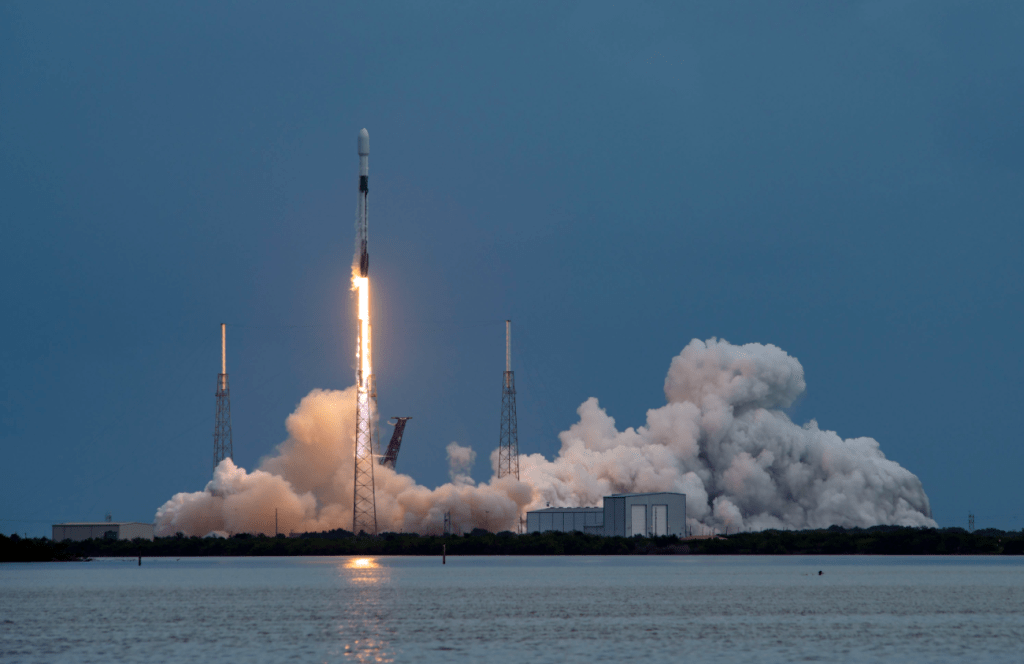
Source: October 24, 2021 launch of SpaceX’s Falcon 9 rocket carrying 60 Starlink satellites to orbit from Space Launch Complex 40 at Cape Canaveral Air Force Station in Florida. See the SpaceX press release, which contains this image.

Whatever Happened to Mars-One?

Source: Artist’s impression of a Mars One community on Mars from MIT

I remember the image above from Mars One and thinking that maybe the private sector could find an innovative way to beat governments to Mars. I also remember the profiles of individuals volunteering for a one-way trip to Mars to be part of the proposed Martian colony. So much for that idea. Mars One ran out of money and appears to be little more than a website at this point, where you can read the following:

In 2016 Mars One ran out of funds and was unable to continue the selection program and the technical studies. In the years after that, several attempts were made to raise additional funds, but they were unsuccessful. Despite that, Mars One has had an impact on Mars exploration by promoting the idea of permanent settlement. We, Mars One’s co-founders, are still convinced that the first crews that go to Mars should (or will have to) go there to stay. 

So Mars One still believes a one-way trip is the best approach. If so, it appears Mars One did not have the secret for a very long existence on Mars. An MIT study discussing the venture said the new martians would have survived a short time before expiring as they attempted to grow their food:

As the air inside the habitat continued to leak, the total atmospheric pressure would drop, creating an oppressive environment that would suffocate the first settler within an estimated 68 days.

I am not sure how that would have helped the drive to Mars if the first spot we established was a graveyard.

So give Mars Once credit for keeping the dream alive, and even being optimistic about the technology someday appearing to make it possible, though not in time for its scheduled mission. Fortunately, it went out of business before derailing our hopes for a successful manned mission to Mars.

Source: Mars One.

Space Investments are No Guarantee

Source: Virgin Orbit.

The recent initial public offering for Virgin Orbit, a commercial space launch company that spun-off from Richard Branson’s Virgin Galactic, did not go as well as planned. IG International reported that Virgin Orbit had hoped to raise $483 million as part of the public offering, but only raised $228 million. Moreover, the stock is down about 20 percent.

Virgin Orbit has already had some successfully launches from its modified Boeing 747, but the space launch industry is getting crowded and risky.

In June 2021, Virgin Orbit’s Tubular Bells: Part One mission for the US Department of Defense placed seven satellites to Low Earth Orbit – four R&D CubeSats for the US Department of Defense, two optical satellites for SatRevolution, and the Royal Netherlands Air Force’s first military satellite.  You can learn more about the past and planned US Department of Defense and NASA launches here.

Source: Virgin Orbit.