Space Stories: Preparing for a Commercial Space Station, Ukraine Protests New ISS Crew, and Metal 3D Printing in Space

Image (Credit): Artist’s rendering of the Starlab commercial space station in orbit. (Starlab Space)

Here are some recent stories of interest related to space stations.

SpaceNews: Starlab Commercial Space Station to Launch on Starship

Starlab Space, the joint venture developing the Starlab commercial space station, has selected SpaceX’s Starship to launch the station on a single flight. Starlab Space, a joint venture of Voyager Space and Airbus Space and Defence, announced Jan. 31 it reached an agreement with SpaceX to launch the Starlab station on Starship. The companies did not disclose terms of the agreement or a projected launch date, although a spokesperson for Starlab Space said the company was confident that Starlab would be launched before the decommissioning of the International Space Station, currently scheduled for 2030.

Kyiv Post: Ex-Russian Military Officer Joins NASA for ISS Mission; Ukrainian Outrage Follows

Alexander Grebenkin, a former Russian military officer and current Roscosmos cosmonaut, is set to travel to the International Space Station as part of the NASA team, as announced on the NASA website, where Ukrainians have commented their outrage. NASA, in collaboration with SpaceX, plans to launch Crew-8 to the International Space Station no earlier than Thursday, Feb. 22.

Aviation Week Network: European Space Agency Launches ‘First’ Metal 3D Printer To ISS

The European Space Agency (ESA) has launched what it says is the “first metal 3D printer” to be hosted on the International Space Station (ISS). While plastic 3D printers have been used aboard the ISS since 2014, a machine that prints stainless steel would be new and could allow astronauts greater self-sufficiency, including the ability to make complex metallic structures in orbit, as well as at future Moon and Mars bases, ESA said Jan. 30.
The ISS is Getting Pretty Crowded

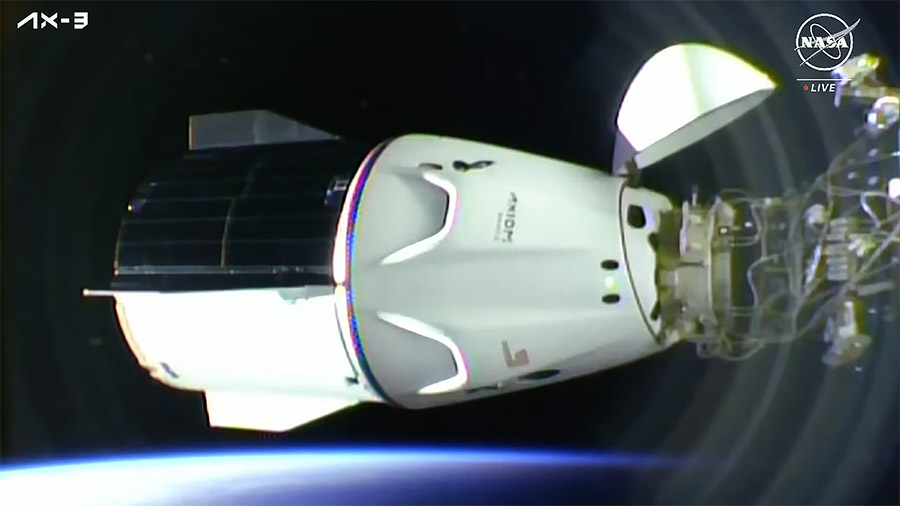
Image (Credit): The SpaceX Dragon Freedom spacecraft, which is carrying four Axiom Mission 3 crew members, docking to the space station shortly after an orbital sunrise. (NASA TV)

The seven real astronauts on the International Space Station (ISS) are now playing host to four visitors for the next two weeks after the Axiom Mission 3 crew came aboard the station earlier today.

Unlike the last two Axiom missions, all three paying members of the Axiom Mission crew are being supported by various European governments:

  • Marcus Wandt, member of the European Space Agency’s (ESA) astronaut reserve (ticket paid by ESA and the Swedish National Space Agency);
  • Walter Villadei, a member of the Italian air force (ticket paid by the Italian air force); and
  • Alper Gezeravcı, a fighter pilot with the Turkish air force (ticket paid by the Turkish government).

At the price of $55 million per seat, I am hoping the governments and space agencies feel they are getting their money’s worth versus being part of the normal 6-month astronaut rotation.

Supposedly, the extra hands will be working on 30 experiments that the normal crew did not have time for, though I would imagine they would be the less important experiments if they would otherwise not be performed at all.

If all of this is truly important work, then I expect such demand will justify the need for commercial space stations down the line to continue the work of the ISS. However, I expect a good chuck of future space interest will come from the tourist side.

In the meantime, I just hope the toilets on board the ISS can deal with the extra passengers.

Note: So as not to give all the attention to the visitors, the current Expedition 70 crew members aboard station are:

  • NASA astronauts Jasmin Moghbeli and Loral O’Hara;
  • ESA astronaut Andreas Mogensen;
  • JAXA (Japan Aerospace Exploration Agency) astronaut Furukawa Satoshi; and
  • Roscosmos cosmonauts Konstantin Borisov, Oleg Kononenko, and Nikolai Chub.

Pic of the Week: Dwarf Irregular Galaxy UGC 8091

Image (Credit): The Hubble Space Telescope’s view of Galaxy UGC 8091. ( ESA/Hubble, NASA Y. Choi (NOIRLab), K. Gilbert (Space Telescope Science Institute), J. Dalcanton (Flatiron Institute and University of Washington))

The image this week is from the NASA/European Space Agency’s (ESA) Hubble Space Telescope. It shows an irregular dwarf galaxy, UGC 8091, that is about seven million light-years away. What I see appears to be jellyfish within some cloudy water. I also the variety of other galaxies you can see throughout the image (see below).

Here is a little more about the image from ESA:

A collection of stars and galaxies fill the scene against a dark background. The image is dominated by a dense collection of stars that make up the irregular galaxy UGC 8091. The stars span a variety of colours, including blue and orange, with patches of blue occupying the central part of the galaxy. There are also visible circular regions of red/pink gas within the galaxy.

Image (Credit): Section of the above image – upper left hand corner. (ESA/Hubble, NASA Y. Choi (NOIRLab), K. Gilbert (Space Telescope Science Institute), J. Dalcanton (Flatiron Institute and University of Washington))

Top Astronomy Stories in 2023

Image (Credit): Chart showing the planned travel of the JUICE spacecraft. (ESA, work performed by ATG under contract to ESA)

I wanted to start out the new year by first remembering all of the great missions from 2023. I also decided to group this work rather than focus on single missions.

Here is what I came up with:

NASA’s Moon Mission: We saw more progress towards the next steps in the Artemis program to put humans on the Moon, including NASA’s announcement of the four astronauts to lead the Artemis II mission, SpaceX’s tests of the Starship rocket, and the design of new spacesuits for the Artemis astronauts.

Other Attempts to Land on the Moon: We saw other nations also reaching for the Moon. While India had great success landing a rover on the lunar South Pole, both Russia and a commercial venture from Japan did not have similar luck. We also saw Japan trying it again late last year.

NASA Asteroid Missions: Asteroids were the big news this year, with Lucy encountering a surprise pair of asteroids, OSIRIS-REx bringing back a sample from the asteroid Bennu, and NASA launching the Psyche mission.

JWST Discoveries: This year we celebrated the anniversary of the James Webb Space Telescope (JWST), which has been better than ever imaged. It is helping to change our understanding of the origin of the universe while poking and prodding at exoplanets to review their secrets.

ESA Missions: The European Space Agency (ESA) has also been very busy in 2023. For instance, the launch of the Euclid mission to study dark matter and dark energy, as well as the JUICE mission to study Jupiter and its moons, will assist with our understanding of the big picture as well as our own neighborhood.

That’s an impressive record, and I look forward to even more great news in 2024.

Holiday Wishes from the Crew on the ISS

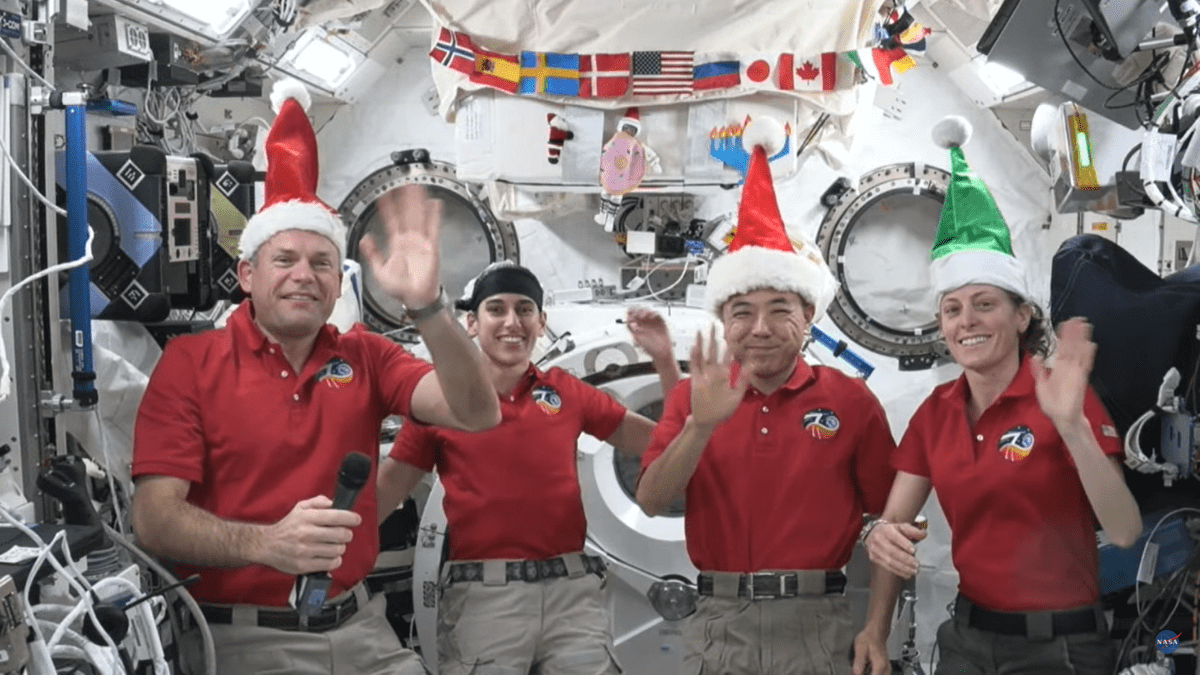
Image (Credit): Expedition 70 astronauts from left: Andreas Mogensen of ESA, Jasmin Moghbeli of NASA, Satoshi Furukawa of JAXA,and Loral O’Hara of NASA. (NASA)

You can watch a holiday video from International Space Station astronauts associated with three space programs provide greetings in three languages. They are away from family during the holidays, yet on the job to keep our space program going.