Space Stories: Bezos on the Moon, Strange Oort Objects, and Europe Visits Venus

Image (Credit): Artist’s rending of the Blue Origin lunar cargo lander. (Blue Origin)

Here are some recent stories of interest.

Reuters: “Bezos’ Space Company Teams with Lockheed, Boeing for NASA Moon Lander Pitch

Jeff Bezos’ space company Blue Origin is partnering with Boeing Co and Lockheed Martin Corp to pitch a lunar lander to NASA as the agency seeks to send humans to the moon again, the companies announced on Tuesday. The joint moon lander proposal, led by Blue Origin, marks the companies’ second attempt to win a coveted moon lander contract as NASA seeks more options for getting astronauts to the lunar surface under its multibillion dollar Artemis program.

Western University: “‘Unexpected’ Space Traveller Defies Theories About Origin of Solar System

Researchers from Western have shown that a fireball that originated at the edge of the Solar System was likely made of rock, not ice, challenging long-held beliefs about how the Solar System was formed. Just at the edge of our Solar System and halfway to the nearest stars is a collection of icy objects sailing through space, known as the Oort Cloud. Passing stars sometimes nudge these icy travellers towards the Sun, and we see them as comets with long tails. Scientists have yet to observe any objects in the Oort Cloud directly, but everything detected so far coming from its direction has been made of ice. Theoretically, the very basis of understanding our Solar System’s beginnings is built upon the foundation that only icy objects exist in these outer reaches and certainly, nothing made of rock.

Universe Today: “ESA’s Upcoming Mission Will Tell us if Venus is Still Volcanically Active

The EnVision mission is ESA’s fifth medium-class mission to Venus. It’s being planned in a partnership between NASA and ESA, and NASA will be providing the synthetic aperture radar instrument, which will map the surface (much as Magellan did). In addition to the two radars, the orbiter will carry spectrometers to study the atmosphere and surface. They will monitor trace gases in the atmosphere and analyze surface composition. The idea is to look for surface changes that might be linked to signs of active volcanism. Along with the VERITAS and DAVINCI missions, EnVision should reveal all we need to know about volcanic activity on Venus.

Pic of the Week: Distant Stellar Nursery

Image (Credit): CB 130-3 as captured by the Hubble Space Telescope. (ESA/Hubble, NASA & STScI, C. Britt, T. Huard, A. Pagan)

This week’s image comes from the Hubble Space Telescope. It shows a distant cloud of gas and dust known as CB 130-3. Such clouds can create new stars, as explained by the European Space Agency:

CB 130-3 is an object known as a dense core, a compact agglomeration of gas and dust. This particular dense core is in the constellation Serpens and seems to billow across a field of background stars.

Dense cores like CB 130-3 are the birthplaces of stars and are of particular interest to astronomers. During the collapse of these cores enough mass can accumulate in one place to reach the temperatures and densities required to ignite hydrogen fusion, marking the birth of a new star. While it may not be obvious from this image, a compact object teetering on the brink of becoming a star is embedded deep within CB 130-3.

Astronomers used Hubble’s Wide Field Camera 3 to better understand the environment surrounding this fledgling star. As this image shows, the density of CB 130-3 isn’t constant; the outer edges of the cloud consist of only tenuous wisps, whereas at its core CB 130-3 blots out background light entirely. The gas and dust making up CB 130-3 affect not only the brightness but also the apparent color of background stars, with stars toward the cloud’s center appearing redder than their counterparts at the outskirts of this image. Astronomers used Hubble to measure this reddening effect and chart out the density of CB 130-3, providing insights into the inner structure of this stellar nursery.

Pic of the Week: A View of Peru

Image (Source): View of the Pacific from the ISS. More information provided below. (NASA)

This week’s image is from the International Space Station (ISS). It shows an October 1, 2022 photo of European Space Agency (ESA) astronaut Samantha Cristoforetti enjoying a view of the Pacific Ocean off the coast of Peru. She is sitting in the ISS’s so called “window to the world.” You can learn more about photo’s taken from this window via this short NASA video.

Space Mission: ESA’s Euclid Telescope

To follow up on the previous post, Russia also lost out on launching the European Space Agency’s (ESA) Euclid spacecraft. Russia was supposed to launch it on a Soyuz-ST/Fregat rocket this December, but the country’s invasion of Ukraine led to a change in plans. SpaceX will now be launching the spacecraft next year.

Euclid was designed to study dark energy and dark matter, and make a 3D-map of the Universe. The project includes scientists from 14 countries: Austria, Denmark, France, Finland, Germany, Italy, Netherlands, Norway, Spain, Switzerland, Portugal, Romania, the UK, and the US.

Euclid hopes to answer the following questions:

  • How did the Universe originate? What were the conditions just after the Big Bang, and how did these give rise to the large-scale structures we see today?
  • Why is the Universe expanding at an accelerating rate today?
  • Is dark energy – a term often used to signify the mysterious force behind this cosmic acceleration – real? If so, is it a constant energy density intrinsic to and spread throughout space, or a new force of nature that slowly evolves as the Universe expands?
  • What is the nature of dark matter, and how do neutrinos possibly contribute? Are there other as-yet-undetected massive particles in the Universe?

Once launched, Euclid will operate in the Sun-Earth Lagrange point 2 (L2), which is where the James Webb Space Telescope is located as well as ESA’s Gaia spacecraft. Gaia, launched in December 2013, is currently mapping the stars in the Milky Way galaxy. It seems L2 is the place to be.

NASA is contributing infrared flight detectors for one of Euclid’s two science instruments. You can read more about the NASA contribution here.

Has Russia Lost its Space Mojo?

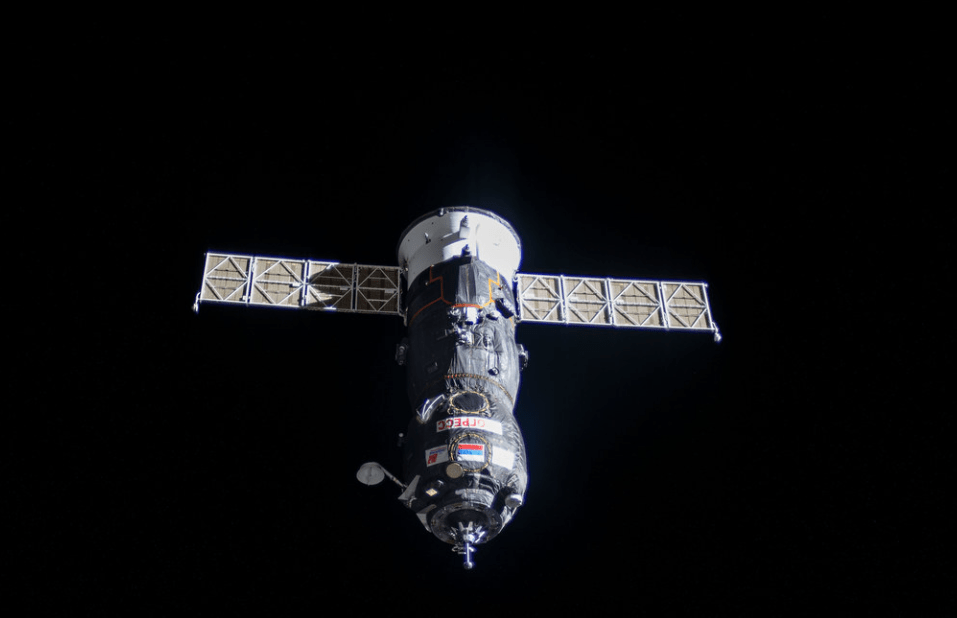
Image (Credit): Russia’s Progress 76 resupply ship approaching the ISS in July 2020. (NASA)

Marina Koren’s article in The Atlantic, titled “The Russian Space Program Is Falling Back to Earth,” has plenty to say about the state of Russia’s space program. Her assessment is pretty bleak outside of the continued collaboration related to the International Space Station (ISS).

She notes:

Beyond the ISS, though, Russia’s space portfolio isn’t all that grandiose these days. Although cosmonauts fly into orbit regularly, Russia does not have a rover on the far side of the moon, as China has, or orbiters around Mars, as India and the United Arab Emirates have. It does not have a fleet of space telescopes like the U.S has. The Soviet Union was the first to send a human being to space, decades ago, and its early accomplishments are a distinct point of national pride. But the Russian space program has stalled for years, plagued by sparse budgets. And that was before Vladimir Putin’s onslaught on Ukraine: Some of the space plans the country still had in the works are falling apart. Now the Russian space effort may be more adrift than ever.

The Russian invasion of Ukraine may be the last straw. It led to the cancellation of various collaborative space projects with other nations. For instance, back in March the European Space Agency (ESA) was forced to suspend its joint ESA/Roscosmos ExoMars Rover mission to Mars.

China seems to be pulling ahead of Russia in the space race, with Russia taking a back seat on future projects, such as a Moon base or new space station. On the ground, Russia has shown it is not up to a war with Ukraine, making its role as a military power questionable. The article notes that Russia’s status as a space power is now also in question.

And shooting down another nation’s satellites will not be seen as a sign of strength in either the military or space arena.