Image (Credit): On July 29, 2011, Cassini captured five of Saturn’s moons in a single frame with its narrow-angle camera. This is a full-color look at a view that was originally published in September 2011. Moons visible in this view: Janus is on the far left; Pandora orbits just beyond the thin F ring near the center of the image; brightly reflective Enceladus appears above center; Saturn’s second largest moon, Rhea, is bisected by the right edge of the image; and the smaller moon Mimas is seen just to the left of Rhea.. (NASA/JPL-Caltech/Space Science Institute)
On this day 2004, the Cassini spacecraft entered the orbit of Saturn. A collaboration of NASA, the European Space Agency (ESA), and the Italian Space Agency, the mission containing NASA’s Cassini space probe and ESA’s Huygens probe was launched in October 15, 1997. Cassini remained in orbit around Saturn from 2004 to 2007. The Cassini spacecraft spent 20 years in space – 13 of them exploring Saturn and its moons.
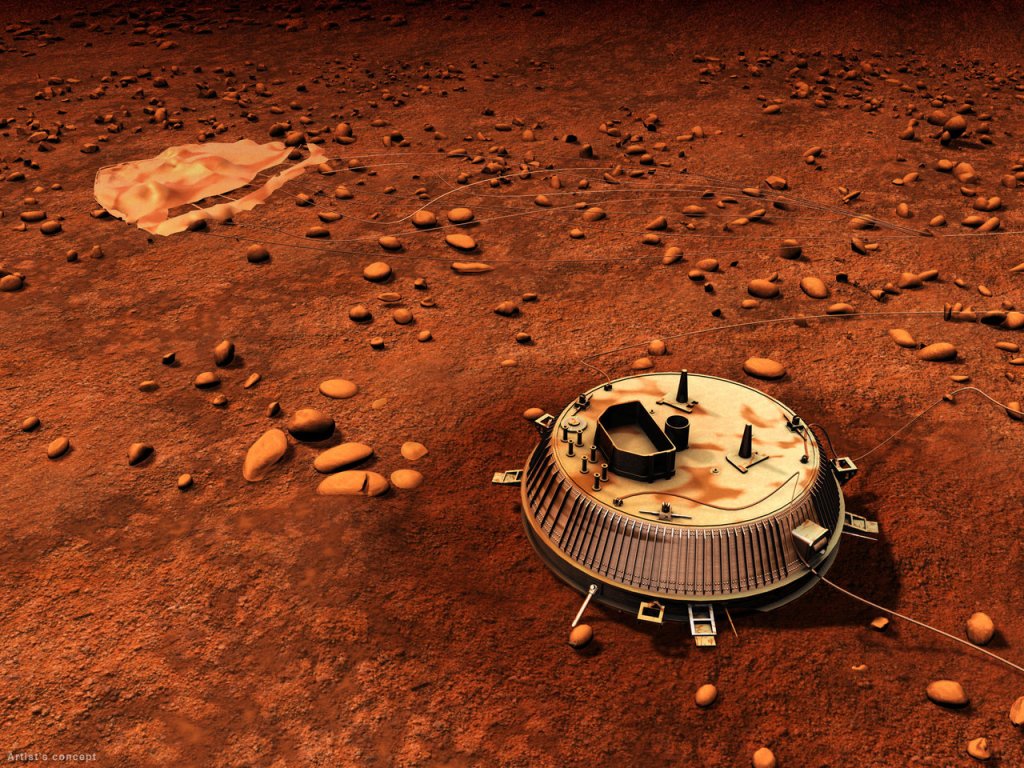
The ESA’s Huygen’s probe entered the atmosphere of Saturn’s largest moon Titan on January 14, 2005 to study the moon’s smog-like atmosphere and take pictures from the surface. The probe was not designed to survive past landing, though it was able to take photos for about three hours before it died. You can watch the probe enter Titan’s atmosphere in this video from ESA.
Image (Credit): An artist’s concept of the Huygens probe on Titan. (NASA)
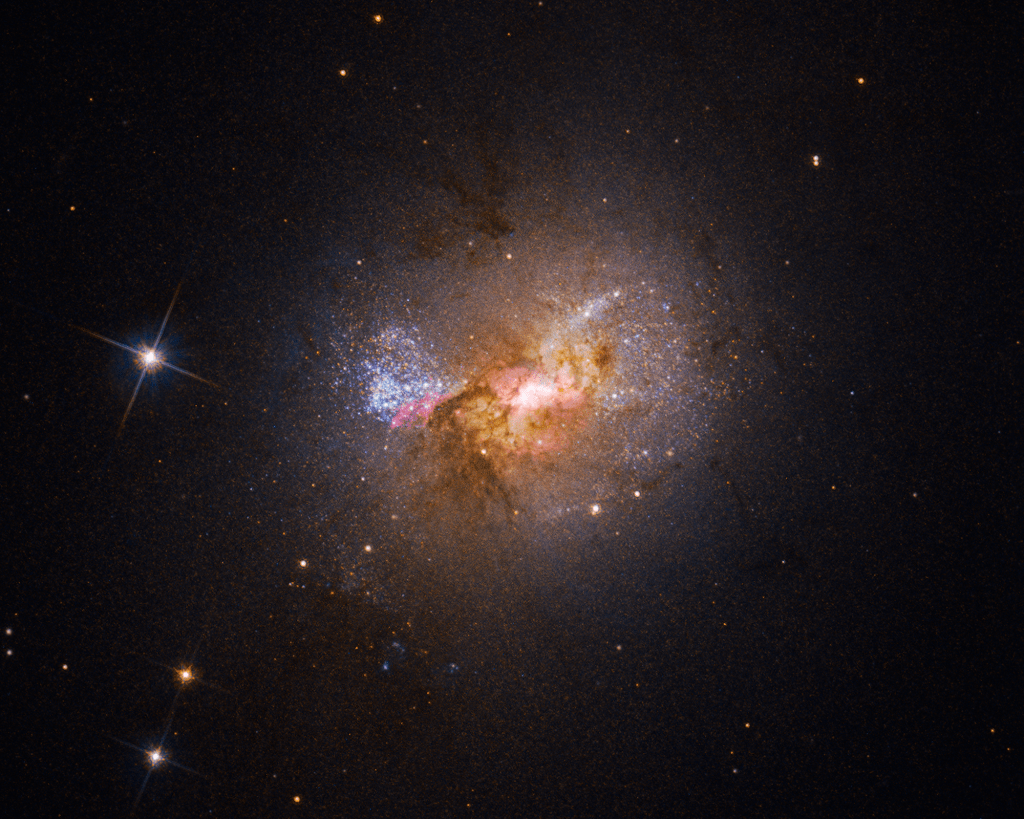
This week’s photo is from the Hubble Space Telescope. It shows the Dwarf starburst galaxy Henize 2-10, which lies 34 million light years away. NASA notes that “The bright region at the center, surrounded by pink clouds and dark dust lanes, indicates the location of the galaxy’s massive black hole and active stellar nurseries.”
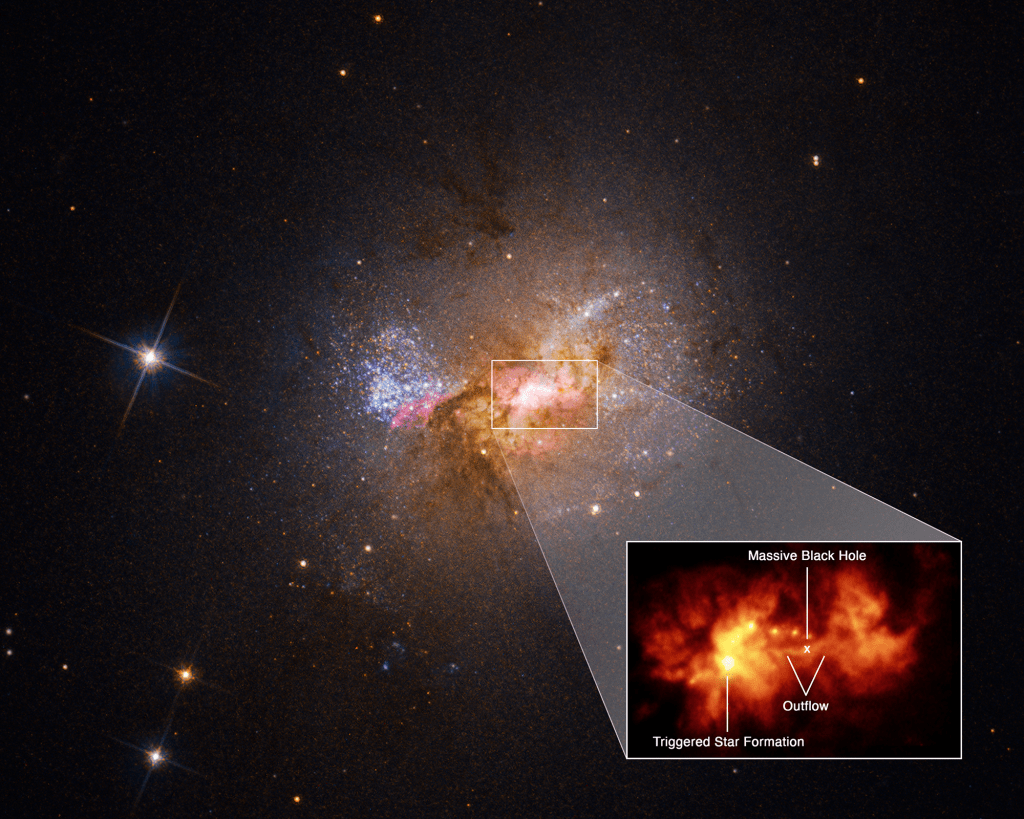
The image below better illustrates the link between the massive black hole and the related star formation. NASA explains:
A pullout of the central region of dwarf starburst galaxy Henize 2-10 traces an outflow, or bridge of hot gas 230 light-years long, connecting the galaxy’s massive black hole and a star-forming region. Hubble data on the velocity of the outflow from the black hole, as well as the age of the young stars, indicates a causal relationship between the two. A few million years ago, the outflow of hot gas slammed into the dense cloud of a stellar nursery and spread out, like water from a hose impacting a mound of dirt. Now clusters of young stars are aligned perpendicular to the outflow, revealing the path of its spread.
Image (Credit): Dwarf starburst galaxy Henize 2-10 with a pullout showing the black hole and related star formation. (NASA, ESA, Zachary Schutte (XGI), Amy Reines (XGI), Alyssa Pagan (STScI))
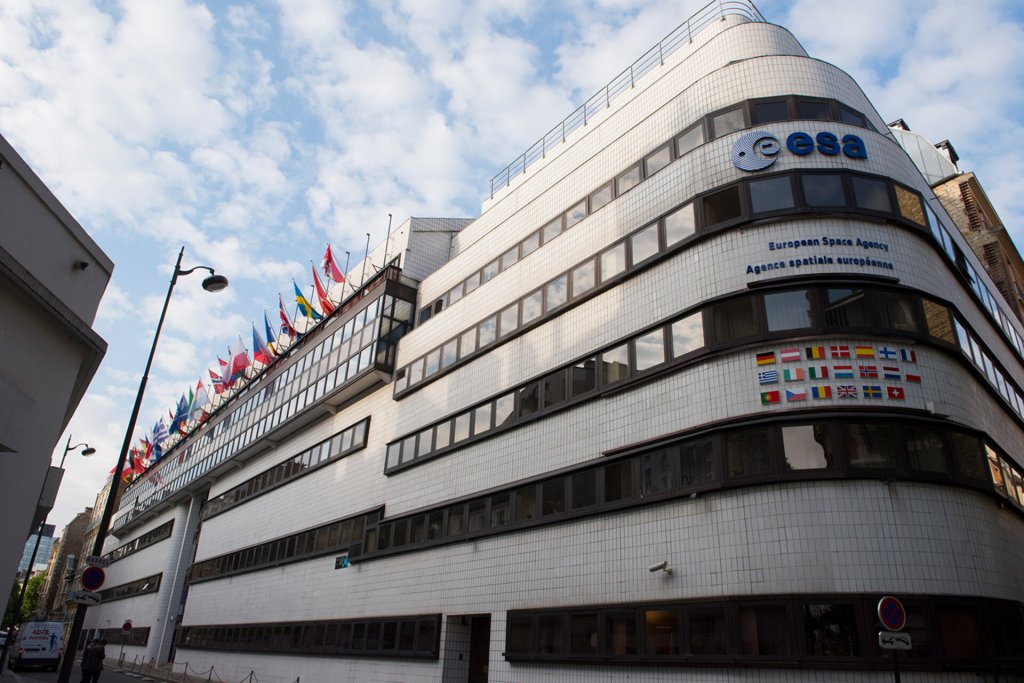
Image (Credit): European Space Agency (ESA) headquarters in Paris. (ESA)
“From understanding our changing planet to exploring Mars, I hugely value the cooperation we have with NASA…By contributing key European hardware and services to exciting programmes such as Artemis and Mars Sample Return, we are building Europe’s autonomy while also being a reliable partner.”
The image this week is from the NASA/ESA Hubble Space Telescope. It shows a cluster of old and young stars in the globular cluster Liller 1 located within the bulge of the Milky Way Galaxy. Here is a full explanation from NASA:
The muted red tones of the globular cluster Liller 1 are partially obscured in this image by a dense scattering of piercingly blue stars. In fact, it is thanks to Hubble’s Wide Field Camera 3 (WFC3) that we are able to see Liller 1 so clearly in this image, because the WFC3 is sensitive to wavelengths of light that the human eye cannot detect. Liller 1 is only 30 000 light-years from Earth — relatively neighbourly in astronomical terms — but it lies within the Milky Way’s ‘bulge’, the dense and dusty region at our galaxy’s centre. Because of that, Liller 1 is heavily obscured from view by interstellar dust, which scatters visible light (particularly blue light) very effectively. Fortunately, some infrared and red visible light are able to pass through these dusty regions. WFC3 is sensitive to both visible and near-infrared (infrared that is close to the visible) wavelengths, allowing us to see through the obscuring clouds of dust, and providing this spectacular view of Liller 1.
Liller 1 is a particularly interesting globular cluster, because unlike most of its kind, it contains a mix of very young and very old stars. Globular clusters typically house only old stars, some nearly as old as the Universe itself. Liller1 instead contains at least two distinct stellar populations with remarkably different ages: the oldest one is 12 billion years old and the youngest component is just 1-2 billion years old. This led astronomers to conclude that this stellar system was able to form stars over an extraordinary long period of time.
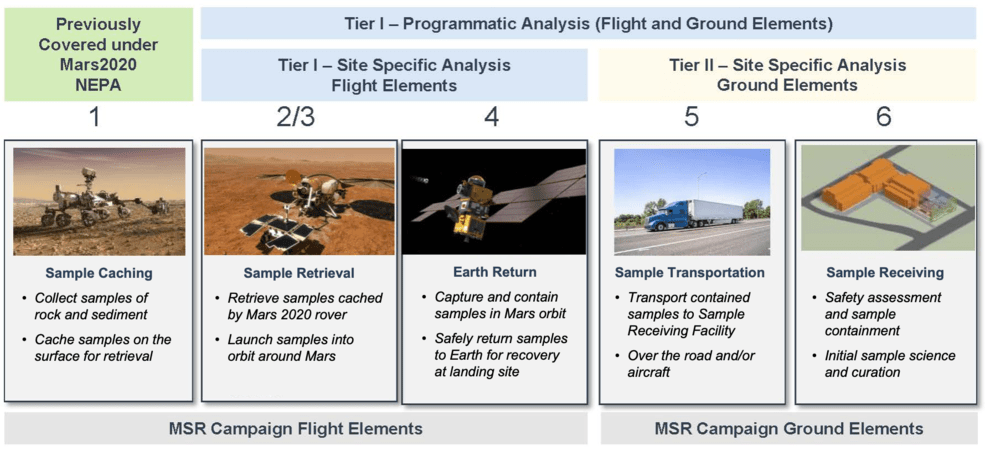
Image (Credit): Mars Sample Return campaign poster. (NASA)
NASA and the European Space Agency are still looking for comments on the process to return Martian rock samples to Earth. Of the six steps needed to collect and return the samples (see graphic above), only the first step is currently underway with the Perseverance Rover exploring Mars. Now we need to get those samples home. You have until May 15th to get comments back to NASA on this.
And what is the time frame for getting these samples back to Earth? The current goal is 2033, assuming all goes well. You may recall that China also wants to collect and return Martian samples by 2030. I expect more delays on both sides. When you add this to the race back to the Moon, the space race is getting more interesting every day.