More From the Senate Hearing on NASA

Image (Credit): Artist’s rendering of the Artemis Gateway. (NASA)

The hearing earlier this week held by the Senate Committee on Commerce, Science, and Transportation contained some clear warnings about the future of the US space program. In addition to comments by the Chairman and Ranking Member, we heard plenty from the witnesses about the importance of Artemis program in terms of political and economic outcomes, concerns about how the program is currently structured, and frustration with the continuing uncertainty about long term funding.

For instance, James Bridenstine, a Former Administrator for NASA, stated these concerns about NASA’s ability to land on the Moon under the Artemis program:

While the United States should celebrate orbiting the Moon in 2026, the United States does not have a lander. Unless something changes, it is highly unlikely the United States will beat China’s projected timeline to the Moon’s surface. Our complicated architecture requires a dozen or more launches in a short time frame, relies on very challenging technologies that have yet to be developed like cryogenic in-space refueling, and still needs to be human rated. While the capability could be transformational over time if payload capacity increases (so far it has decreased), the complexity of the architecture precludes alacrity.

Michael Gold, President of Civil and International Space for Redwire, emphasized the need for NASA to continue to resist White House cuts, such as the planned elimination of the Gateway piece in the initial budget proposal, in order to keep the program on track. He stated:

NASA’s waffling on Gateway has left our international partners confused, frustrated, and exploring alternatives to American partnerships. If we fail to continue with Gateway, we will force our partners to consider shifting support from Artemis and America, to China and its International Lunar Research Station (ILRS) program. Unlike the U.S., China has maintained strong and consistent continuity for its lunar beyond [low Earth orbit] spaceflight program, making a collaboration with China potentially far less risky than gambling on what, prior to Artemis, has been a mercurial American beyond LEO space strategy. If our international partners make such a shift to China, it will not only impact the space field but will have substantial diplomatic, geopolitical, and economic consequences on Earth.

And not to be outdone, Lieutenant General John Shaw, Former Deputy Commander of the U.S. Space Command, wanted to ensure the Artemis program was part of a “grand strategy” that could match the Chinese grand strategy integrating the exploration, economic opportunities, and security needs. In his testimony, he stated:

During my military career, I watched and studied – as any good soldier would of a potential adversary – as China slowly but surely developed and deployed its own civilian and military space capabilities and set its own agenda for space achievements. It is clear to me that the Chinese Communist Party is already employing its own integrated grand strategy for the earthmoon system, with only superficial distinction between civil, commercial, and national security activities, and all focused on a common purpose. I believe if we do not unify and synchronize our efforts, we will find ourselves, rather than the space leaders we are today, instead in a position of increasing disadvantage in space as we progress further into this century.

It was clear from what was said throughout the hearing that everyone in the room saw the benefits of a thriving Artemis mission that continued far beyond Artemis II. In fact, Artemis IX was mentioned as well. The real question was whether the US was willing to commit to a Moon and Mars mission for the long term and fund it appropriately so that our country, our commercial partners, and our country partners can realize the benefits for years to come.

That is the question that no one can answer here. However, the Chinese have already answered it for themselves. We can either watch them succeed, or fully commit to the Artemis program and win this latest space race.

Pew Study Reports on NASA’s Support Among the Public

A recent Pew Research Center report titled Republicans’ Views of Justice Department, FBI Rebound as Democrats’ Views Shift More Negative found that NASA was among the fourth most favorably viewed federal agency from among 16 agencies. Not surprisingly, the IRS placed last. However, it was joined at the bottom by ICE and the Department of Justice.

As shown in the graphic above, 64 percent of the American interviewed had a positive view of NASA, 15 percent did not, and 20 percent were not sure about what they thought about NASA. In another graphic, we learn that the 64 percent figure comes from 61 percent of Republicans and 71 percent of Democrats.

This comes at a time of planned deep cuts at the space agency. So what troubles the Republicans most about NASA?

According to Acting NASA Administrator Sean Duffy, one of the problems at NASA is the climate science focus. Mr. Duffy recently stated:

All the climate science and all of the other priorities that the last administration had at NASA we’re going to move aside, and all of the science that we do is going to be directed towards exploration, which is the mission of NASA.

Is that consistent with what the public says it wants in terms of priorities? Not at all. In fact, the public has the opposite view according to another Pew Research Center report from 2023, Americans’ Views of Space: U.S. Role, NASA Priorities and Impact of Private Companies, where monitoring the Earth’s climate was a much higher priority to Americans than sending astronauts to the Moon or Mars (see graphic below).

So the current White House is cutting a favored program and shifting the remaining resources in a direction that is inconsistent with the pubic’s stated preferences. This does not sound like a winning strategy for the White House or, more importantly, the American public paying the bills.

Space Quote: Understanding NASA Interplanetary Transmissions and Applying it to SETI

Image (Credit): Artist’s rending of the Perseverance Mars rover on the Martian surface. (NASA/JPL-Caltech)

”Based on data from the last 20 years, we found that if an extraterrestrial intelligence were in a location that could observe the alignment of Earth and Mars, there’s a 77% chance that they would be in the path of one of our transmissions — orders of magnitude more likely than being in a random position at a random time.”

Statement by Penn State graduate student Pinchen Fan, one of the authors of a recent study, Detecting Extraterrestrial Civilizations that Employ an Earth-level Deep Space Network. The study looked at NASA transmissions from Earth to space missions in the the solar system to determine if it could assist with the search for extraterrestrial intelligence (SETI).

Space Stories: New Glenn’s Martian Probes, AI Space Doctors, and Questions About a Mission to Uranus

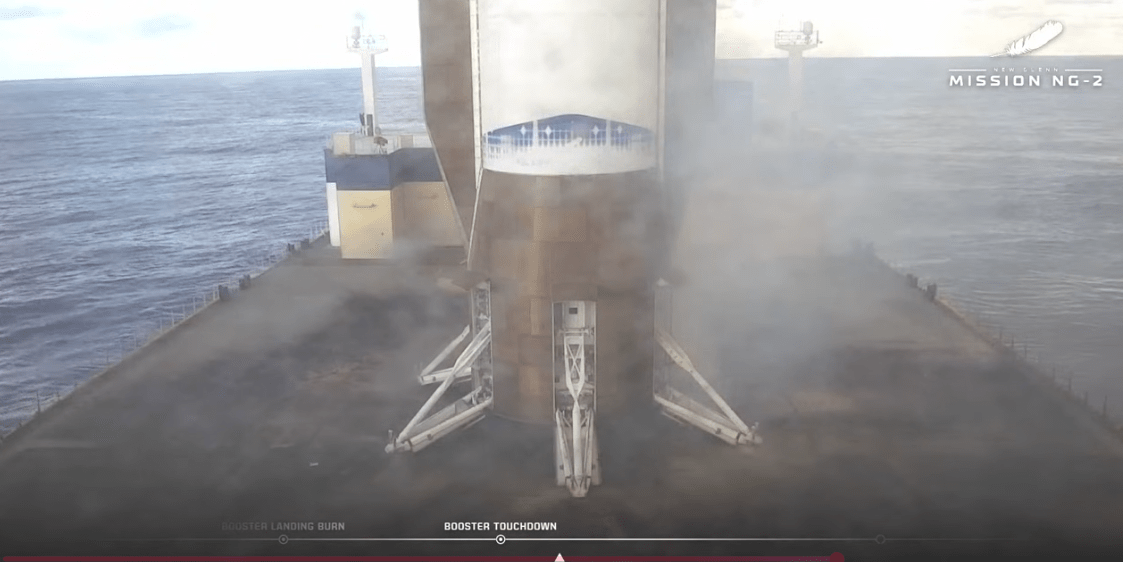
Image (Credit): Blue Origin’s New Glenn Rocket. (Blue Origin)

Here are some recent space-related stories of interest.

Space.com: Blue Origin’s 2nd New Glenn Rocket Launch will Fly Twin NASA Mars Probes to Space on Sep. 29

Blue Origin is gearing up for the second-ever launch of its powerful New Glenn rocket, which will loft NASA’s ESCAPADE mission to Mars. The company says it has been working closely with NASA on preparations leading up to New Glenn’s next launch, dubbed NG-2, and is targeting no earlier than (NET) Sep. 29. The twin ESCAPADE (Escape and Plasma Acceleration and Dynamics Explorers) probes have been awaiting their turn aboard New Glenn, which was originally slated to carry the satellites on its maiden launch in January. However, NASA opted not to risk a costly mission delay due to the debut liftoff of the new rocket.

American Bazaar: NASA and Google Test AI Medical Assistant for Astronaut Missions

NASA, which is committing to a new era of human spaceflight with its Artemis mission, is working with Google to test a proof of concept for Crew Medical Officer Digital Assistant (CMO‑DA), a type of Clinical Decision Support System (CDSS). This has been created to allow astronauts to diagnose and treat symptoms when no doctor is available or communications to Earth are blacked out. “Trained on spaceflight literature, the AI system uses cutting-edge natural language processing and machine learning techniques to safely provide real-time analyses of crew health and performance,” Google representatives said in a statement.

Scientific American:“NASA Budget Cuts Could End U.S. Exploration of the Outer Solar System

In the spring of 2022 the U.S. space community selected its top priority for the nation’s next decade of science and exploration: a mission to Uranus, the gassy, bluish planet only seen up close during a brief spacecraft flyby in 1986. More than 2.6 billion kilometers from Earth at its nearest approach, Uranus still beckons with what it could reveal about the solar system’s early history—and the overwhelming numbers of Uranus-sized worlds that astronomers have spied around other stars. Now President Donald Trump’s proposed cuts to NASA could push those discoveries further away than ever—not by directly canceling the mission but by abandoning the fuel needed to pull it off.

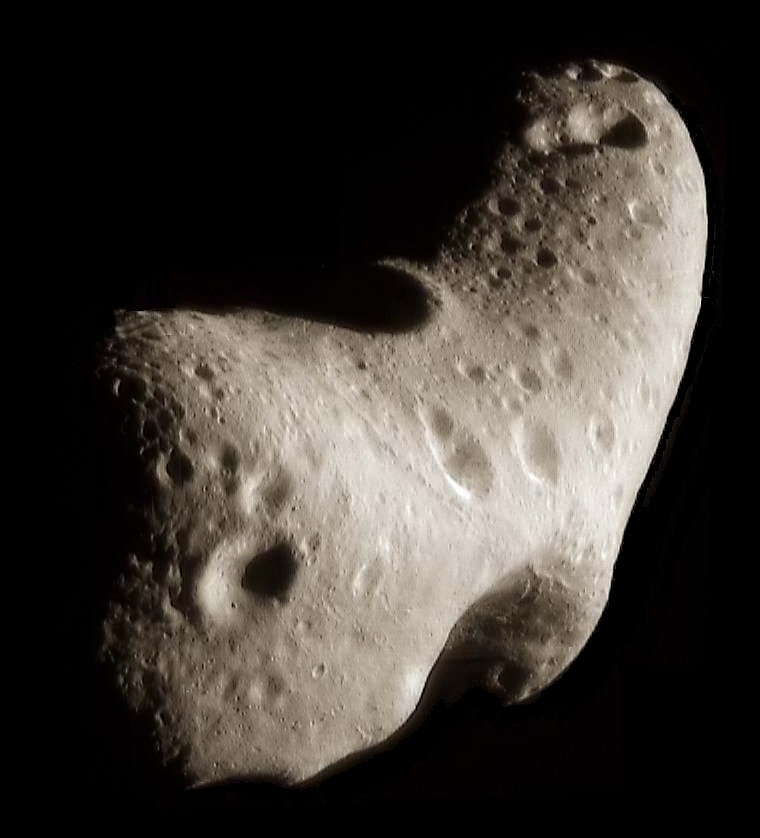
A Day in Astronomy: The Discovery of Phobos

Image (Credit): Mar’s moon Phobos. (NASA / JPL-Caltech / University of Arizona)

On this day in 1877, American astronomer Asaph Hall discovered the Martian moon Phobos while at the US Naval Observatory in Washington, D.C. He had discovered Mar’s other moon Deimos six days earlier.

Oddly enough, the idea of two moons orbiting Mars was first proposed in 1726 by Jonathan Swift in his tale Gulliver’s Travels. In the book, astronomers on the flying island of Laputia were noted to have

… discovered two lesser stars, or satellites, which revolve around Mars, whereof the innermost is distant from the center of the primary exactly three of his diameters, and the outermost five: the former revolves in the space of ten hours, and the latter in twenty-one and a half.

All Professor Hall had to do was confirm the work of the Laputian astronomers.