“As an astronaut, I believe our current technology may not have solutions for critical situations we are bound to face moving away from low Earth orbit, and this incident illustrates exactly that. NASA needs to address some urgent and sometimes uncomfortable questions. For example, should a doctor always be on the crew? Should a spaceship heading to Mars have high-tech medical capabilities and facilities — not just a ‘med kit’? A kit consisting of only medications, saline solution, a defibrillator and a few basic instruments places a crew at a serious disadvantage if things really go south.”
-Statement for former NASA astronaut Clayton Anderson in a Washington Post editorial published after this week’s return of four crew members who needed to be evacuated from the International Space Station due to a medical emergency. Had the health issue occurred six months into a trip to Mars the circumstances would have been dire without sufficient health resources. This is more evidence that acquiring the necessary hardware for space travel may be the easy part compared to the software, also known as humans.
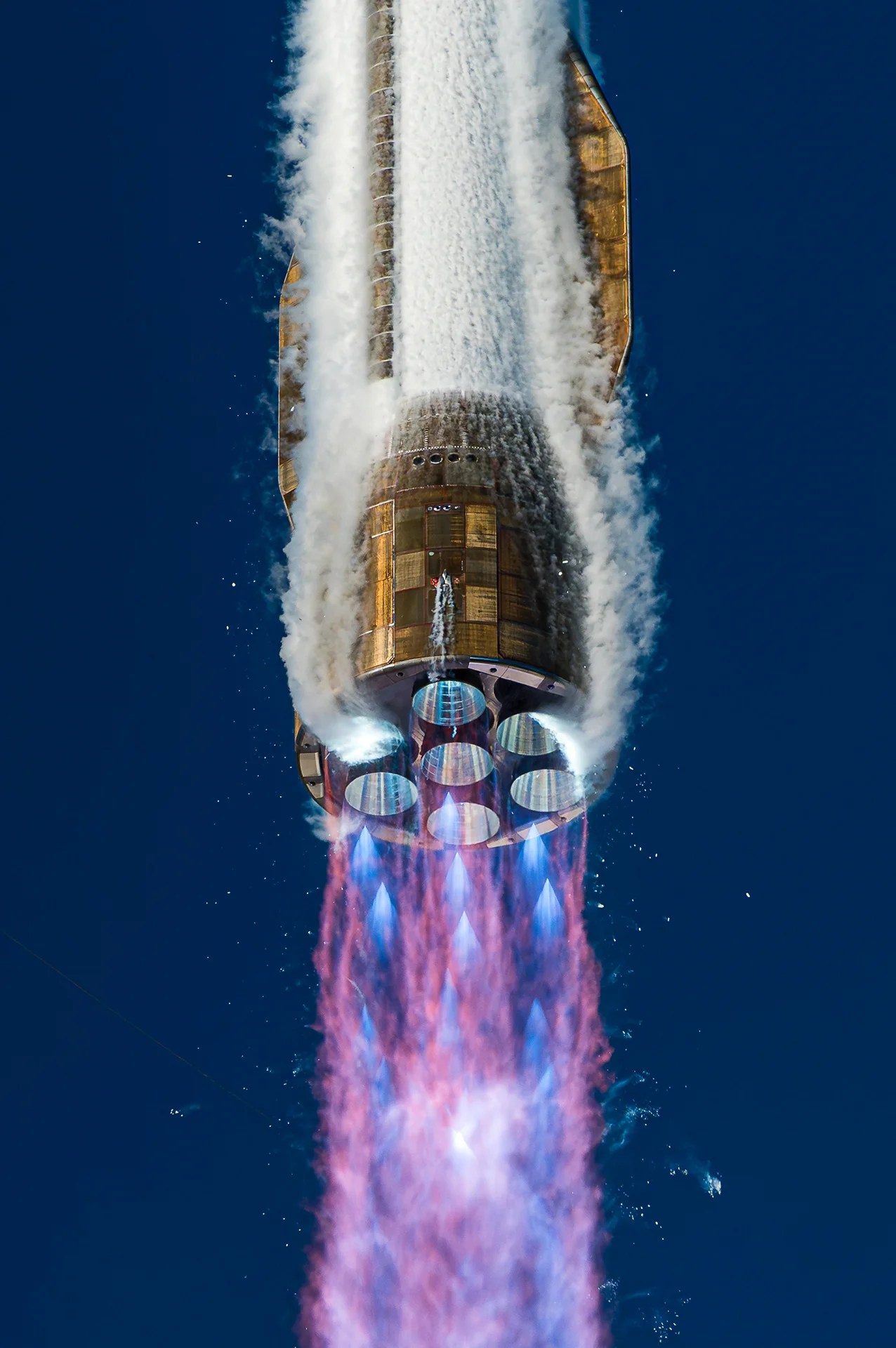
Image (Credit): Blue Origin’s New Glenn rocket as it launched from Launch Complex 36 at Cape Canaveral Space Force Station in Florida on November 13, 2025. (Blue Origin)
This week’s image comes from Scientific American magazine’s best space photos of 2025. It shows Blue Origin’s New Glenn rocket lifting off from Launch Complex 36 at Cape Canaveral Space Force Station in Florida on November 13, 2025. It was carrying NASA’s twin Escape and Plasma Acceleration and Dynamics Explorers (ESCAPADE) spacecraft, which are destined for Mars. The two identical spacecraft will investigate how the solar wind interacts with Mars’ magnetic environment and how this interaction drives the planet’s atmospheric escape.
Today the House and Senate came together to agree on NASA’s FY 2026 budget, and the news could not have been better. Overall, NASA is looking at basically a flat budget (compared to a threatened 24 percent cut) with only a 1 percent cut in science funding from last year’s level (compared to the threatened 47 percent cut). The only thing left on the table – or should we say on the Martian surface – is the sample return.
Credit certainly goes to a House and Senate that showed bipartisan support for the maintenance of NASA and its missions. This should make the new NASA Administrator very happy as he tries to sort through the muck from earlier this year and find a path forward.
Now we just has to hope that this bill can get through the White House. Given that foreign policy is the preferred policy these days, and DOGE is MIA, it may actually happen.
Image (Credit): A portion of the International Space Station’s Russian segment is pictured with docked spacecraft including Europe’s Automated Transfer Vehicle (ATV) and the Soyuz TMA-20 crew vehicle. (NASA)
Here are some recent space-related stories of interest.
For several years now, in discussing plans for its human spaceflight program beyond the International Space Station, Russian officials would proudly bring up the Russian Orbital Station, or ROS…Oleg Orlov, director of the Institute of Biomedical Problems of the Russian Academy of Sciences, said ROS will no longer be composed of entirely new modules. Rather, its core will be the Russian segment of the International Space Station. “The Scientific and Technical Council of Roscosmos supported this proposal and approved the deployment of a Russian orbital station as part of the Russian segment of the ISS,” Orlov reportedly said.
NASA is losing critical communication links with its Mars missions. After recently losing contact with the MAVEN spacecraft, the agency faces the impending loss of the Mars Odyssey orbiter, which has been circling the Red Planet for over two decades. As both orbiters approach the end of their operational lifespans, NASA will soon have to find ways to maintain data relay capabilities for its rovers and other missions on the fourth planet.
A key discovery from NASA’s Cassini mission in 2008 was that Saturn’s largest moon Titan may have a vast water ocean below its hydrocarbon-rich surface. But reanalysis of mission data suggests a more complicated picture: Titan’s interior is more likely composed of ice, with layers of slush and small pockets of warm water that form near its rocky core. Led by researchers at NASA’s Jet Propulsion Laboratory in Southern California and published in the journal Nature on Wednesday, the new study could have implications for scientists’ understanding of Titan and other icy moons throughout our solar system.