Image (Credit): The Moon as seen from the International Space Station. (NASA)
“No one, and no religion, owns the moon, and, were the beliefs of the world’s multitude of religions considered, it’s quite likely that no missions would ever be approved…Simply, we do not and never have let religious beliefs dictate humanity’s space efforts — there is not and should not be a religious test.”
-Statement by Celestis CEO and co-founder Charles Chafer in an email to Space.com regarding Native American concerns about a NASA -funded rocket taking human remains to the Moon next week. A second company, Elysium Space, will also be placing human remains on the Moon as part of this same mission. NASA separately noted in response to the Native American concerns, “We don’t have the framework for telling [private companies] what they can and can’t fly.”
The last Full Moon of 2023 rises over the Mediterranean as seen from Aci Castello on Dec. 26. The ten frames in this composite image ranged from 1/800 to 1/100 second at ISO 400 with a zoom lens at 200 mm and f/13.
Image (Credit): Chart showing the planned travel of the JUICE spacecraft. (ESA, work performed by ATG under contract to ESA)
I wanted to start out the new year by first remembering all of the great missions from 2023. I also decided to group this work rather than focus on single missions.
NASA Asteroid Missions: Asteroids were the big news this year, with Lucy encountering a surprise pair of asteroids, OSIRIS-REx bringing back a sample from the asteroid Bennu, and NASA launching the Psyche mission.
JWST Discoveries: This year we celebrated the anniversary of the James Webb Space Telescope (JWST), which has been better than ever imaged. It is helping to change our understanding of the origin of the universe while poking and prodding at exoplanets to review their secrets.
ESA Missions: The European Space Agency (ESA) has also been very busy in 2023. For instance, the launch of the Euclid mission to study dark matter and dark energy, as well as the JUICE mission to study Jupiter and its moons, will assist with our understanding of the big picture as well as our own neighborhood.
That’s an impressive record, and I look forward to even more great news in 2024.
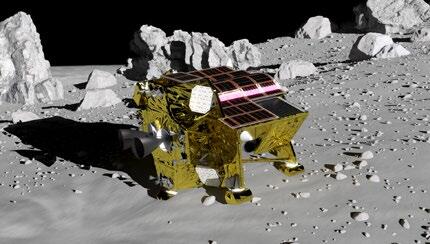
Japan is determined to get onto the moon as soon as possible. An attempt to land on the Moon earlier this year by a private Japanese company ended in failure, but things are looking good so far with the latest mission.
Launched on September 6th, the Japan Aerospace Exploration Agency (JAXA) spacecraft, called the Smart Lander for Investigating Moon (SLIM) and nicknamed the “Moon Sniper” lander, is now in orbit around the Moon. The plan is to place a robotic explorer on the lunar surface by mid-January.
Demonstrate the accurate lunar landing techniques embodied in a small explorer; and
Accelerate the study of the moon and other planets using the lighter exploration system.
In terms of the upcoming events, JAXA stated the following in a press release:
From now until mid-January 2024, the apolune point will be lowered, and the orbit adjusted to a circular orbit at an altitude of approximately 600km. The perilune point will then lower and preparations for landing will begin. On January 19, the perilune point will be lowered to an altitude of 15km, and the descent towards the Moon will start at around 0:00am (JST) on January 20. Landing on the lunar surface is scheduled for around 0:20am (JST) on January 20.
Image (Credit): ULA’s new Vulcan Centaur rocket. (ULA)
United Launch Alliance (ULA), a space rocket partnership between Boeing and Lockheed Martin, is now being offered for sale. Both Blue Origin and Cerberus are showing interest, which could upset the space business as Blue Origin takes a big step forward or Cerberus gets into the space business.
ULA, formed in 2006, has both a wealth of experience as well as the confidence of the US military, even though SpaceX has been eating into that business. ULA also has ready commercial customers, including a partnership with Amazon to launch 47 rockets to bring the Kuiper broadband constellation into orbit.
The ties to Mr. Bezos, owner of Amazon, go even deeper than that. The ULA’s new rocket, the Vulcan Centaur, will use engines built by Blue Origin, another one of Mr. Bezos’ companies. This may make a Blue Origin a natural new owner to ULA.
The potential buyers may want to wait until the test launch of the Vulcan on January 8th. At that time, the Vulcan rocket will be used to launch the Astrobotic Peregrine commercial lunar lander, the first of NASA’s Commercial Lunar Payload Services initiative designed to deliver science and technology experiments to the lunar surface.
None of this means Boeing or Lockheed Martin are moving away from space altogether. Boeing is still working on its Starliner to bring individuals and cargo to low-Earth orbit as well as its Space Launch System, which serves as the backbone of the Artemis program. Lockheed Martin will be busy as well with its Orion capsule and human landing system (with Blue Origin and Boeing as well), additional key components of the Artemis program.
Any reshuffling is okay as long as it adds to the array of commercial options for NASA. A new player like Cerberus might be welcome, but I also see some value to pushing an experienced and involved Blue Origin to the top of its game a little quicker so it can go head-to-head with SpaceX.