Growing Options in Moon Dust

Image (Credit): Placing a plant grown during the experiment in a vial for eventual genetic analysis. (UF/IFAS photo by Tyler Jones)

Speaking of moon dust, it seems scientists have found that they can grow plants in lunar soil. This is quite a surprise given the nature of moon dust. It would seem to be an even greater feat than growing plants in Martian soil.

NASA has reported that scientists at the University of Florida have successfully grown plants in actual lunar soil from the Apollo 11, 12, and 17 missions. Only water and a nutrient solution were added to the soil before seeds were planted. Plants started to sprout in two days. After 20 days the plants were harvested and studied before they had started to flower. While the lunar soil plants were somewhat stunted and stressed, the experiment was a success.

NASA noted:

This research opens the door not only to someday growing plants in habitats on the Moon, but to a wide range of additional questions. Can understanding which genes plants need to adjust to growing in regolith help us understand how to reduce the stressful nature of lunar soil? Are materials from different areas of the Moon more conducive to growing plants than others? Could studying lunar regolith help us understand more about the Mars regolith and potentially growing plants in that material as well? All of these are questions that the team hopes to study next, in support of the future astronauts traveling to the Moon.

This is a fascinating finding if it will allow us to use the lunar surface to feed astronauts rather than bringing more material from the Earth. It is also very timely as NASA is preparing the way for human habitation on the Moon under the Artemis Program.

We wanted to learn from the Moon before pushing onto Mars. This is a clear sign that we are doing so.

Space Quote: A Mature Rocket Market?

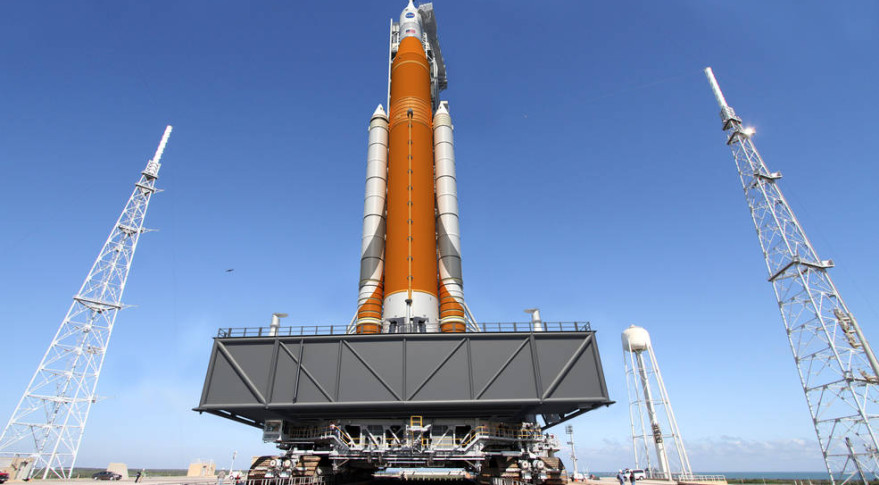
Image (Credit): Space Launch System rocket. (NASA)

“The launch industry is at a point where the technology is so mature that it may not be necessary to have the U.S. government invest in it… It may be we’re at a tipping point with this rocket.”

-Statement by Dan Goldin, a former NASA administrator, regarding NASA’s expenditures on the Space Launch System (SLS) in a Wall Street Journal article, “NASA Is Building Moon Rockets, Maybe for the Last Time.” The SLS and Orion spacecraft are part of NASA’s Artemis Program to return astronauts to the Moon.

Do You Have Moon Dust in Your Portfolio?

Image (Credit): Moon dust on auction. (Bonhams)

With the drop in the stock market and fall of cryptocurrency, maybe it is time to expand the portfolio into some new areas. You can always consider moon dust, a small sample of which sold last month for about $500,000 when auctioned at Bonhams. The sample in question was from the Apollo 11 lunar mission

The auction house had this to say about the sample:

5 Scanning Electron Microscope (SEM) aluminum sample stubs, each topped with approximately 10 mm diameter carbon tape containing Apollo Moon dust, 4 of which with particles collected by Neil Armstrong, the first person to walk on the Moon, as part of the Apollo 11 contingency sample, July 21, 1969 and later removed by NASA from the Apollo 11 Contingency Sample Return Container (CSRC) Decontamination Bag; stubs hand numbered by NASA scientists in marker on bottom 2 through 6.

A “contingency sample” is basically an initial sample in case something happens during the mission that prevents the the full collection of material. But what is interesting here is that the contingency sample bag still contained some lunar dust when it was lost, and then it was caught up in a court case, and then sold at auction, and then inspected by NASA, who inappropriately removed the moon dust, which was eventually returned. The drama and incompetence of the US government in this case is almost worth the price of the dust. Hence, this is a unique substance in many ways, and it does make cryptocurrency sound pretty boring.

Just do not expect to see many lunar dust sales in the future. NASA is very protective of such material when it is not misplacing it.

Mars Sample Return: Do You Have Comments?

Image (Credit): Mars Sample Return campaign poster. (NASA)

NASA and the European Space Agency are still looking for comments on the process to return Martian rock samples to Earth. Of the six steps needed to collect and return the samples (see graphic above), only the first step is currently underway with the Perseverance Rover exploring Mars. Now we need to get those samples home. You have until May 15th to get comments back to NASA on this.

And what is the time frame for getting these samples back to Earth? The current goal is 2033, assuming all goes well. You may recall that China also wants to collect and return Martian samples by 2030. I expect more delays on both sides. When you add this to the race back to the Moon, the space race is getting more interesting every day.

Video: The Problem With “The Rare Earth Hypothesis”

Image (Credit): Upgraded Drake Equation to account for the Rare Earth factors. (Cool Worlds Lab)

Cool Worlds Lab has another great video out, this time discussing the Rare Earth Hypothesis. This hypothesis assumes that a multitude of factors are necessary for life to develop in the universe, and the program goes deeper into a few of these factors, including the need for:

  1. A magnetosphere;
  2. Plate tectonics;
  3. A large moon;
  4. Impacts from asteroids and comets; and
  5. A Jupiter-sized planet.

The program challenges some of these factors and also highlights the need for a more open understanding of the origins of life beyond our current understanding. Basically, the conditional probably of the Drake Equation or even the modified Drake Equation unnecessarily leads one down a very narrow path.

It’s an eye-opening review of the evidence and worth watching. Check it out.