“No competent thinker [can] maintain any single nebula to be a star system of coordinate rank with the Milky Way.”
–Agnes Mary Clerke, Irish astronomer, founding member of the British Astronomical Association, and honorary member of the Royal Astronomical Society, commenting in 1890 on the likelihood that other galaxies existed beyond the Milky Way. This comment was captured in an excellent article from the July 31, 2021 Science News, “A Century of New Worlds,” which discusses discoveries in astronomy over the last 100 years. The article also notes that it was the work of another female astronomer, Henrietta Leavitt, that helped to eventually prove the existence of other galaxies.
Extra: A crater on the Moon is named after astronomer Agnes Mary Clerke (shown below).
Source/Credit: Clerke crater from NASA’s Apollo 17.
With all the previous posts about NASA’s Artemis mission, I should have outlined the three stages ahead as we return to the Moon:
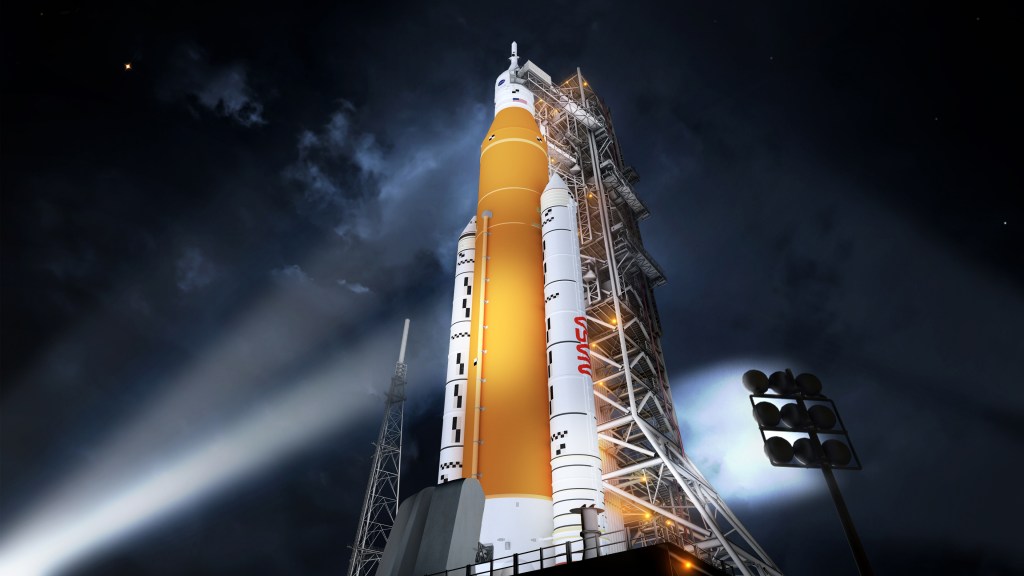
Artemis I: This stage involves an uncrewed flight test around the Moon. The new Space Launch System carrying the empty Orion spacecraft will launch from NASA’s Kennedy Space Center in Florida. The mission will last from four to six weeks. The European Space Agency has supplied a key piece for this mission – a service module, which will supply the spacecraft’s main propulsion system and power (and also house air and water for astronauts on future missions).
Artemis II: This next stage will confirm all of the Orion spacecraft’s systems operate as designed with crew aboard in the actual environment of deep space as the spacecraft circles the Moon. The mission is expected to last just over 10 days
Artemis III: This third and final stage will land a crew on the surface of the Moon. NASA has awarded Human Landing System contracts to Blue Origin, Dynetics, and SpaceX. This final stage will be followed by annual crewed missions to the Moon.
The ultimate goal of Artemis is to establish a presence on the Moon as well as build an orbiting Gateway that can serve as a multi-purpose outpost providing essential support for long-term human return to the lunar surface. The Gateway will also serve as a staging points for deep space exploration, such as travel to Mars.
This is a broad and hopeful mission. The only thing that seems a bit odd is the website mission statement for Artemis:
With Artemis missions, NASA will land the first woman and first person of color on the Moon, using innovative technologies to explore more of the lunar surface than ever before. We will collaborate with commercial and international partners and establish the first long-term presence on the Moon. Then, we will use what we learn on and around the Moon to take the next giant leap: sending the first astronauts to Mars.
I think the first focus of this multi-billion dollar lunar mission should be space exploration, which should also include a diverse crew. Maybe it is better to stick to the more universal statement in the earlier Artemis Plan:
Under the Artemis program, humanity will explore regions of the Moon never visited before, uniting people around the unknown, the never seen, and the once impossible. We will return to the Moonrobotically beginning next year, send astronauts to the surface within four years, and build a longterm presence on the Moon by the end of the decade…we will use the Moon as the stepping stone for our next greatest leap—human exploration of Mars.
You say potato and I say spuds.
Source/Credit: Artemis I mission map from NASA.
Note: NASA’s Artemis page was somewhat out of date when I posted this summary. For instance, in April 2021, SpaceX was chosen to provide the lunar lander.
Update: On March 31st, NASA announced it was looking for “…other U.S. companies to provide new lander development and demonstration missions from lunar orbit to the surface of the Moon.”
Source/Credit: The Luna-25 Moon Station from Russia’s Lavochkin Research and Production Association.
The image above is an artist’s rending of Russia’s Luna-25 Moon Station that was to be launched last year and is now scheduled to be launched in July 2022. It will be the first domestic spacecraft in the country’s modern history on the surface of the Moon. Luna-25 will be equipped with a soil-sampling robotic arm and camera to image the terrain. The last lunar mission was Luna-24 in 1976 by the then Soviet Union, which returned Moon samples to the Earth.
Source/Credit: NASA Administrator Bill Nelson, Official Portrait from NASA/Bill Ingalls.
“…in order for a space program to be successful it has to be a multi-administration effort. It’s like building an aircraft carrier; that takes about 12 years and spans many administrations. So the space program has to be the same way.”
–NASA Administrator Bill Nelson responding to a Time Magazine question about the lack of continuity among presidential administrations on moon missions.
On Friday, February 4th, you can watch another crazy science fiction movie if you are up to it, but be prepared. Moonfall has the following premise from Movieinsider.com:
In Moonfall, a mysterious force knocks the Moon from its orbit around Earth and sends it hurtling on a collision course with life as we know it. With mere weeks before impact and the world on the brink of annihilation, NASA executive and former astronaut Jo Fowler (Academy Award® winner Halle Berry) is convinced she has the key to saving us all – but only one astronaut from her past, Brian Harper (Patrick Wilson, “Midway”) and a conspiracy theorist K.C. Houseman (John Bradley, “Game of Thrones”) believes her. These unlikely heroes will mount an impossible last-ditch mission into space, leaving behind everyone they love, only to find out that our Moon is not what we think it is.
Moonfall has plenty of stars, as was the case with the earlier disaster film Don’t Look Up. That said, I think you can just sit back and let this one wash over you without worrying about any science. I doubt NASA needed to be consulted on this one. In fact, late last week NASA sent out the following tweet:
At only ~240,000 miles away, our nearest neighbor affects our life here on Earth. Here are a few reasons why we’re grateful the Moon is stable in its orbit (no offense @MoonfallFilm)
After you enjoy the show, you may want to check out what is planned for the Moon as part of the Artemis Program. This accompanying video by NASA, How We Are Going to the Moon, is pretty dramatic all by itself (with the Moon remaining in orbit, of course).