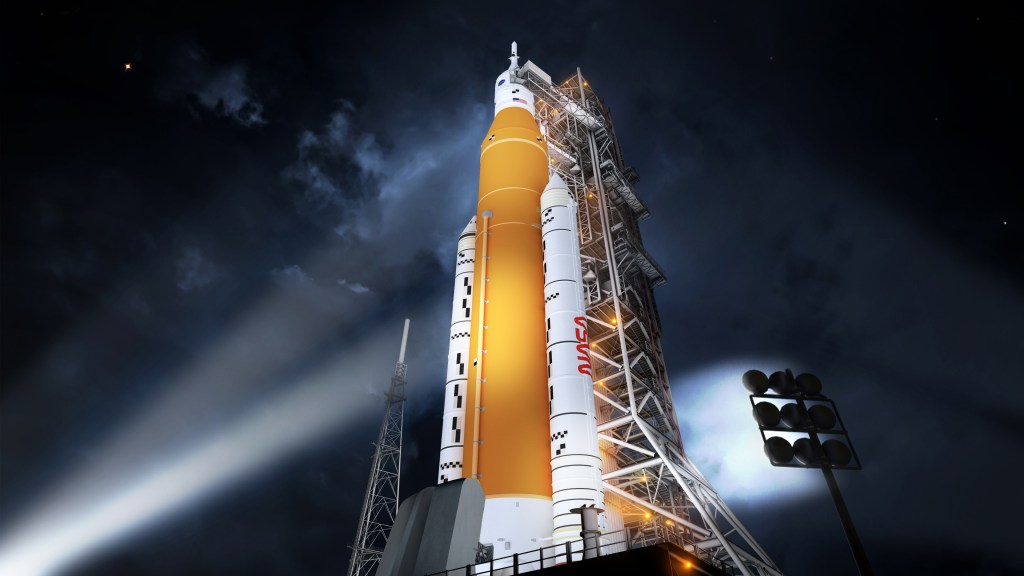
Image (Credit): Space Launch System rocket. (NASA)
“The launch industry is at a point where the technology is so mature that it may not be necessary to have the U.S. government invest in it… It may be we’re at a tipping point with this rocket.”
-Statement by Dan Goldin, a former NASA administrator, regarding NASA’s expenditures on the Space Launch System (SLS) in a Wall Street Journal article, “NASA Is Building Moon Rockets, Maybe for the Last Time.” The SLS and Orion spacecraft are part of NASA’s Artemis Program to return astronauts to the Moon.
With the drop in the stock market and fall of cryptocurrency, maybe it is time to expand the portfolio into some new areas. You can always consider moon dust, a small sample of which sold last month for about $500,000 when auctioned at Bonhams. The sample in question was from the Apollo 11 lunar mission
The auction house had this to say about the sample:
5 Scanning Electron Microscope (SEM) aluminum sample stubs, each topped with approximately 10 mm diameter carbon tape containing Apollo Moon dust, 4 of which with particles collected by Neil Armstrong, the first person to walk on the Moon, as part of the Apollo 11 contingency sample, July 21, 1969 and later removed by NASA from the Apollo 11 Contingency Sample Return Container (CSRC) Decontamination Bag; stubs hand numbered by NASA scientists in marker on bottom 2 through 6.
A “contingency sample” is basically an initial sample in case something happens during the mission that prevents the the full collection of material. But what is interesting here is that the contingency sample bag still contained some lunar dust when it was lost, and then it was caught up in a court case, and then sold at auction, and then inspected by NASA, who inappropriately removed the moon dust, which was eventually returned. The drama and incompetence of the US government in this case is almost worth the price of the dust. Hence, this is a unique substance in many ways, and it does make cryptocurrency sound pretty boring.
Just do not expect to see many lunar dust sales in the future. NASA is very protective of such material when it is not misplacing it.
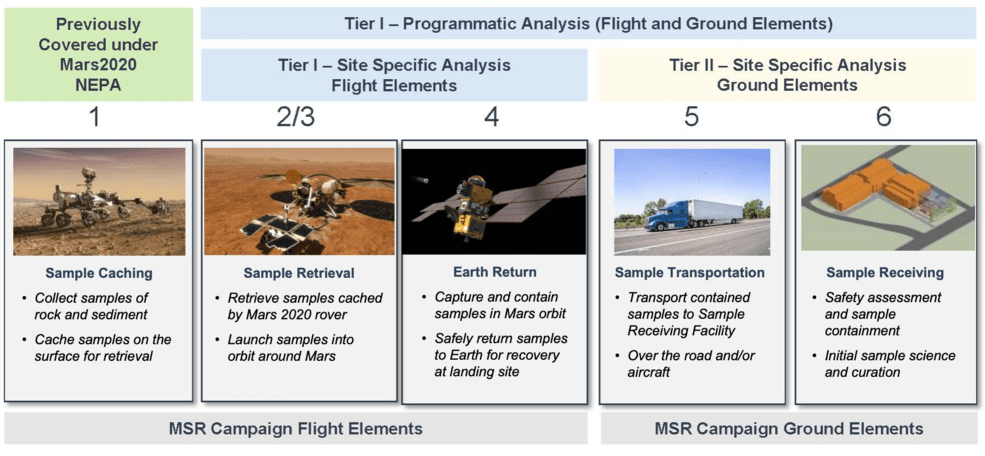
Image (Credit): Mars Sample Return campaign poster. (NASA)
NASA and the European Space Agency are still looking for comments on the process to return Martian rock samples to Earth. Of the six steps needed to collect and return the samples (see graphic above), only the first step is currently underway with the Perseverance Rover exploring Mars. Now we need to get those samples home. You have until May 15th to get comments back to NASA on this.
And what is the time frame for getting these samples back to Earth? The current goal is 2033, assuming all goes well. You may recall that China also wants to collect and return Martian samples by 2030. I expect more delays on both sides. When you add this to the race back to the Moon, the space race is getting more interesting every day.
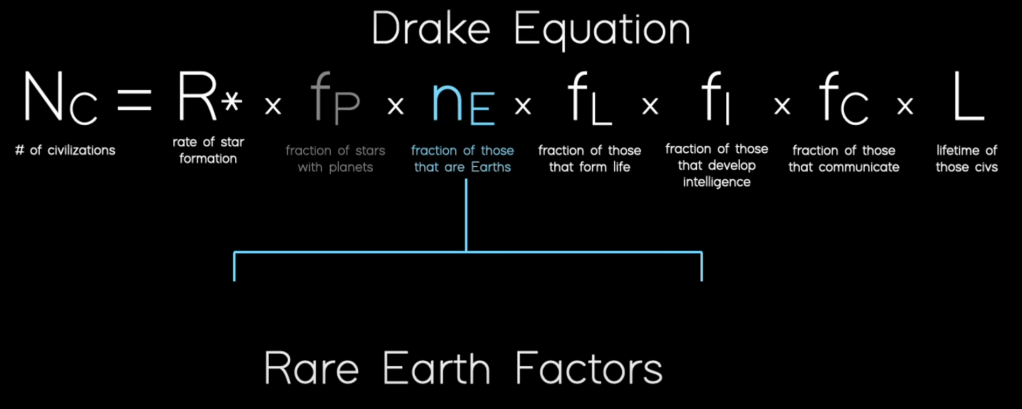
Image (Credit): Upgraded Drake Equation to account for the Rare Earth factors. (Cool Worlds Lab)
Cool Worlds Lab has another great video out, this time discussing the Rare Earth Hypothesis. This hypothesis assumes that a multitude of factors are necessary for life to develop in the universe, and the program goes deeper into a few of these factors, including the need for:
A magnetosphere;
Plate tectonics;
A large moon;
Impacts from asteroids and comets; and
A Jupiter-sized planet.
The program challenges some of these factors and also highlights the need for a more open understanding of the origins of life beyond our current understanding. Basically, the conditional probably of the Drake Equation or even the modified Drake Equation unnecessarily leads one down a very narrow path.
It’s an eye-opening review of the evidence and worth watching. Check it out.
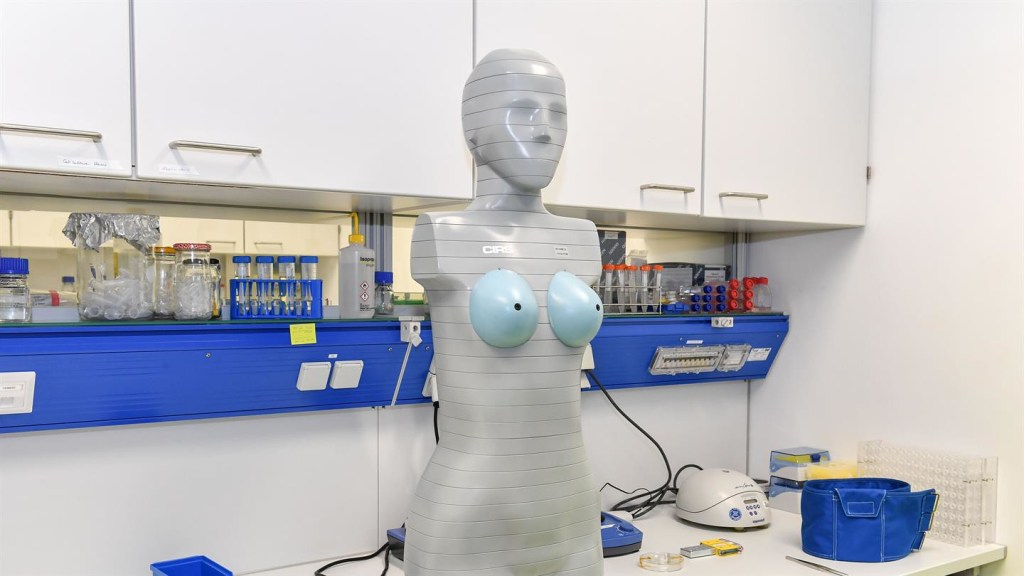
Image (Credit): The Helga manikin to be used on the Orion capsule to the Moon. (German Aerospace Center)
No, it is not a new television show or a rude comment, but rather a real plan to test the effects of space radiation on manikins that simulate the female body. The test is in preparation for future Artemis missions to the Moon. NASA is concerned about the effects of radiation on female astronauts since their anatomy is different than that of males and may be more prone to certain types of cancer.
As reported by Phys.org, the two manikins – Helga and Zohar – will fly aboard the Orion capsule for about six weeks as part of his first uncrewed flight to the Moon. While Helga will fly in the Orion capsule unprotected, Zohar will be wearing a radiation protection vest. In this way, scientists can study the full effect of the vest.
The experiment was designed by the German Aerospace Center (hence the German manikin names), which has conducted similar studies aboard the International Space Station (ISS). However, the radiation levels for a lunar mission will be much higher than that found on the ISS.
The Artemis mission will be the first time a female leaves low-Earth orbit , so it is essential that we know the potential impact of this trip on females. We wish the best to both Helga and Zohar.