Television: Blade Runner 2099

If you are not in the mood this weekend to see The Dog Stars, the latest Ridley Scott film, remember we still have another Ridley Scott show coming later this year.

Blade Runner 2099, a new 8-episode series, premieres on Amazon Prime this November 25th. While Mr. Scott was not involved with this production, his view of the future continues to amaze and haunt us.

Set in Los Angeles 50 years after the last film, the new series includes plenty of humans and Replicants, but this time it is the Replicants who are on top. It is quite a twist in the story at a time when AI is everywhere and AI-related unemployment is a continual worry.

This trailer on Youtube shows you what to expect from the new series.

Unfortunately, Harrison Ford will not be returning for this new series, but it still boasts a good number of well known talent, including Michelle Yeoh (Star Trek: Discovery), Hunter Schafer (The Hunger Games: The Ballad of Songbirds & Snakes), Dimitri Abold (The Hunger Games: The Ballad of Songbirds & Snakes), Lewis Gribben (Somewhere Boy), Matthew Needham (House of the Dragon), Maurizio Lombardi (Ripley), and others.

I want to walk into the future with my eyes wide open, so I am eager to watch the new series.

Update: As far as the role of AI in books, movies and television, I recommend a YouTube video by The Art of Storytelling titled “Sci-Fi Was Right About AI.” It touches on Blade Runner and Dune, as well as Star Trek, Star Wars, The Matrix, and many earlier works as well.
Survey Results: Americans and UFOs

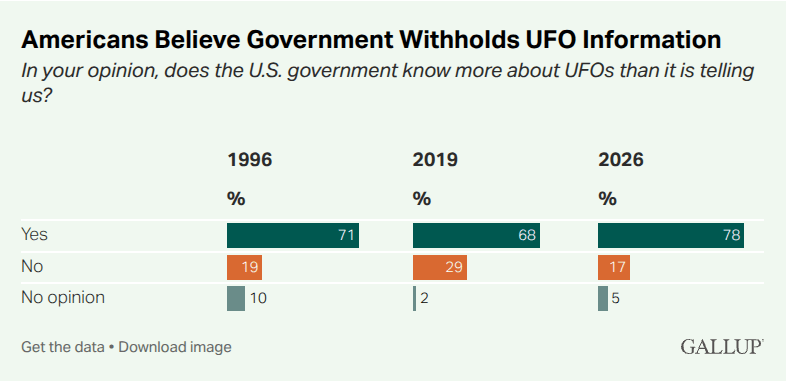
Americans are skeptical about their government for many reasons beyond the Epstein Files. In the case of UFOs, they continue to believe that Uncle Sam is withholding the truth. As shown in the figure above, this skepticism has grown over the years.

The results from a recent Gallup poll, outlined in Americans Still Skeptical That UFOs Are Aliens, have even more to say about how American feel, including:

  • 37% believe at least some UFOs have been alien spacecraft;
  • Individuals between age 30 to 49 are more likely to believe UFOs have been alien spacecraft; and
  • 17% of Americans say they have personally seen something they thought was a UFO.

Steven Spielberg, creator of this summer’s blockbuster movie Disclosure Day, is probably not all that surprised by these results. He has been telling this same story about encounters with aliens since 1977 with his movie Close Encounters of the Third Kind.

I think it is also reasonable to be skeptical about the existence of UFOs at this point. As Carl Sagan stated in his book Other Worlds:

UFOs: The reliable cases are uninteresting and in the interesting cases are unreliable.

Hence, it might be reasonable to be skeptical on both fronts – we cannot trust our government to properly share what it knows about UFOs, yet what it knows about UFOs is of no real value.

In Case You Missed It/Podcast: The Second Monster in Aliens

A few months back, NPR’s Planet Money podcast had a terrific episode titled, “The Real Horror of ‘Alien’ and How It Explains Why We’re Not Paid Enough.”

In the episode, we learn more about Weyland-Yutani, the company in the 1979 film Alien that employed the crew on the space tug Nostromo. You may remember that this crew eventually became little more than a meal and incubator for more monsters.

Maybe there was another monster on the ship as well. Maybe it was even a bigger monster, because it had already inflected the entire Earth economy. Something called monopsony, which is basically when all of the workers become the quasi-slaves of a few corporations. Unread contracts and absent labor unions became the basis for much abuse on and off the spaceships.

It’s a fun episode that allows you to see the film from the perspective of an economist as well as an everyday worker.

You can also hear from Fede Álvarez, who directed and co-wrote a subsequent film Alien: Romulus. It will probably be no surprise that Weyland-Yutani doesn’t become a better place to work.

Science fiction is often a mirror on society, even if we don’t see our reflection right away. Think about all of those drug commercials on television where everyone is dancing, yet the announcer keeps telling you about the horrible side-effects and possibility of death. Sometimes you just need to close your eyes and listen. The mirror can work even without your eyes.

Sci-Fi Stories: Dune & Duncan, The Sixth Nik, and Foundational Theories

Credit: Warner Bros. Pictures

Here are a few sci-fi stories of interest.

—Den of Geek: “Dune 3 Trailer Just Revealed the Most Important Character in the Franchise“

It’s not really about Paul Atreides. Paul may be Lisan al-Gaib, he may be the Kwisatz Haderach, but Paul is not actually the main character of the Dune franchise. Instead, that honor goes to the character introduced in the latest trailer for Dune: Part Three, the character you knew as Duncan Idaho. The latest trailer shows the internal fractures in Paul’s (Timothée Chalamet) life as he continues the Fremen jihad launched after he dethroned Padishah Emperor Shaddam IV (Christopher Walken) at the end of the previous movie. His partner Chani (Zendaya) feels betrayed by his actions and his legal wife, Shaddam IV’s daughter Princess Irulan (Florence Pugh) joins the plot that the Face Dancer Scytale (Robert Pattinson) launches against him. Central to this conspiracy is the introduction of the man we first met as Duncan Idaho, played by Jason Momoa. Despite what he appears to be, this man is actually called Hayt, and he is the most important character in Frank Herbert‘s Dune novels.

—Chicago Review of Books: “Body Horror At Its Best: Daniel Kraus’s “The Sixth Nik”“

Imagine a future Earth where bodily and mental modifications are the standard. The internet, riddled with rogue AI, has become a sequestered and dangerous pseudo-entity known as the Snarl. Humanity has expanded beyond Earth to settle on other planets. The forefront of technology includes spaceships made from synthetic organic materials resembling internal human organs. In central focus of this society of the future, and in focus of the novel to be discussed today, are a collection of six metallic coin-shaped technologies called niks. Niks are implanted in the brains of a lineage of children, giving them incredible powers of intuition—and lifespans that end at the onset of puberty. When one child dies, the niks are removed from their head, and the next child is chosen. This initial description can hardly begin to cover the scope and depths of The Sixth Nik, a new science fiction novel from the accomplished Daniel Kraus.

—Movieweb: “5 ‘Foundation’ Theories That Will Change the Way You Watch Season 4“

Foundation Season 4 still has no official release date, but it is expected to arrive in 2027. The explosive Season 3 finale set up some great storylines that both extend what’s already been adapted from the Isaac Asimov novels and other subplots that are original to the Apple TV project. Like many familiar with the source material, I was caught massively off-guard by the writers changing the true identity of the Mule at the end of last season. It was one of the biggest twists in the novels, and the adaptation was bold enough to include a huge bait-and-switch. As such, I think it’s fair to say that reading the books doesn’t guarantee knowledge of what’s to come in Foundation Season 4.

Note: Do not forget to watch the third official trailer for the upcoming Dune: Part Three movie.

Space Quote: Every Day is Disclosure Day

Credit: Image by Smim Bipi from Pixabay

“There’s no effort to keep it secret. If we [get] a signal, it’s going to be out there. The next step is transparency.”

-Statement by Dr. Carol Oliver, as quoted in a Scientific American article titled, “What Disclosure Day Gets Wrong About the Search for Aliens.” Dr. Oliver is a professor of science communication and astrobiology at the University of New South Wales in Australia. She is also involved with the latest version of the SETI Post-Detection Protocols, which establishes procedures for astronomers who believe they have detected evidence of an extra-terrestrial civilization.

Update: For more on Disclosure Day, check out this StarTalk podcast, Disclosure Day with Steven Spielberg & David Koepp.