Image (Credit): Lunar shadow captured on October 14, 2023. (NASA)
This image of last week’s annular solar eclipse was captured by NASA’s Earth Polychromatic Imaging Camera (EPIC) imager carried aboard the Deep Space Climate Observatory (DSCVR), which is a joint venture between NASA, NOAA, and the U.S. Air Force.
An annular eclipse occurs when the Moon passes in front of the Sun but is too far from Earth to completely obscure it. The Moon is at or near its farthest distance from Earth—known as its apogee—during an annular eclipse, making it look smaller in the sky. This leaves the Sun’s edges exposed in a red-orange ring, dubbed the “ring of fire.” A satellite caught an earthly view of the event, as the Moon’s shadow crossed North America.
NASA also provided a map showing those areas in the United States most impacted by the eclipse (shown below).
Image (Credit): Map showing the dark path of the annularity stretching across the lower 48 states from Oregon to Texas. (NASA)
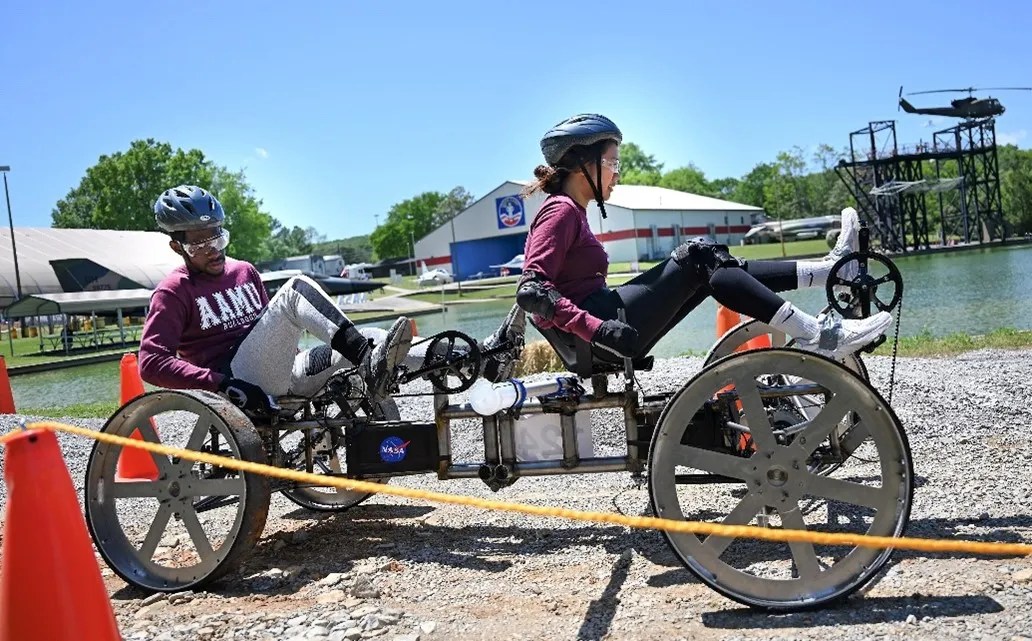
Image (Credit): Students at this year’s obstacle course at the U.S. Space & Rocket Center during NASA’s Human Exploration Rover Challenge event. (NASA)
NASA has selected 72 student teams to begin an engineering design challenge to build human-powered rovers that will compete next April at the U.S. Space & Rocket Center in Huntsville, Alabama, near the agency’s Marshall Space Flight Center. Celebrating its 30th anniversary in 2024, the Human Exploration Rover Challenge tasks high school, college, and university students to design, build, and test lightweight, human-powered rovers on an obstacle course simulating lunar and Martian terrain, all while completing mission-focused science tasks.
NASA is mobilizing the scientific community to ensure the agency’s next big space telescope will be ready to deliver a “big picture” view of the universe almost immediately after launching. The Nancy Grace Roman Telescope — also known as the Roman Space Telescope, or just Roman — is set to launch in 2027 and will view the cosmos with a staggeringly wide field of view. Its big-picture observations of distant and early galaxies could help scientists solve the mysteries of dark matter and dark energy. Collectively, this so-called dark universe accounts for 95% of the energy and matter in the cosmos, yet the true nature of dark matter and dark energy eludes scientists.
New plans have been revealed for a $2 billion research center run by UC Berkeley at the NASA Ames Center in Mountain View, Santa Clara County. The Berkeley Space Center, as it will be called, will reshape 36 acres on the sprawling Ames Research Center, providing a hub for future companies to collaborate with the school and NASA scientists & engineers to improve technology for aviation, space exploration, and how people live and work in space.
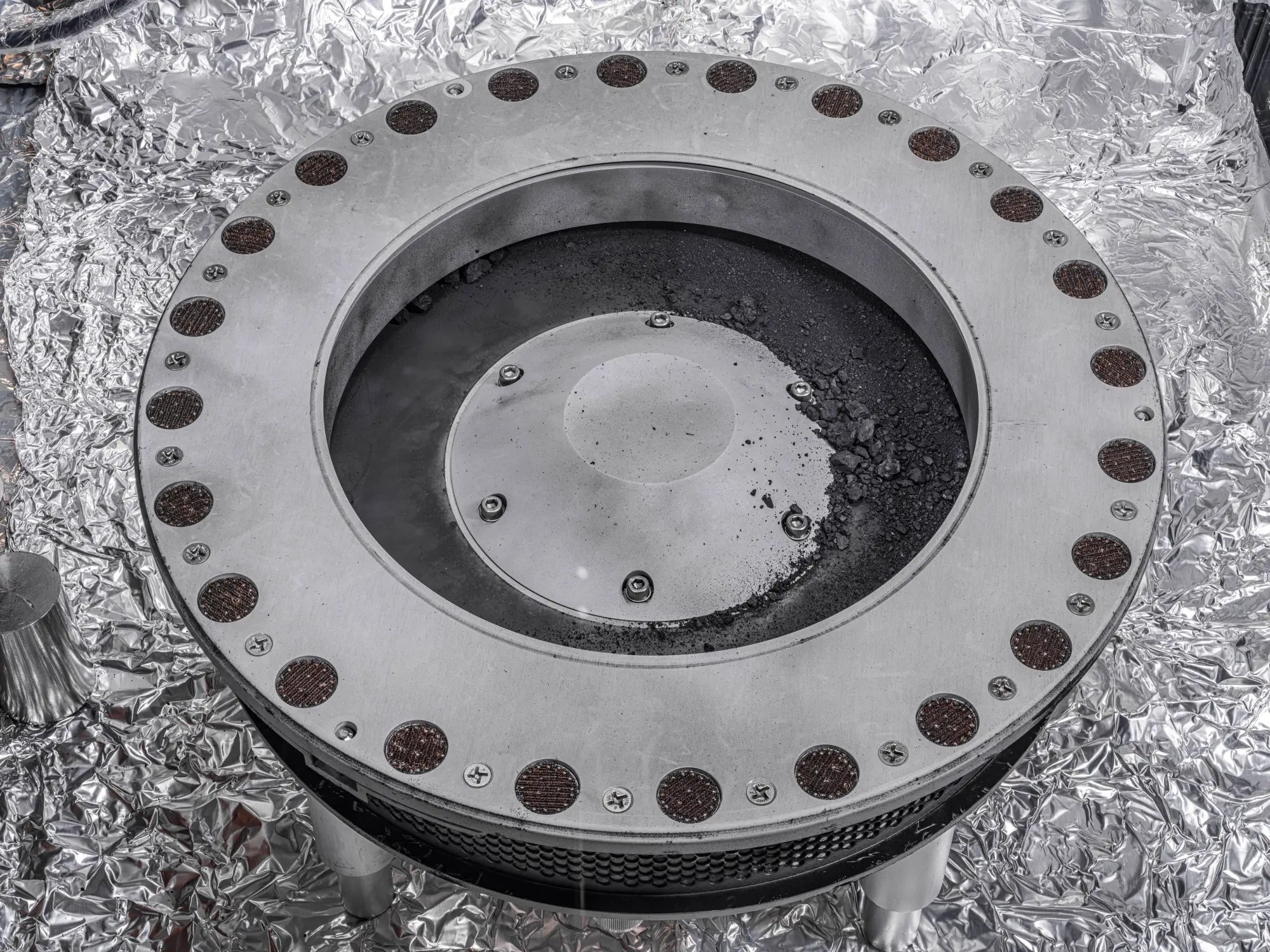
Image (Credit): Outside view of the OSIRIS-REx sample collector. You an see sample material from asteroid Bennu on the middle right. (NASA/Erika Blumenfeld & Joseph Aebersold)
“As we peer into the ancient secrets preserved within the dust and rocks of asteroid Bennu, we are unlocking a time capsule that offers us profound insights into the origins of our solar system…The bounty of carbon-rich material and the abundant presence of water-bearing clay minerals are just the tip of the cosmic iceberg. These discoveries, made possible through years of dedicated collaboration and cutting-edge science, propel us on a journey to understand not only our celestial neighborhood but also the potential for life’s beginnings. With each revelation from Bennu, we draw closer to unraveling the mysteries of our cosmic heritage.”
–Statement by Dante Lauretta, OSIRIS-REx principal investigator, regarding the recently-arrived sample collected from asteroid Bennu. NASA and its partners are expected to study the sample for the next two years to learn more about the asteroid and our solar system.
First, the US Government Accountability Office reported that NASA’s Space Launch System (SLS) is unaffordable, and now NASA’s Office of Inspector General (OIG) doubles down on that earlier finding, reporting that the SLS, a key component of the Artemis program, has costs that are spinning out of control.
Our analysis shows a single SLS Block 1B will cost at least $2.5 billion to produce—not including Systems Engineering and Integration costs—and NASA’s aspirational goal to achieve a cost savings of 50 percent is highly unrealistic. Specifically, our review determined that cost saving initiatives in several SLS production contracts such as reducing workforce within Boeing’s Stages contract and gaining manufacturing efficiencies with Aerojet Rocketdyne’s RS-25 Restart and Production Contract were not significant and, as a result, a single SLS will cost more than $2 billion through the first 10 SLS rockets produced under [the Exploration Production and Operations Contract].
NASA OIG concludes that maybe other contractors needs to be considered, stating:
Although Congress directed NASA in 2010 to build a heavy-lift rocket and crew capsule using existing contracts from the canceled Constellation effort to meet its space exploration goals, the Agency may soon have more affordable commercial options to carry humans to the Moon and beyond. In our judgment, the Agency should continue to monitor the commercial development of heavy-lift space flight systems and begin discussions of whether it makes financial and strategic sense to consider these options as part of the Agency’s longer-term plans to support its ambitious space exploration goals.
Where are these “more affordable commercial options”? Could it be SpaceX? Blue Origin? If so, let’s start the transition ASAP so that the Moon and Mars remain a realistic goal in the near future. We have plenty of talent in this country and a race to the top is what we need, not a space agency stuck with an Edsel rocket system.
It may be Friday the 13th, but the news has been positive about the Psyche spacecraft, which earlier today successfully launched from NASA’s Kennedy Space Center in Florida.
Here is part of a statement by Arizona State University Professor Lindy Elkins-Tanton, the Principal Investigator (PI) of the Psyche mission, from back in 2017 as she awaited word on whether the Psyche mission had been green-lighted by NASA:
I’ve only been working on this project for five and a half years. Some of my competitors have been through the process before with the same ideas, and are coming up on a decade of trying to fly their concept. Still, five and a half years. About 150 people have worked on this concept with me. We’ve written about 2,000 pages, including the step 1 and step 2 proposals and all the written, edited, revised, formatted, and published answers to questions that came in between. We have art and models and videos and new scientific and engineering results because of all our efforts to understand how to get to the metal world Psyche and what we might find if we did, and how we could measure it and send the information back to Earth and understand it and interpret it for everyone in the world.
To say our hearts are in this project would be too facile, too surficial, too trite. We have lived and breathed this. We know and love each other and we know each other’s families and we have learned when to be quiet and let the other person work through a peak of frustration late at night after no rest for weeks. We have sweated through countless reviews and celebrated with numerous cakes and dinners the many intermediate successes that allowed us to get here, the ultimate intermediate success, the privilege to wait for the phone call.
Here is PI Lindy Elkins-Tanton’s quote from earlier today:
We said ‘goodbye’ to our spacecraft, the center of so many work lives for so many years – thousands of people and a decade…But it’s really not a finish line; it’s a starting line for the next marathon. Our spacecraft is off to meet our asteroid, and we’ll fill another gap in our knowledge – and color in another kind of world in our solar system.
Congratulations to PI Lindy Elkins-Tanton and her team on a job well done (so far, of course).