Image (Credit): Artist’s rendering of Lucy near an asteroid. The two large discs are the solar arrays. (Southwest Research Institute)
NASA’s Lucy spacecraft continues to face some engineering issues as it travels away from Earth after the first of two flybys before it can reach the Trojan asteroids where it will begin its survey. While the earlier problems with deploying its solar array continue, the matter will most likely need to be resolved in 2024 when the spacecraft is closer to Earth again. Fortunately, the array is 98 percent deployed, so there is no risk to the 12-year mission at this time.
NASA will keep all of us posted. You can read more about the solar array issues here.
Image (Credit): Lucy’s orbital path (shown in green). (NASA)
Image (Credit): Artist’s rendering of NASA’s New Horizons spacecraft. (NASA/JHUAPL/SwRI)
On this day in 2006, NASA launched the New Horizons spacecraft from Cape Canaveral Space Force Station. The objective of the mission was to explore Pluto and the Kuiper Belt. In 2015, the spacecraft spent six months studying Pluto and its moons. New Horizons is now on an extended mission exploring other parts of the Kuiper Belt.
New Horizons flew past Pluto in 2015 and the Kuiper belt object (KBO) Arrokoth in 2019. In its second extended mission, New Horizons will continue to explore the distant solar system out to 63 astronomical units (AU) from Earth. The New Horizons spacecraft can potentially conduct multi-disciplinary observations of relevance to the solar system and NASA’s Heliophysics and Astrophysics Divisions. Additional details regarding New Horizons’ science plan will be provided at a later date.
Image (Credit): Pluto as seen by the New Horizons spacecraft (with enhanced color). (NASA/JHUAPL/SwRI)
After 30 years in orbit, mission operations for the joint NASA-JAXA Geotail spacecraft have ended, after the failure of the spacecraft’s remaining data recorder. Since its launch on July 24, 1992, Geotail orbited Earth, gathering an immense dataset on the structure and dynamics of the magnetosphere, Earth’s protective magnetic bubble. Geotail was originally slated for a four-year run, but the mission was extended several times due to its high-quality data return, which contributed to over a thousand scientific publications. While one of Geotail’s two data recorders failed in 2012, the second continued to work until experiencing an anomaly on June 28, 2022. After attempts to remotely repair the recorder failed, the mission operations were ended on November 28, 2022.
Astronomers have released a gargantuan survey of the galactic plane of the Milky Way. The new dataset contains a staggering 3.32 billion celestial objects—arguably the largest such catalog so far. The data for this unprecedented survey were taken with the Dark Energy Camera, built by the US Department of Energy, at the NSF’s Cerro Tololo Inter-American Observatory in Chile, a Program of NOIRLab.
While much of the world’s press recently focused on Virgin Orbit’s failed ‘horizontal’ aircraft launch of a batch of 9 small satellites from Spaceport Cornwall, other rivals are gearing up to tap into the growing demand for satellite launches. Sweden has claimed the crown as “mainland Europe’s first orbital launch site”. Ursula von der Leyen, President of the European Commission, helped cut the ribbon at Kiruna, Sweden, saying: “This spaceport offers an independent European gateway to space. It is exactly the infrastructure we need, not only to continue to innovate but also to further explore the final frontier.”
Image (Credit): Artist’s rendering of exoplanet TOI-700e. (NASA/JPL-Caltech/Robert Hurt)
The search for another Earth continues, and a professor from Michigan State may have found a perfect candidate. Joey Rodriguez, an assistant professor in MSU’s Department of Physics and Astronomy, was working with researchers involved with NASA’s Transiting Exoplanet Survey Satellite (TESS) when the discovery was made. Since being launched in 2018, the TESS spacecraft is surveying 200,000 stars looking for exoplanets that transit in front of their parent star and thereby periodically block part of the star’s light.
Back in 2020, the TESS team spotted the 100 light-year distant solar system and three exoplanets, but the latest finding includes Earth-size TOI-700e, which orbits in the habitable zone around parent star TOI-700. Its orbit is closer to that of Venus than Earth, yet still within the habitable zone.
In the Lansing State Journalarticle reporting the finding, Emily Gilbert, a postdoctoral fellow at NASA’s Jet Propulsion Laboratory in Southern California leading the project, stated:
This is one of only a few systems with multiple, small, habitable-zone planets that we know of,…That makes the TOI-700 system an exciting prospect for additional follow-up.
A closer look at the planet’s atmosphere will tell scientists more about the likelihood of life on the surface. Maybe this will be another candidate for the James Webb Space Telescope (JWST). The JWST has already probed other exoplanets to learn more about their atmosphere.
You can learn more about the new exoplanet at this NASA link.
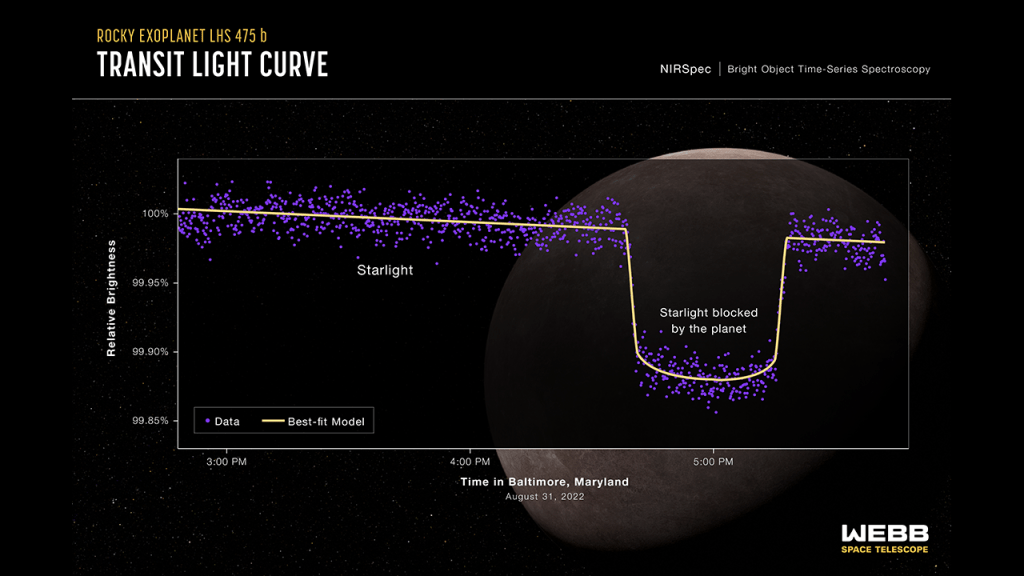
Researchers confirmed an exoplanet, a planet that orbits another star, using NASA’s James Webb Space Telescope for the first time. Formally classified as LHS 475 b, the planet is almost exactly the same size as our own, clocking in at 99% of Earth’s diameter. The research team is led by Kevin Stevenson and Jacob Lustig-Yaeger, both of the Johns Hopkins University Applied Physics Laboratory in Laurel, Maryland.
Russia will send up a new capsule next month to bring back three space station crew members whose original ride home was damaged, officials said Wednesday. The two Russians and one American will stay several extra months at the International Space Station as a result of the capsule switch, possibly pushing their mission to close to a year, NASA and Russian space officials told reporters.
In the space around Jupiter, a torus of plasma created and fed by Io’s volcanic emissions grew significantly richer between July and September of last year and persisted until December, showing the moon underwent a spate of volcanic activity that released a huge amount of material. For something that’s just a little bit bigger than Earth’s Moon, Io is an absolute beast of volcanism. It’s bristling with volcanoes, with around 150 of the 400 known volcanoes erupting at any given time, creating vast lakes of molten lava.