Source/Credit: NASA, ESA, and N. Da Rio (University of Virginia); Processing: Gladys Kober (NASA/Catholic University of America).
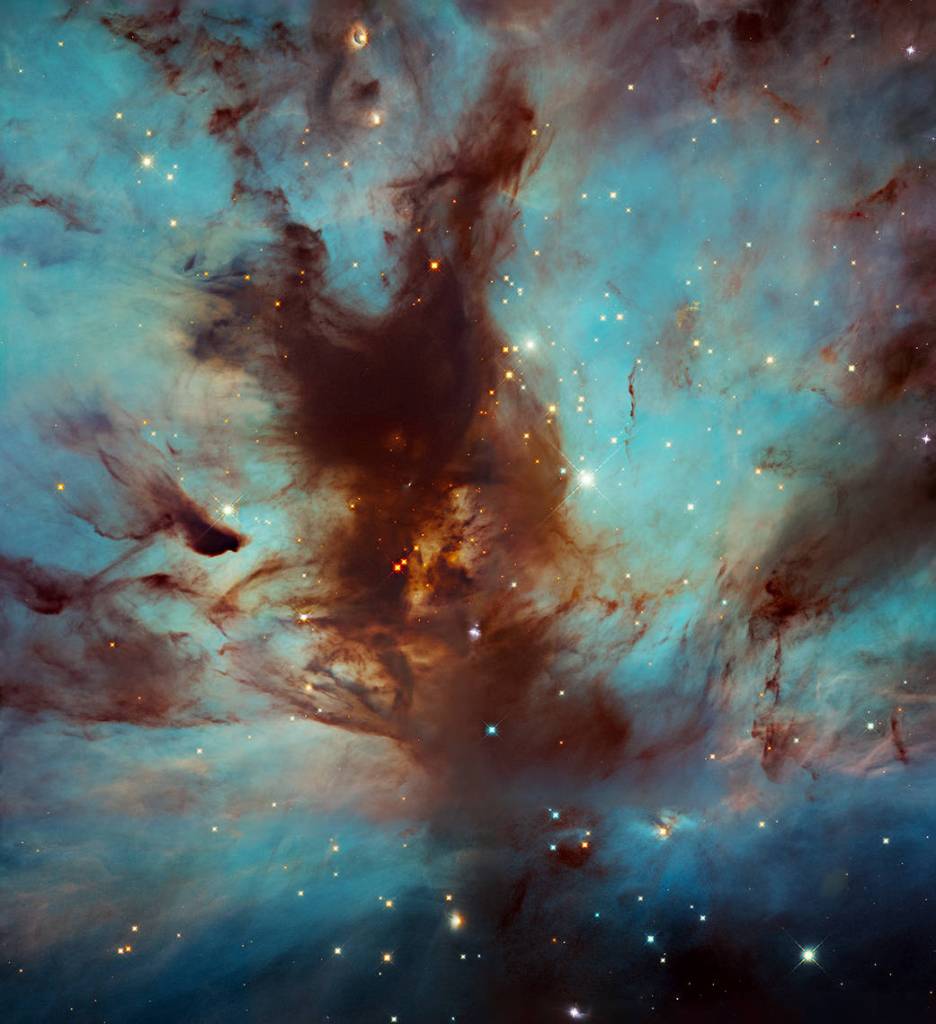
This week’s image from the Hubble Space Telescope shows the Flame Nebula in the constellation Orion, as explained by NASA:
The Flame Nebula, also called NGC 2024, is a large star-forming region in the constellation Orion that lies about 1,400 light-years from Earth. It’s a portion of the Orion Molecular Cloud Complex, which includes such famous nebulae as the Horsehead Nebula and Orion Nebula. This image focuses on the dark, dusty heart of the nebula, where a star cluster resides, mostly hidden from view. Nearby (but not visible in this image) is the bright star Alnitak, the easternmost star in the Belt of Orion. Radiation from Alnitak ionizes the Flame Nebula’s hydrogen gas. As the gas begins to cool from its higher-energy state to a lower-energy state, it emits energy in the form of light, causing the visible glow behind the swirled wisps of dust.
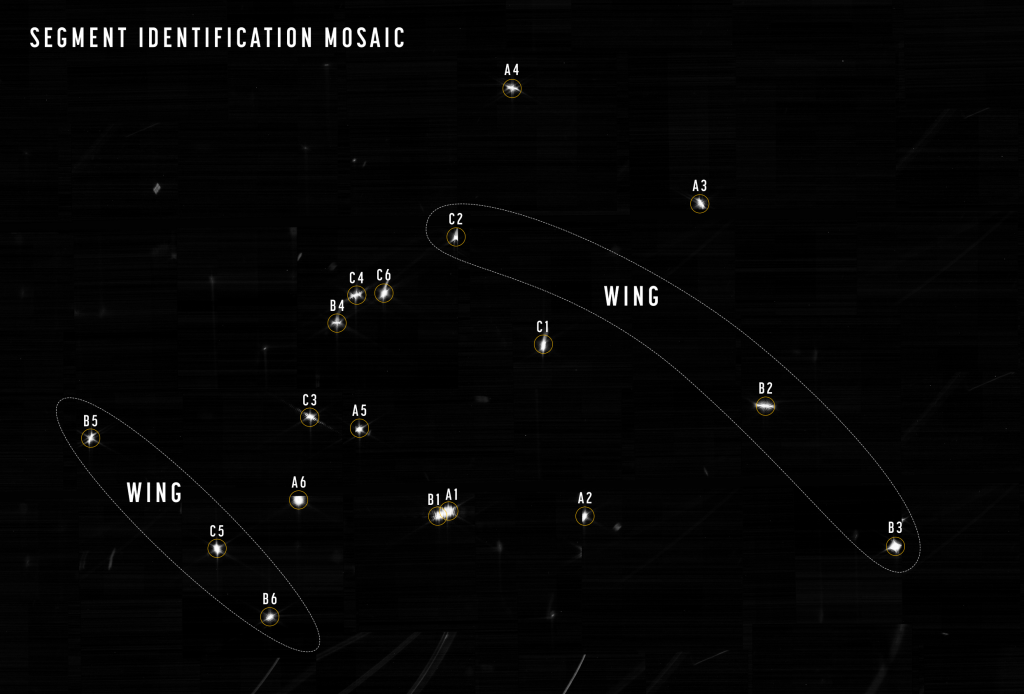
NASA has shared the first images from the James Webb Space Telescope (JWST), which includes the selfie of the 18-part mirror shown above. The space telescope is still aligning these mirror segments before prime time, so we will probably see more selfies and related shots for the time being, such as the images below (one labeled) showing the 18 segment views of one star that will eventually become one view of one star.
Keep these raw images in mind once we start to see mind-blowing images from the JWST. This amazing device is just getting started. The first of these images should start to appear this summer.
Source/Credit: Galaxy cluster (described below) from NASA.
The image above is from the Hubble Space Telescope and shared on NASA’s site last month under the title “Hubble Spots a Starship-Shaped Galactic Pair.” While the author of the story below seesthe USS Enterprise from Star Trek, I see a decloaking Klingon Bird-of-Prey. Here is the full description from NASA:
The subject of this image is a group of three galaxies, collectively known as NGC 7764A. They were imaged by the NASA/ESA Hubble Space Telescope, using both its Advanced Camera for Surveys (ACS) and Wide Field Camera 3 (WFC3). The two galaxies in the upper right of the image appear to be interacting with one another — indeed, the long trails of stars and gas extending from them both give the impression that they have both just been struck at great speed, thrown into disarray by the bowling-ball-shaped galaxy to the lower left of the image. In reality, however, interactions between galaxies happen over very long time periods, and galaxies rarely collide head-on with one another. It is also unclear whether the galaxy to the lower left is actually interacting with the other two, although they are so relatively close in space that it seems possible that they are. By happy coincidence, the collective interaction between these galaxies have caused the two on the upper right to form a shape, which from our Solar System’s perspective, ressembles the starship known as the USS Enterprise from Star Trek!
NGC 7764A, which lies about 425 million light years from Earth in the constellation Phoenix, is a fascinating example of just how awkward astronomical nomenclature can be. The three galaxies are individually referred to as NGC 7764A1, NGC 7764A2 and NGC 7764A3, and just to be really difficult, an entirely separate galaxy, named NGC 7764, sits in the skies about a Moon’s distance (as seen from Earth) away. This rather haphazard naming makes more sense when we consider that many of the catalogues for keeping track of celestial bodies were compiled well over 100 years ago, long before modern technology made standardising scientific terminology much easier. As it is, many astronomical objects have several different names, or might have names that are so similar to other objects’ names that they cause confusion.
“No competent thinker [can] maintain any single nebula to be a star system of coordinate rank with the Milky Way.”
–Agnes Mary Clerke, Irish astronomer, founding member of the British Astronomical Association, and honorary member of the Royal Astronomical Society, commenting in 1890 on the likelihood that other galaxies existed beyond the Milky Way. This comment was captured in an excellent article from the July 31, 2021 Science News, “A Century of New Worlds,” which discusses discoveries in astronomy over the last 100 years. The article also notes that it was the work of another female astronomer, Henrietta Leavitt, that helped to eventually prove the existence of other galaxies.
Extra: A crater on the Moon is named after astronomer Agnes Mary Clerke (shown below).
Source/Credit: Clerke crater from NASA’s Apollo 17.
With all the previous posts about NASA’s Artemis mission, I should have outlined the three stages ahead as we return to the Moon:
Artemis I: This stage involves an uncrewed flight test around the Moon. The new Space Launch System carrying the empty Orion spacecraft will launch from NASA’s Kennedy Space Center in Florida. The mission will last from four to six weeks. The European Space Agency has supplied a key piece for this mission – a service module, which will supply the spacecraft’s main propulsion system and power (and also house air and water for astronauts on future missions).
Artemis II: This next stage will confirm all of the Orion spacecraft’s systems operate as designed with crew aboard in the actual environment of deep space as the spacecraft circles the Moon. The mission is expected to last just over 10 days
Artemis III: This third and final stage will land a crew on the surface of the Moon. NASA has awarded Human Landing System contracts to Blue Origin, Dynetics, and SpaceX. This final stage will be followed by annual crewed missions to the Moon.
The ultimate goal of Artemis is to establish a presence on the Moon as well as build an orbiting Gateway that can serve as a multi-purpose outpost providing essential support for long-term human return to the lunar surface. The Gateway will also serve as a staging points for deep space exploration, such as travel to Mars.
This is a broad and hopeful mission. The only thing that seems a bit odd is the website mission statement for Artemis:
With Artemis missions, NASA will land the first woman and first person of color on the Moon, using innovative technologies to explore more of the lunar surface than ever before. We will collaborate with commercial and international partners and establish the first long-term presence on the Moon. Then, we will use what we learn on and around the Moon to take the next giant leap: sending the first astronauts to Mars.
I think the first focus of this multi-billion dollar lunar mission should be space exploration, which should also include a diverse crew. Maybe it is better to stick to the more universal statement in the earlier Artemis Plan:
Under the Artemis program, humanity will explore regions of the Moon never visited before, uniting people around the unknown, the never seen, and the once impossible. We will return to the Moonrobotically beginning next year, send astronauts to the surface within four years, and build a longterm presence on the Moon by the end of the decade…we will use the Moon as the stepping stone for our next greatest leap—human exploration of Mars.
You say potato and I say spuds.
Source/Credit: Artemis I mission map from NASA.
Note: NASA’s Artemis page was somewhat out of date when I posted this summary. For instance, in April 2021, SpaceX was chosen to provide the lunar lander.
Update: On March 31st, NASA announced it was looking for “…other U.S. companies to provide new lander development and demonstration missions from lunar orbit to the surface of the Moon.”