This week’s photo is from the Planetary Society’s Year in Pictures collection. The photo shows NASA’s latest Mars rover, Perseverance, as well as the helicopter Ingenuity in the background (hard to see at first). A better image of the helicopter is provided below. The rover landed on Mars in February 2021 at the Jezero Crater and has been conducting science ever since that time. NASA plans to send some of the Perseverance’s soil samples back to Earth for more study. You can learn more about this Mars mission here.
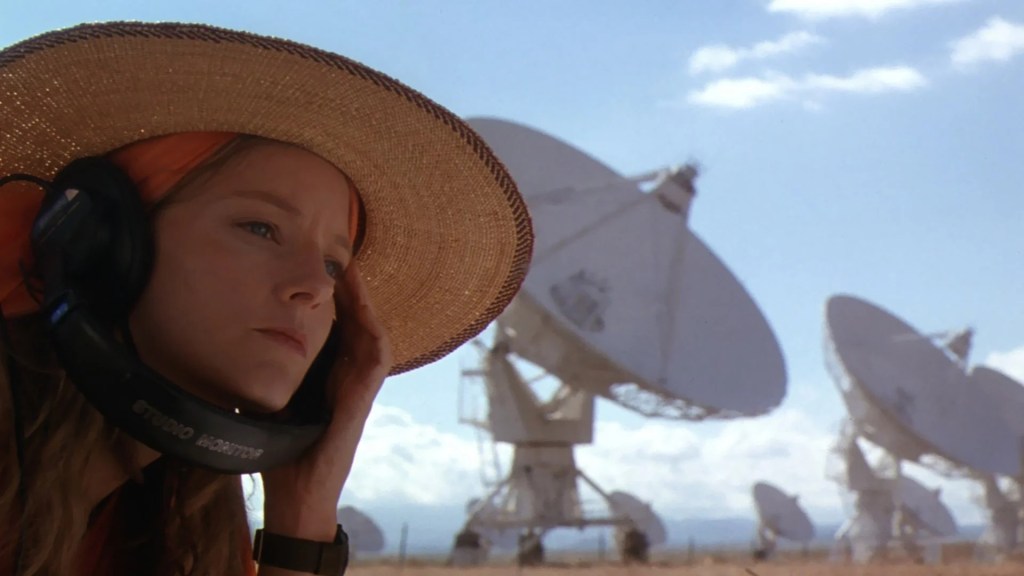
Years ago, two spacecraft exited our solar system at about 35,000 miles per hour with a message to anyone who finds them detailing our location in the galaxy, the beauty of the Earth, and our culture in terms of warm wishes, music, and natural sounds. Crafted by Carl Sagan and others, the golden discs or records placed on Voyager I and II also contains instructions on how to read the material. And thanks to the site Open Culture, we can learn more about how one would unravel these instructions. It reminds me of Jodie Foster’s character in the movie Contact as she tried to interpret signals being received from afar. I recommend you check out the two videos that are part of the “How to Decode NASA’s Message to Aliens” page.
Source: Jodie Foster in Contact from Warner Bros. Pictures.
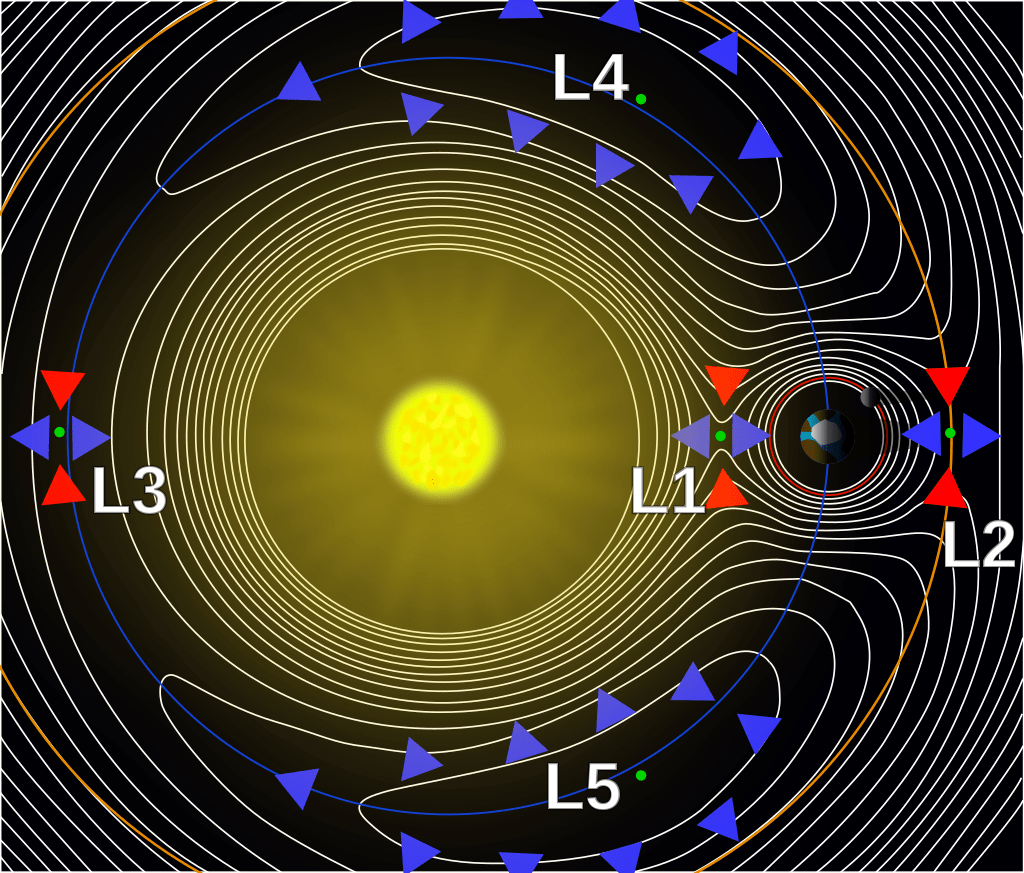
Now that the James Webb Space Telescope (JWSP) has deployed its 21-foot, gold-coated primary mirror, it is in good shape as it heads for the Sun-Earth’s second Lagrange point, known as L2, which is nearly 1 million miles from Earth. However, it will not be the first spacecraft to park in this spot to conduct a scientific mission.
I looked around to get a good inventory of what was operating, and will be operating, at L2 when JWST arrives and found the best listing on Wikipedia. Here is the inventory:
From 2003 to 2004: NASA’s WIND studied radio waves and plasma that occur in the solar wind and in the Earth’s magnetosphere (now in L1).
From 2009 to 2013: The European Space Agency’s (ESA) Herschel Space Observatory sifted through star-forming clouds to trace the path by which potentially life-forming molecules, such as water, form.
From 2009 to 2013: The ESA’s Planck spacecraft observatory mapped the anisotropies of the cosmic microwave background at microwave and infrared frequencies, with high sensitivity and small angular resolution.
From 2011 to 2012: Chinese National Space Programs’s Chang’e 2 tested the Chinese tracking and control network (after first serving as a lunar probe).
Current missions at L2:
Since 2014: The ESA Gaia probe has been measuring the positions, distances and motions of stars, with a mission to construct a 3D space catalog containing approximately 1 billion astronomical objects (stars, planets, comets, asteroids, quasars, and more).
Since 2019: The joint Russian-German high-energy astrophysics observatory Spektr-RG has been conducting a seven-year X-ray survey, the first in the medium X-ray band less than 10 keV energies, and the first to map an estimated 100,000 galaxy clusters.
Of course, there are future missions planned for L2, and plenty of craft operating in L1, L4, and L5. That will be a story or two for another time.
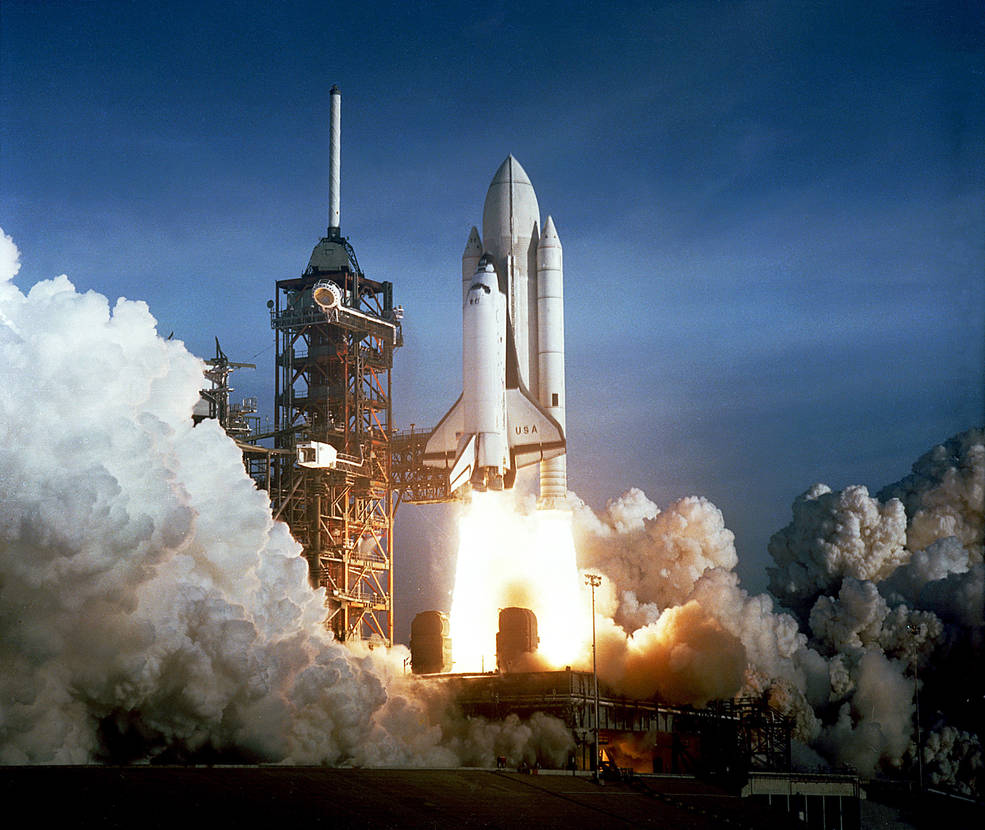
Source: NASA imagine showing Space shuttle Columbia lifting off from Launch Pad 39A on April 12, 1981, to begin STS-1.
Earlier his week NASA highlighted the 50 year anniversary of President Nixon’s decision to initiate a space shuttle program to follow the success of the Apollo Moon missions. The story states:
In January 1972, he directed NASA to develop and build a reusable space transportation system, commonly known as the space shuttle. The reusability of the shuttle’s components was expected to provide regular access to space to many customers, while at the same time reducing costs.
The space shuttle was proposed by the National Aeronautics and Space Council, which also proposed a trip to Mars. The Council’s report states:
As a focus for the development of new capability, we recommend the United States accept the long-range option or goal of manned planetary exploration with a manned Mars mission before the end of this century as the first target.
While the space shuttle was eventually operational by 1981, we still await a clear timeline for a trip to Mars. NASA said it will start with a trip back to the Moon first. Let’s hope we do not need to wait another 50 years before a manned trip to Mars.
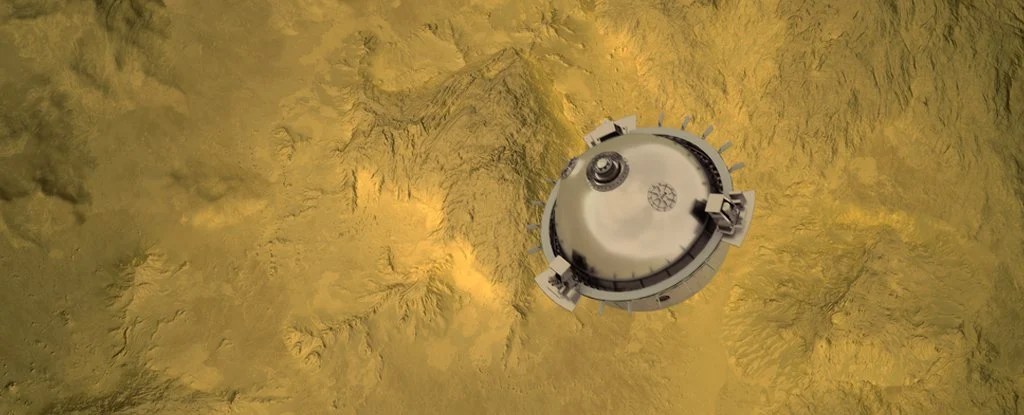
Source: Sciencealert.com webpage – “We’re Going Back to Venus! NASA Announces Two New Missions by 2030.”
Before we get too far into 2022, it is worth considering some of the top astronomy stories from 2021. Space.com put together a nice list that I highlighted below.
Discovery of Comet Bernardinelli-Bernstein: “…It may be 10 times wider and 1,000 times more massive than a typical comet.”
Amateur astronomer discovers a new moon around Jupiter: “The new moon, called EJc0061, belongs to the Carme group of Jovian moons.”
NASA will return to Venus this decade: “…NASA has not launched a dedicated mission to the planet since 1989.”
The sun is reawakening: “In early November, for instance, a series of solar outbursts triggered a large geomagnetic storm on our planet.”
James Webb Space Telescope flies into space: “…JWST is heading to an observational perch located about a million miles from our planet.”
Event Horizon Telescope takes high-resolution image of black hole jet: “The end result is a resolution that is 16 times sharper and an image that is 10 times more accurate than what was possible before.”
Scientists spot the closest-known black hole to Earth: “Just 1,500 light-years from Earth…”
Earth’s second ‘moon’ flies off into space: “…the object, known as 2020 SO, is a leftover fragment of a 1960s rocket booster from the American Surveyor moon missions.”
Parker Solar Probe travels through the sun’s atmosphere: “The probe managed to get as low as 15 solar radii, or 8.1 million miles (13 million km) from the sun’s surface.”
Perseverance begins studying rocks on Mars: “Perseverance is taking its observations from the 28-mile-wide (45 kilometers) Jezero Crater, which was home to a river delta and a deep lake billions of years ago.”
Visit the Space.com website for more details on each of these astronomy science stories.