NASA and MIT Found More Than 5,000 Exoplanet Candidates

Source: NASA’s TESS.

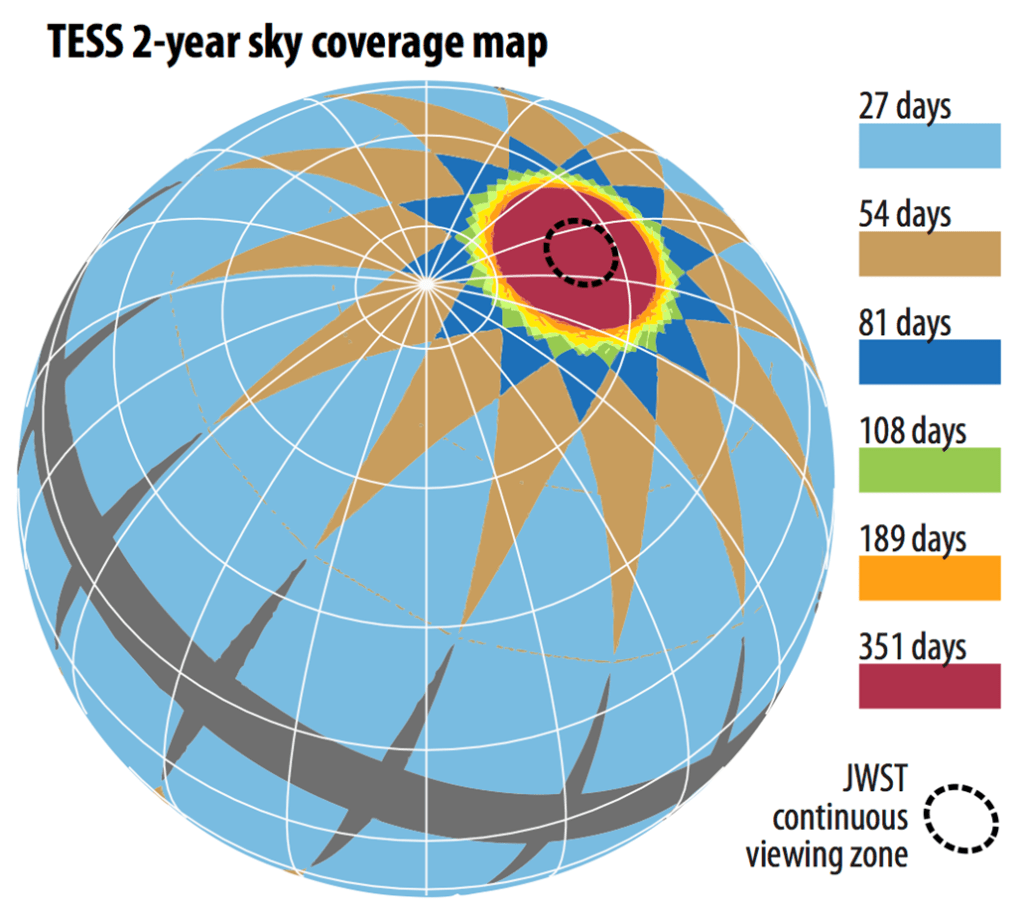
The volume of possible new worlds continues to expand with the work of the MIT-led NASA mission to observe the heavens for potential exoplanet candidates. Since 2018, the Transiting Exoplanet Survey Satellite (TESS) program has been monitoring stars for temporary drops in brightness caused by planetary transits (the mapping of the initial two years of viewing is provided above). With the addition of new candidates from July 2020 to June 2021, the count of potential exoplanets now exceeds 5,000. Potential candidates will be studied to learn more about their characteristics. TESS’s mission goal has been to discover 50 planets of size less than 4 Earth radii with measured masses.

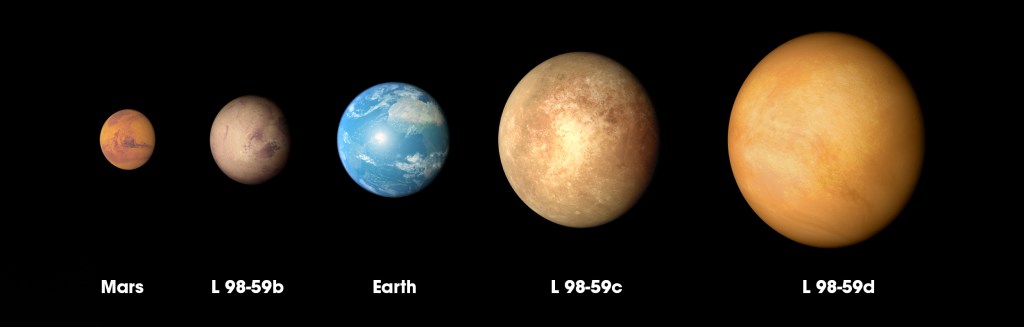
You can read more about some of TESS’s earlier exoplanet discoveries (shown below and here). For instance, L 98-59b is about 80 percent Earth’s size and orbits L 98-59, an M dwarf about one-third the mass of the Sun. L98-59 is about 35 light-years away. 

Source: NASA’s TESS.

NASA’s Travel Agency

Source: NASA’s Jet Propulsion Laboratory.

If you are getting tired of staying home these days, NASA has some fun destinations in mind for you. Late last year, NASA’s Jet Propulsion Laboratory (JPL) put together “Visions of the Future” to show you where the space agency hopes to go someday. You may not want to pack just yet, but whether it is this solar system or some other solar system, NASA wants to help.

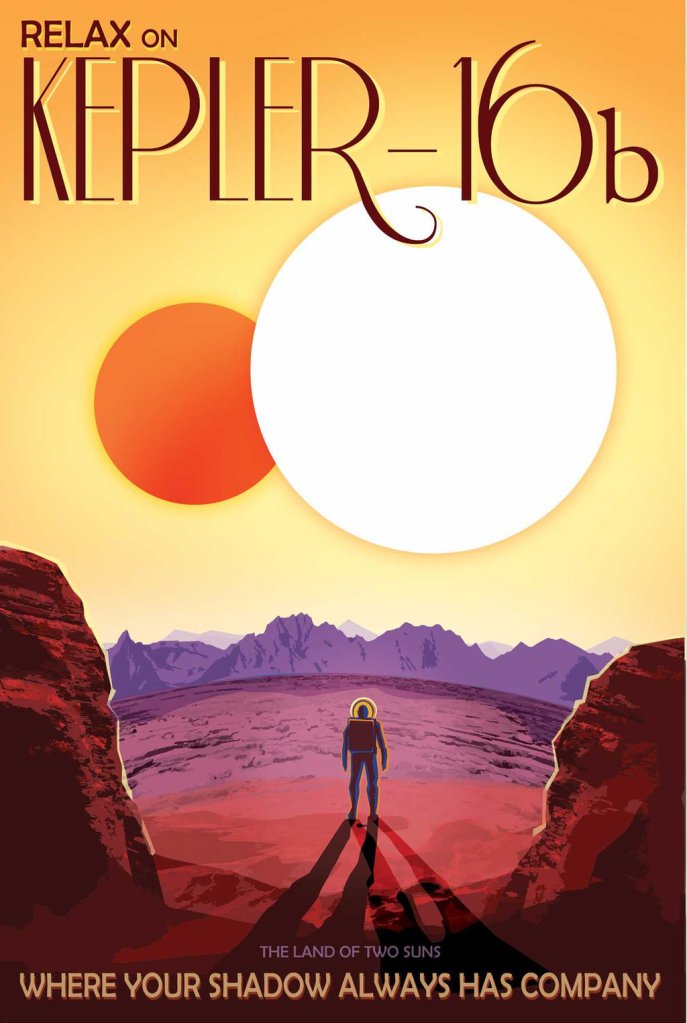
The poster above for Kepler-16b comes with this enticing description:

Like Luke Skywalker’s planet “Tatooine” in Star Wars, Kepler-16b orbits a pair of stars. Depicted here as a terrestrial planet, Kepler-16b might also be a gas giant like Saturn. Prospects for life on this unusual world aren’t good, as it has a temperature similar to that of dry ice. But the discovery indicates that the movie’s iconic double-sunset is anything but science fiction.

You might also enjoy this NASA video showing some space activities in these prime locations.

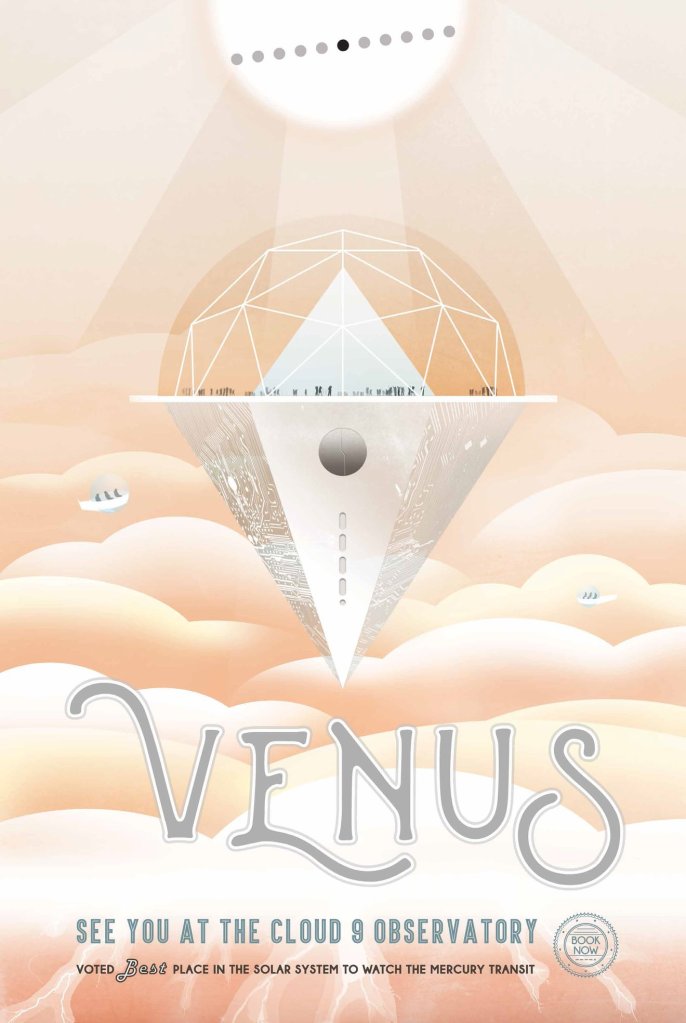
I dropped in a few more posters below, but be sure to check out all of them. A big thanks also to the folks at JPL for these fun images. The 14 posters were created by nine artists, designers, and illustrators.

Of course, these free photos are already being sold on Etsy.com and elsewhere as posters and t-shirts.

Source: NASA’s Jet Propulsion Laboratory.

Dead End: No Life Found in Martian Rock

Source: Meteorite from The Guardian.

A 4-billion-year-old meteorite from Mars did not show any signs of life, according to The Guardian newspaper. That said, the 4-pound rock found in Antarctica in 1984 that presumably broke off of Mars’ surface billions of years ago does have compounds that could lead to life.

More samples should be on their way if NASA’s Perseverance Rover mission on Mars can assist with the return of Martian samples back here to Earth for additional study. So there is still hope that we will find more interesting results down the road.

Extra: The origin (now debunked) story on this rock from a NASA research team of scientists at the Johnson Space Center, Houston, TX, and at Stanford University, Palo Alto, CA, was titled “Meteorite Yields Evidence of Primitive Life on Early Mars.”

Source: Mars from NASA

Is the U.S. Running Low on Astronauts?

Source: NASA OIG.

Does NASA need more astronauts than it has for upcoming missions? The Office of Inspector General’s (OIG) office believes NASA may have a problem. In a January 11, 2022 OIG report, NASA’s Management of its Astronaut Corps, the auditors found:

The processes NASA uses to size, train, and assign astronauts to specific missions are primarily calibrated toward meeting the current needs of the [International Space Station]. For example, NASA’s process for sizing the astronaut corps is designed to ensure that a sufficient number of astronauts are available to meet the Agency’s flight manifest needs, which includes maintaining a planned crew of between three and four astronauts on the Station over the next 5 years. However, the astronaut corps is projected to fall below its targeted size or minimum manifest requirement in fiscal year (FY) 2022 and FY 2023 due to attrition and additional space flight manifest needs. More concerning, the Astronaut Office calculated that the corps size would exactly equal the number of flight manifest seats NASA will need in FY 2022. As a result, the Agency may not have a sufficient number of additional astronauts available for unanticipated attrition and crew reassignments or ground roles such as engaging in program development, staffing Astronaut Office leadership and liaison positions, and serving as spokespeople for the Agency. In light of the expanding space flight opportunities anticipated for the Artemis missions, the corps might be at risk of being misaligned in the future, resulting in disruptive crew reorganizations or mission delays.

The real point it that bad human resource management may lead to mission delays, including the Artemis lunar landing mission. So what does the OIG recommend? The report states:

To ensure the training process for future Artemis missions is developed with sufficient time for implementation and revision, the Director of the Flight Operations Directorate and the Chief of the Astronaut Office should coordinate with Artemis program offices to complete the development and chartering of the framework of Artemis boards and panels to ensure alignment with future mission training needs for new vehicles and missions, including Orion, next-generation spacesuits, [human landing system], and Gateway.

NASA management agreed with all four recommendations in the OIG report aimed at resolving this shortage issue. I know these back office management issues can be dry, but without a solid pipeline of talent into the space program we will simply have a diminished program. Luckily, the auditors are doing their job and alerting management. Now is it NASA’s job to turn all of this around.