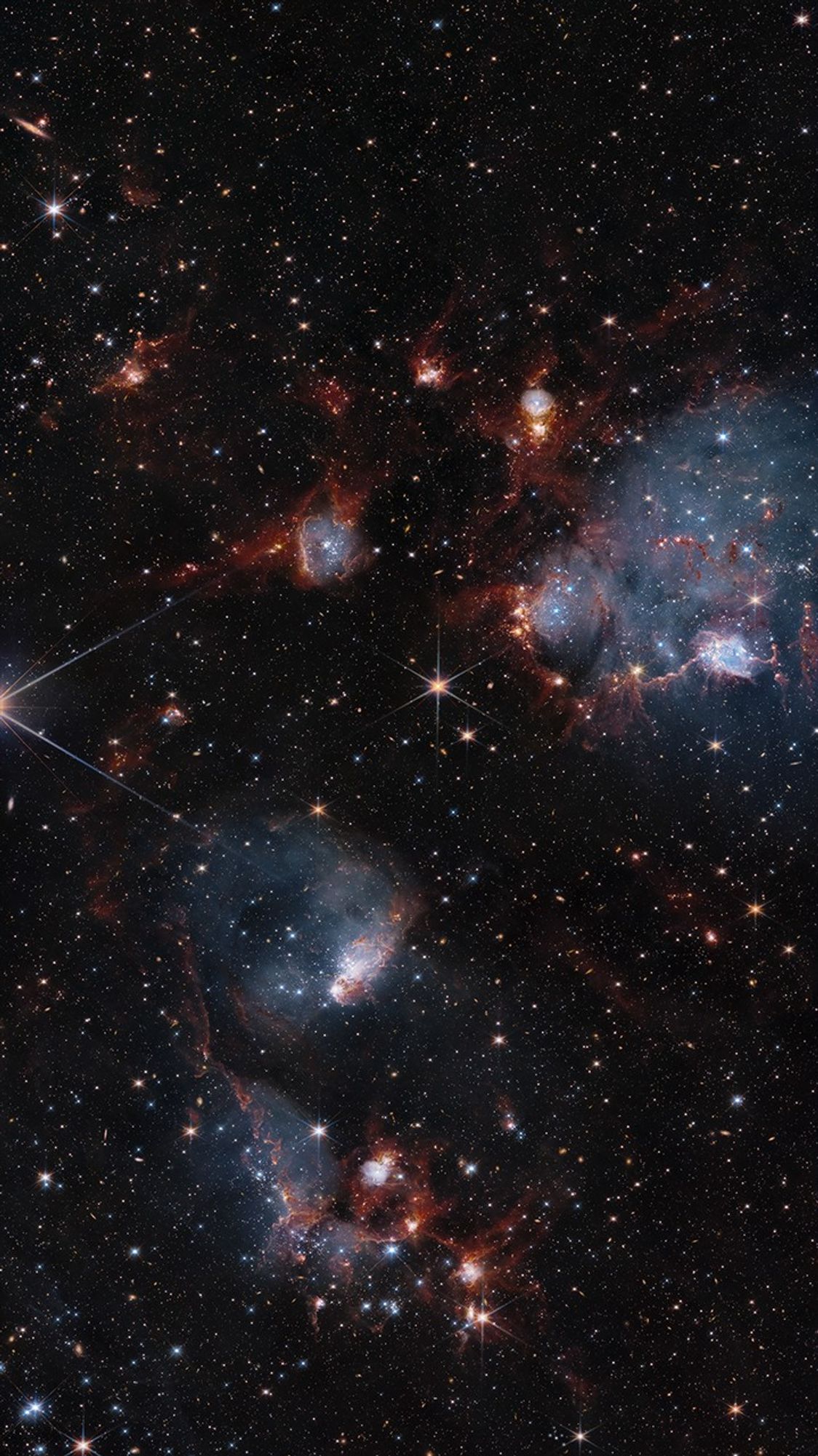
I’m glad to hear that NASA is working with Netflix to expand the amount of space stories available to the public.
This summer Netflix will make NASA+ live programming available to its customers, meaning more of the public can watch interviews with astronauts, the launch of space missions, and the happenings aboard the International Space Station (ISS). NASA also has plenty of entertaining videos about astronomy, various space missions, and more.
Of course, all of this is already available to the public for free on NASA’s website, but maybe this can draw in those eager viewers searching around for something to watch and not already aware of the website.
Any attempts to bring more attention to NASA’s amazing science and ongoing discoveries is good publicity as well as great programming.
Even if you cannot attend the protest on Monday, the site notes:
If you would rather not join this protest then there are still ways you can help. Please absolutely flood your representatives in Congress with pleas to save NASA. When you do, drive home the point that the cuts are happening now! Most of Congress seems to think that they will save NASA if they work out a budget for the coming fiscal year that funds NASA at previous levels. They don’t realize that NASA’s acting administrator, under pressure from the White House, OMB, and DOGE, are enacting “realignments” and cuts now. So please please please tell Congress that every day our nation is losing dedicated and brilliant career civil servants, contractors, and programs, that NASA is being fed into the woodchipper now. Congress must act immediately to save NASA, not wait for October 1!
Image (Credit): JWST image subtracting light from the star TWA 7 (marked with a circle and a star symbol) to highlight the exoplanet identified as TWA 7 b. (NASA, ESA, CSA, Anne-Marie Lagrange (CNRS, UGA), Mahdi Zamani (ESA/Webb))
The James Webb Space Telescope (JWST ) continues to amaze us with its discoveries. It has now captured the image of an exoplanet with the mass of Saturn orbiting star TWA 7, representing the first exoplanet captured by JWST in this way. TWA 7 is a young red dwarf star located about 34 light-years away.
JWST used its Mid-Infrared Instrument (MIRI) coronograph to mask the light of the star so that the light from orbiting exoplanets could be detected. Astronomers are pretty confident that what they are seeing is an orbiting planet rather than a star or galaxy in the background. For example, the smaller orange orb on the left represents a background star.
Anne-Marie Lagrange, CNRS researcher at the Observatoire de Paris-PSL and Université Grenoble Alpes in France as well as lead author of the Nature paper, stated.
Our observations reveal a strong candidate for a planet shaping the structure of the TWA 7 debris disk, and its position is exactly where we expected to find a planet of this mass.
NASA’s investments are paying off as we attempt to learn more about this strange universe of ours. Hopefully, members of Congress are paying attention.
Image (Credit): The arrow indicates the impact site for ispace’s Resilience lunar lander, as seen by the Lunar Reconnaissance Orbiter Camera on June 11, 2025. (NASA/Goddard/Arizona State University)
It doesn’t look like much, but NASA’s Lunar Reconnaissance Orbiter recently spotted the small crater made by the crashed ispace lunar lander named Resilience. The Japanese lander crashed on the Moon’s surface earlier this month after the company’s second try at a lunar landing.
The Moon is littered with debris and pockmarks from various successful and failed missions. The Apollo crew alone left enormous amounts of trash, debris, and space equipment scattered around the Moon. The Russians also left quite a bit of space equipment on the Moon many years ago, as well as its most recent Luna-25 mission, which crash-landed.
We can only hope that the Artemis mission will soon enough be adding to the equipment on the Moon without the drama of crash landings.
Georgia Tech scientists have uncovered evidence that a mountain on the rim of Jezero Crater — where NASA’s Perseverance Rover is currently collecting samples for possible return to Earth — is likely a volcano. Called Jezero Mons, it is nearly half the size of the crater itself and could add critical clues to the habitability and volcanism of Mars, transforming how we understand Mars’ geologic history. The study, “Evidence for a composite volcano on the rim Jezero crater on Mars,” was published this May in the Nature-family journal Communications Earth & Environment, and underscores how much we have left to learn about one of the most well-studied regions of Mars.
Due to its diffuse nature, roughly half of ordinary matter in the universe went unaccounted for and had been considered “missing”—until now. In a new study in Nature Astronomy, a team of astronomers at Caltech and the Center for Astrophysics | Harvard & Smithsonian (CfA) has, for the first time, directly detected and accounted for all the missing matter. To do this, the team used brief, bright radio flashes in the distant cosmos, called fast radio bursts (FRBs), to illuminate the matter lying between the FRBs and us. “The FRBs shine through the fog of the intergalactic medium, and by precisely measuring how the light slows down, we can weigh that fog, even when it’s too faint to see,” says Liam Connor, assistant professor at Harvard and lead author of the study, who performed much of the work while a Caltech research assistant professor working with Vikram Ravi, assistant professor of astronomy at Caltech.
Members of the House and Senate called in the White House to promptly offer a new candidate for NASA administrator after the surprise withdrawal of Jared Isaacman’s nomination. In briefings organized by the Aerospace Industries Association June16, representatives of House and Senate delegations to the Paris Air Show said it was critical that the agency get permanent leadership as it deals with potential significant cuts to its budget in the coming fiscal year.