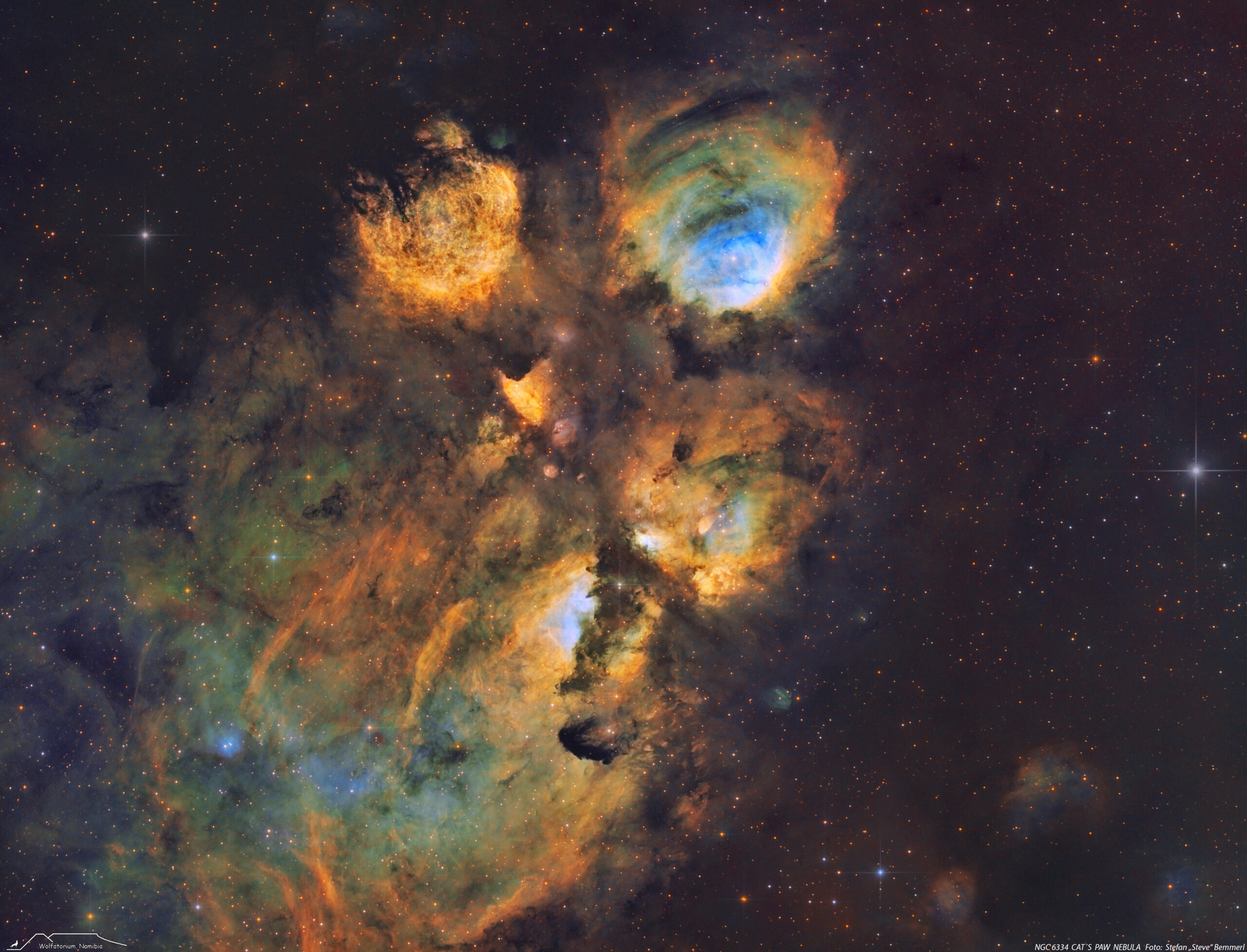
Image (Credit): The Cat’s Paw Nebula. (Stefan Steve Bemmerl & Team Wolfatorium, Hakos/Namibia)
This week’s image is from NASA’s Astronomy Picture of the Day website. It was the picture of the day for May 10, 2022. This is the story that goes with the image:
Nebulas are perhaps as famous for being identified with familiar shapes as perhaps cats are for getting into trouble. Still, no known cat could have created the vast Cat’s Paw Nebula visible toward the constellation of the Scorpion (Scorpius). At 5,500 light years distant, Cat’s Paw is an emission nebula with a red color that originates from an abundance of ionizedhydrogen atoms. Alternatively known as the Bear Claw Nebula and cataloged as NGC 6334, stars nearly ten times the mass of our Sun have been born there in only the past few million years. Pictured here is a deep field image of the Cat’s Paw Nebula in light emitted by hydrogen, oxygen, and sulfur.
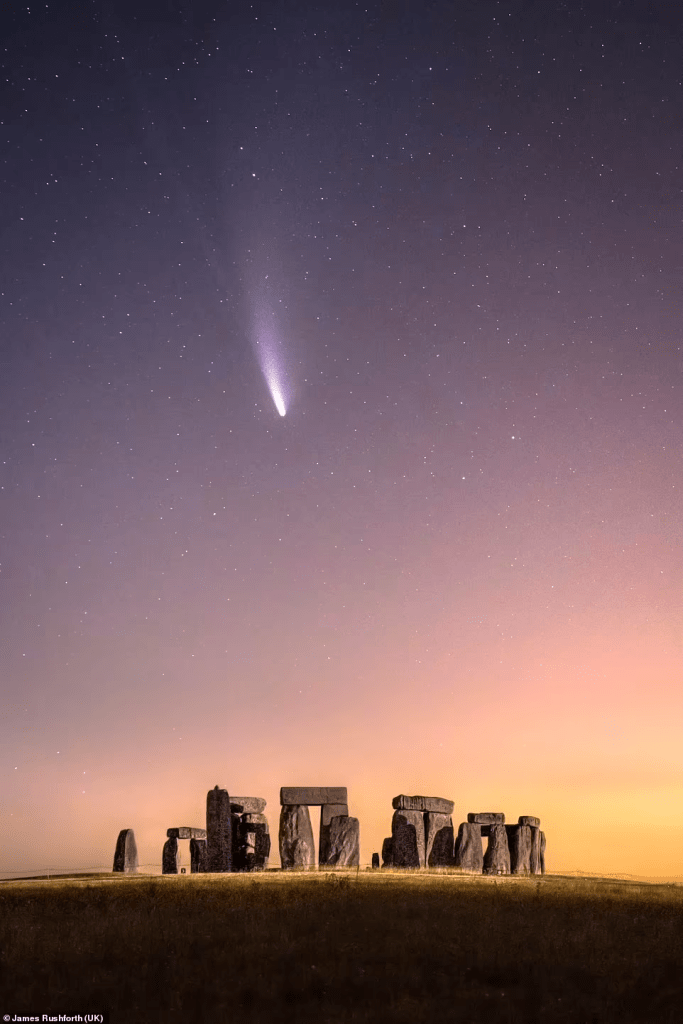
Image/(Credit): Comet Neowise as seen flying over Stonehenge. (James Rushforth)
This week’s photo is from photographer James Rushforth who caught Comet Neowise over Stonehenge. The comet was discovered by astronomers on March 27, 2020 during the NEOWISE mission of the Wide-field Infrared Survey Explorer (WISE) space telescope.
Mr. Rushforth’s photo was one of about 4,500 photos entered into the2021 annual Royal Observatory Greenwich astronomy photography competition. His image above made the shortlist. You can see other shortlisted entries here. The winning entry, announced last September, is shown below.
Image/(Credit): Titled “The Golden Ring,” the image shows an annular solar eclipse taken in the Ali region of Tibet on June 21, 2020. (Shuchang Dong)
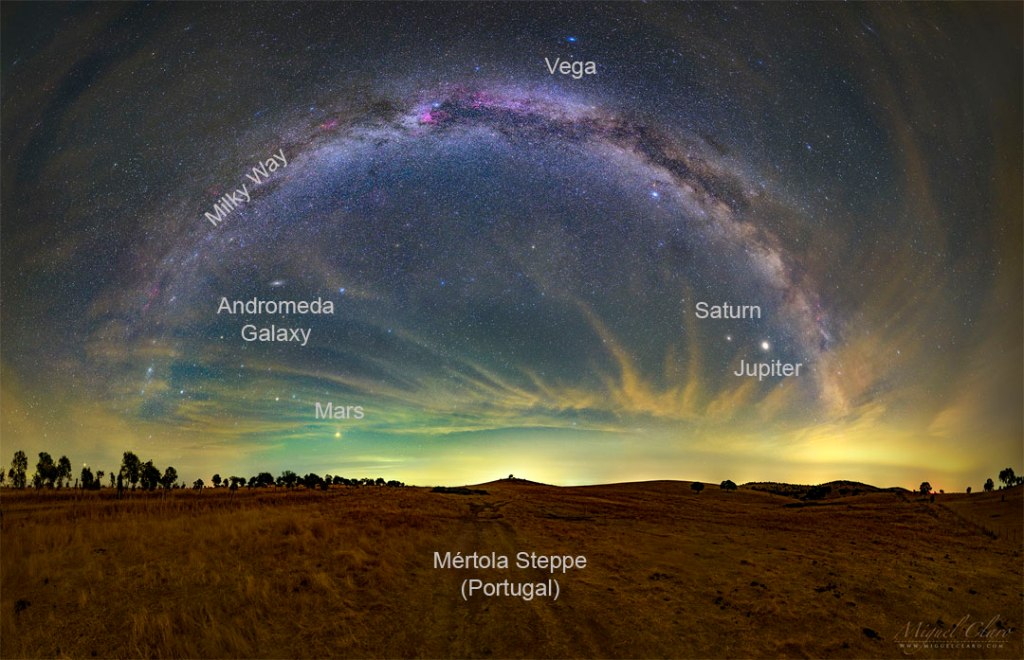
Image (Credit): Night sky in Portugal. (Miguel Claro, The World at Night, Dark Sky Alqueva)
This week’s photo is an amazing night shot in Portugal showing planets, stars, and galaxies. Here is the full description from NASA’s Astronomy Picture of the Day:
The mission was to document night-flying birds — but it ended up also documenting a beautiful sky. The featured wide-angle mosaic was taken over the steppe golden fields in Mértola, Portugal in 2020. From such a dark location, an immediately-evident breathtaking glow arched over the night sky: the central band of our Milky Way galaxy. But this sky had much more. Thin clouds crossed the sky like golden ribbons. The planet Mars appeared on the far left, while the planets Saturn and Jupiter were also simultaneously visible — but on the opposite side of the sky, here seen on the far right. Near the top of the image the bright star Vega can be found, while the far-distant and faint Andromeda Galaxy can be seen toward the left, just below Milky Way’s arch. As the current month progresses, several planets are lining up in the pre-dawn sky: Jupiter, Venus, Mars, and Saturn.
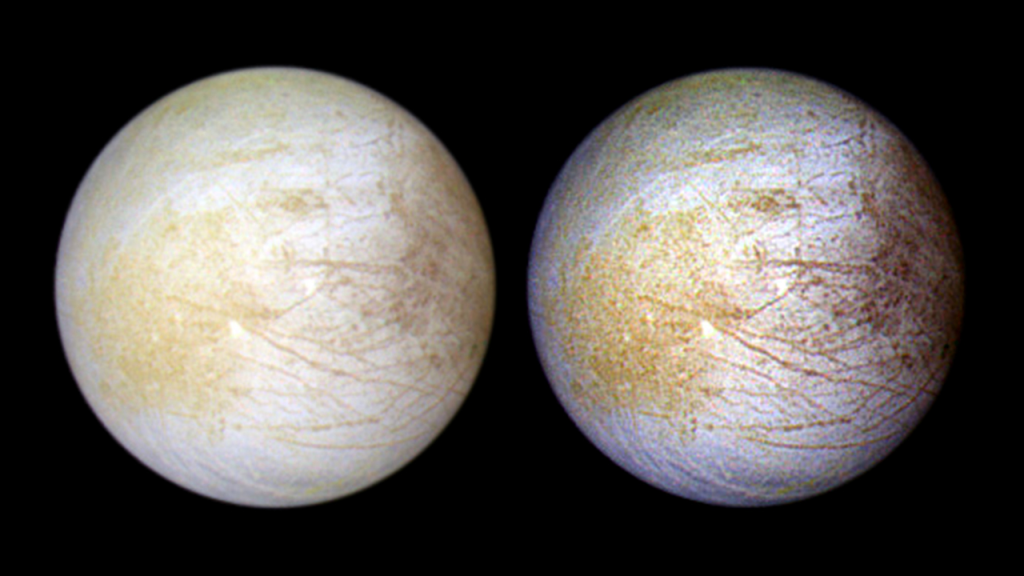
Image (Credit): Hubble images of Jupiter’s moon Europa. (NASA, NASA-JPL, University of Arizona)
This week’s photo of Jupiter’s moon Europa was taken by the Hubble Space Telescope in June 1997 (and released by NASA on October 14, 2021). Here is the story about these two images (the left one in natural color and the right one enhanced) from the Hubble site:
This photograph of the Jovian moon Europa was taken in June 1997 at a range of 776,700 miles by NASA’s Galileo spacecraft.
Slightly smaller than Earth’s moon, Europa has a very smooth surface and the solid ice crust has the appearance of a cracked eggshell. The interior has a global ocean with more water than found on Earth. It could possibly harbor life as we know it.
Hubble Space Telescope observations of Europa have revealed the presence of persistent water vapor in its very tenuous atmosphere. Hubble observations, spanning 1999 to 2015, find that water vapor is constantly being replenished throughout one hemisphere of the moon. This is a different finding from Hubble’s 2013 observations that found localized water vapor from geysers venting from its subsurface ocean. This water vapor comes from a different process entirely. Sunlight causes the surface ice to sublimate, transitioning directly into gas.
This color composite Galileo view combines violet, green, and infrared images. The view of the moon is shown in natural color (left) and in enhanced color designed to bring out subtle color differences in the surface (right). The bright white and bluish part of Europa’s surface is composed mostly of water ice, with very few non-ice materials. Long, dark lines are fractures in the crust, some of which are more than 1,850 miles long.
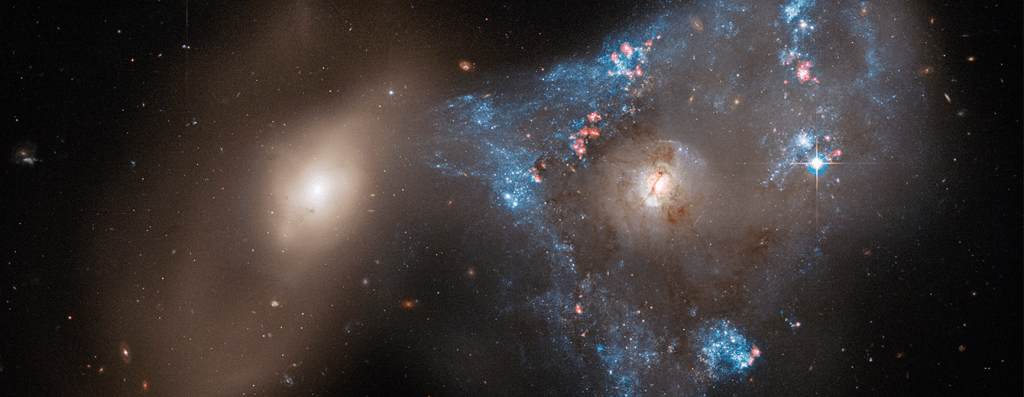
Image (Credit): Space Triangle image from the Hubble Space Telescope. (NASA, ESA, STScI, Julianne Dalcanton with the Center for Computational Astrophysics/Flatiron Inst., UWashington)
This week’s image is from the Hubble Space Telescope. It shows the collision of spiral galaxy NGC 2445 on the right and NGC 2444 on the left, creating what appears to be a triangle of new stars. Here is a little more on the pair from NASA’s Hubblesite:
A spectacular head-on collision between two galaxies fueled the unusual triangular-shaped star-birthing frenzy, as captured in a new image from NASA’s Hubble Space Telescope…
Astronomers suggest that the galaxies passed through each other, igniting the uniquely shaped star-formation firestorm in NGC 2445, where thousands of stars are bursting to life on the right-hand side of the image. This galaxy is awash in starbirth because it is rich in gas, the fuel that makes stars. However, it hasn’t yet escaped the gravitational clutches of its partner NGC 2444, shown on the left side of the image. The pair is waging a cosmic tug-of-war, which NGC 2444 appears to be winning. The galaxy has pulled gas from NGC 2445, forming the oddball triangle of newly minted stars.


 Our Awesome Universe