Pic of the Week: Spanish Dancer Galaxy

Image (Credit): Spanish Dancer Galaxy (Dark Energy Survey/DOE/FNAL/DECam/CTIO/NOIRLab/NSF/AURA)

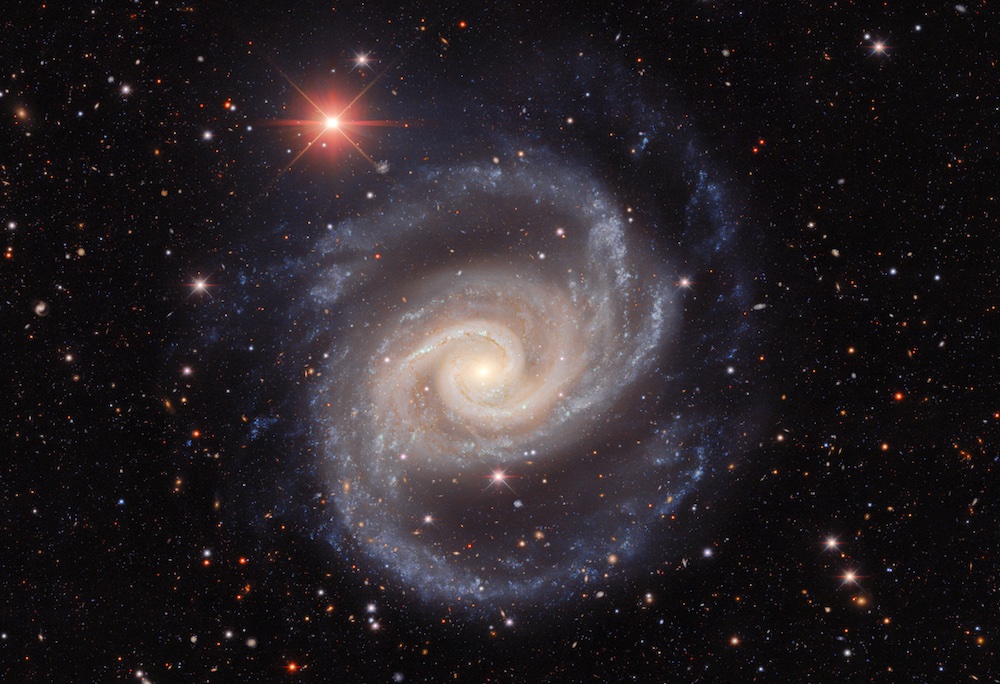
This week’s image, from the Cerro Tololo Inter-American Observatory in Chile, is nicknamed the Spanish Dancer Galaxy. Here is a little more on from the National Science Foundation’s (NSF) National Optical-Infrared Astronomy Research Laboratory (NOIRLab):

Located in the constellation Dorado and lying around 70 million light-years away, NGC 1566 is a grand-design spiral galaxy with two arms that appear to wind around the galactic core, just like the arms of a dancer as they spin around and around in a furious twirl. This image was taken from Chile at the Cerro Tololo Inter-American Observatory (CTIO), a Program of NSF’s NOIRLab, using the Dark Energy Camera. The galaxy’s face-on view to us, its location, and its composition make it a trove of observational opportunities for astronomers across many fields of astronomy.

NGC 1566 is home to stars at all stages of stellar evolution. In this image, the bright blue color that outlines the arms of the galaxy arises from young, brightly burning stars. Darker spots within these arms are dust lanes. The arms are rich in gas, and form large-scale areas that provide the perfect environment for new stars to form. Closer to the center of the galaxy are cooler, older stars and dust, all evident by the redder color in the image. This galaxy has even been host to an observed stellar end-of-life event, when a supernova, named SN2010el, burst onto the scene in 2010.

The center of NGC 1566 is dominated by a supermassive black hole. The distinct and highly luminous nucleus of the galaxy is known as an active galactic nucleus. The light from the nucleus changes on timescales of only hundreds of days, making its exact classification difficult for astronomers. 

Pic of the Week: Test-Bed Telescope 2

Source/Credit: Test-Bed Telescope 2 from the ESA.

This week’s photo is from the European Space Agency (ESA) and shows a recently-completed telescope in Chile designed to detect dangerous asteroids. Here is the full story:

Part of the world-wide effort to scan and identify near-Earth objects, the European Space Agency’s Test-Bed Telescope 2 (TBT2), a technology demonstrator hosted at ESO’s La Silla Observatory in Chile, has now started operating. Working alongside its northern-hemisphere partner telescope, TBT2 will keep a close eye on the sky for asteroids that could pose a risk to Earth, testing hardware and software for a future telescope network.

Pic of the Week: Lunar Transit

Source/Credit: Thierry Legault

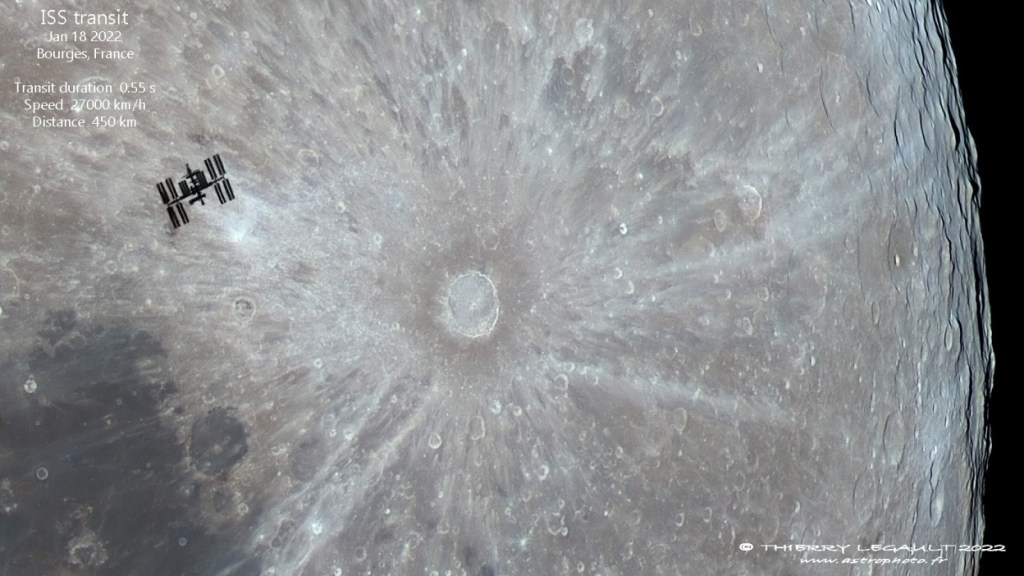
This week’s photo is a “lunar transit” of the International Space Station (ISS) taken on January 18, 2022. The details in the photo are impressive, including Tycho crater. The Mashable article accompanying this image states:

The silhouette of the space station is so clear, observers can make out a faint grid pattern on its solar panel arrays. The attached SpaceX Crew-3 spacecraft, which brought up NASA astronauts Raja Chari, Tom Marshburn, and Kayla Barron, as well as European Space Agency astronaut Matthias Maurer in November, is easily identifiable.

Pic of the Week: The Flame Nebula

Source/Credit: NASA, ESA, and N. Da Rio (University of Virginia); Processing: Gladys Kober (NASA/Catholic University of America).

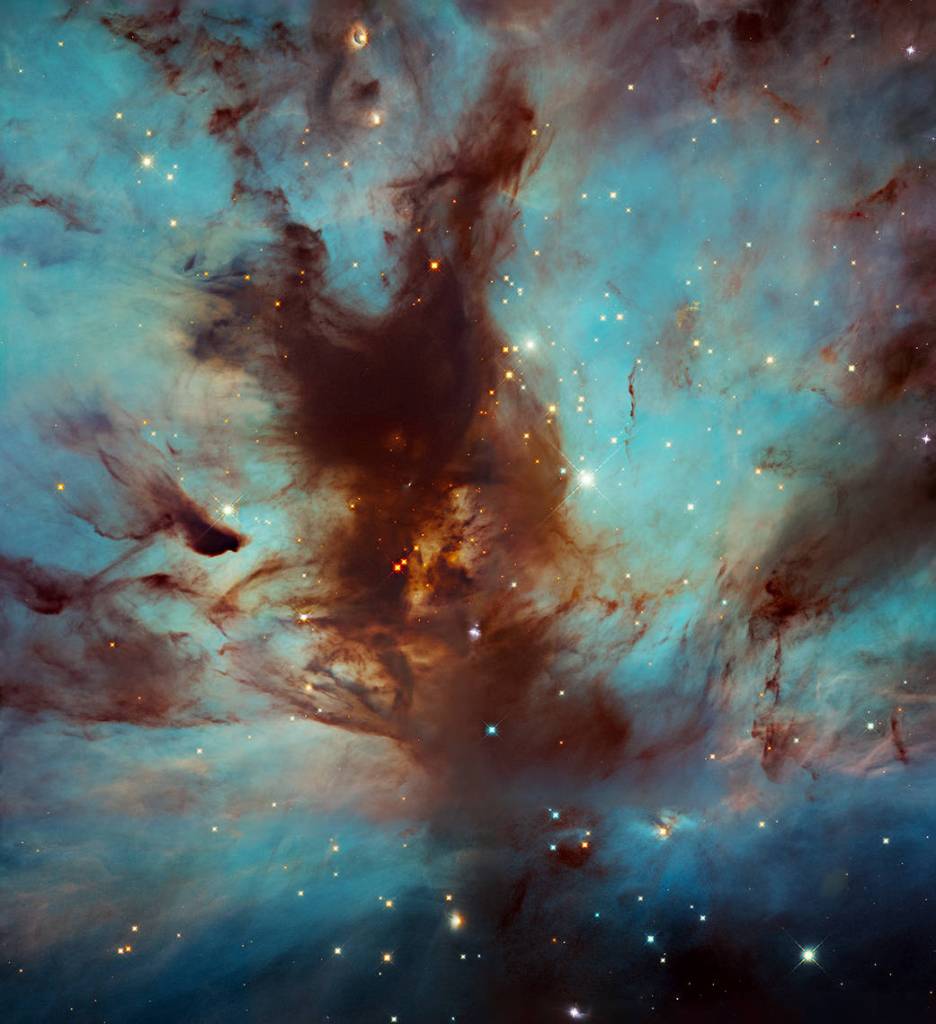
This week’s image from the Hubble Space Telescope shows the Flame Nebula in the constellation Orion, as explained by NASA:

The Flame Nebula, also called NGC 2024, is a large star-forming region in the constellation Orion that lies about 1,400 light-years from Earth. It’s a portion of the Orion Molecular Cloud Complex, which includes such famous nebulae as the Horsehead Nebula and Orion Nebula. This image focuses on the dark, dusty heart of the nebula, where a star cluster resides, mostly hidden from view. Nearby (but not visible in this image) is the bright star Alnitak, the easternmost star in the Belt of Orion. Radiation from Alnitak ionizes the Flame Nebula’s hydrogen gas. As the gas begins to cool from its higher-energy state to a lower-energy state, it emits energy in the form of light, causing the visible glow behind the swirled wisps of dust.

Pic of the Week: Distant Dancing Galaxies

Source/Credit: Galaxy cluster (described below) from NASA.

The image above is from the Hubble Space Telescope and shared on NASA’s site last month under the title “Hubble Spots a Starship-Shaped Galactic Pair.” While the author of the story below sees the USS Enterprise from Star Trek, I see a decloaking Klingon Bird-of-Prey. Here is the full description from NASA:

The subject of this image is a group of three galaxies, collectively known as NGC 7764A. They were imaged by the NASA/ESA Hubble Space Telescope, using both its Advanced Camera for Surveys (ACS) and Wide Field Camera 3 (WFC3). The two galaxies in the upper right of the image appear to be interacting with one another — indeed, the long trails of stars and gas extending from them both give the impression that they have both just been struck at great speed, thrown into disarray by the bowling-ball-shaped galaxy to the lower left of the image. In reality, however, interactions between galaxies happen over very long time periods, and galaxies rarely collide head-on with one another. It is also unclear whether the galaxy to the lower left is actually interacting with the other two, although they are so relatively close in space that it seems possible that they are. By happy coincidence, the collective interaction between these galaxies have caused the two on the upper right to form a shape, which from our Solar System’s perspective, ressembles the starship known as the USS Enterprise from Star Trek!

NGC 7764A, which lies about 425 million light years from Earth in the constellation Phoenix, is a fascinating example of just how awkward astronomical nomenclature can be. The three galaxies are individually referred to as NGC 7764A1, NGC 7764A2 and NGC 7764A3, and just to be really difficult, an entirely separate galaxy, named NGC 7764, sits in the skies about a Moon’s distance (as seen from Earth) away. This rather haphazard naming makes more sense when we consider that many of the catalogues for keeping track of celestial bodies were compiled well over 100 years ago, long before modern technology made standardising scientific terminology much easier. As it is, many astronomical objects have several different names, or might have names that are so similar to other objects’ names that they cause confusion.

Source/Credit: Klingon Bird-of-Prey from wallpapercave.com.