Pic of the Week: Hurricane Erin in the Caribbean Sea

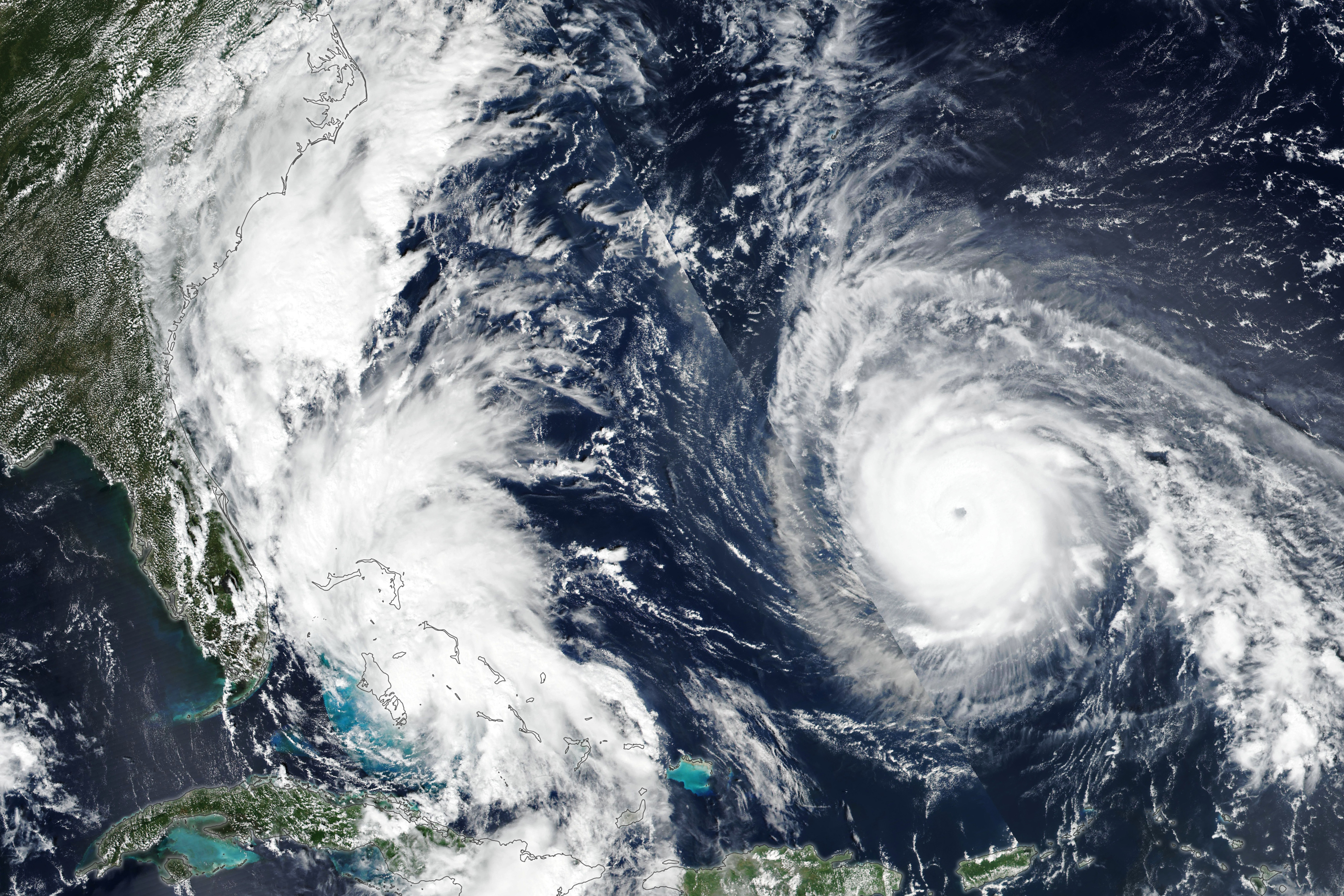
Image (Credit): Hurricane Erin in the Caribbean Sea on August 18, 2025. (NASA Earth Observatory images by Michala Garrison, using MODIS data from NASA EOSDIS LANCE and GIBS/Worldview, and the Suomi National Polar-orbiting Partnership)

This week’s image is from the NASA Earth Observatory. It shows Hurricane Erin, the first Atlantic hurricane in the 2025 season, as it travels through the Caribbean Sea earlier this week. The image below labels the various islands in the image.

Image (Credit): Hurricane Erin in the Caribbean Sea on August 18, 2025 (with island identifiers). (NASA Earth Observatory images by Michala Garrison, using MODIS data from NASA EOSDIS LANCE and GIBS/Worldview, and the Suomi National Polar-orbiting Partnership)

Pic of the Week: Student-Designed Artemis II Posters

Credit: Mingyi Gan.

The above image is one of 24 winning posters designed by students at the School of Visual Arts (SVA) in New York City. The contest, sponsored by SVA and NASA, is called The Artemis II/Earthrise Poster Project.

All of the posters will be on display next month at the SVA Gramercy Gallery located at 209 East 23rd Street, 1st floor, New York, NY 10010.

You can learn more about the event and view more of these creative posters at this link.

Pic of the Week: The Third Interstellar Visitor

Image (Credit): Interstellar comet 3I/Atlas captured by the Hubble Space Telescope. (NASA, ESA, D. Jewitt (UCLA), J. DePasquale (STScI))

This week’s image is from the NASA/European Space Agency’s (ESA) Hubble Space Telescope. It shows an image of interstellar comet 3I/Atlas from July 21, 2025. The comet was about 365 million kilometers from Earth. First identified by a telescope in Chile last month, this is the third such object to be observed by astronomers.

Here is a little more from the ESA about this unusual object:

Hubble also captured a dust plume ejected from the Sun-warmed side of the comet, and the hint of a dust tail streaming away from the nucleus. Hubble’s data yields a dust-loss rate consistent with comets that are first detected around 480 million kilometres from the Sun. This behaviour is much like the signature of previously seen Sun-bound comets originating within our Solar System. The big difference is that this interstellar visitor originated in some other Solar System elsewhere in our Milky Way galaxy. 3I/ATLAS is traveling through our Solar System at roughly 210,000 kilometres per hour, the highest velocity ever recorded for a Solar System visitor. This breathtaking sprint is evidence that the comet has been drifting through interstellar space for many billions of years. The gravitational slingshot effect from innumerable stars and nebulae the comet passed added momentum, ratcheting up its speed. The longer 3I/ATLAS was out in space, the higher its speed grew.

Pic of the Week: “Another World”

Image (Credit): 2025 shortlisted photo titled “Another World” by Felix Sproll. (https://reachforthestars.ie/exhibition/)

This week’s image comes from Ireland’s DIAS Reach for the Stars 2025 astronomy photo competition. The 2025 winners have yet to be announced, but the photos are available for the public to view (and vote on until last week).

This shortlisted entry by photographer Felix Sproll is titled “Another World.” It was taken in Dun Laoghaire located in Dublin, Ireland.

This is the story about the image from its creator:

Full moon rising behind Baily Lighthouse on Howth 9km away looking like another planet. I happened to be in Dun Laoghaire when I saw that the full Moon was set to rise on the opposite side of Dublin bay so I ligned it up with Baily Lighthouse at the end of Howth. I calculated the position to get the moon in the centre of the lighthouse when it reached the lighthouse using the photopills app. Nikon Z7ii and tamron 100-400 at 400mm, 1/5sec, ISO 6400, F6.3, minor adjustments in LR.

You can find many other fun images on the competition website. Winners will be announced next month.

Pic of the Week: The Veil Nebula

Image (Credit): The Veil Nebula as captured by the Hubble Space Telescope. (ESA/Hubble & NASA, R. Sankrit)

This week’s image was captured by the NASA/European Space Agency (ESA) Hubble Space Telescope. The beautiful array of colors in the Veiled Nebula can be found about 2,400 light-years away.

Here is more about the image from NASA:

The remnant of a star roughly 20 times as massive as the Sun that exploded about 10,000 years ago, the Veil Nebula is situated about 2,400 light-years away in the constellation Cygnus. Hubble images of this photogenic nebula were first taken in 1994 and 1997, and again in 2015.

This view combines images taken in three different filters by Hubble’s Wide Field Camera 3, highlighting emission from hydrogen, sulfur, and oxygen atoms. The image shows just a small fraction of the Veil Nebula; if you could see the entire nebula without the aid of a telescope, it would be as wide as six full Moons placed side-by-side.

Although this image captures the Veil Nebula at a single point in time, it helps researchers understand how the supernova remnant evolves over decades. Combining this snapshot with Hubble observations from 1994 will reveal the motion of individual knots and filaments of gas over that span of time, enhancing our understanding of this stunning nebula.