Disarming Space Will Have to Wait

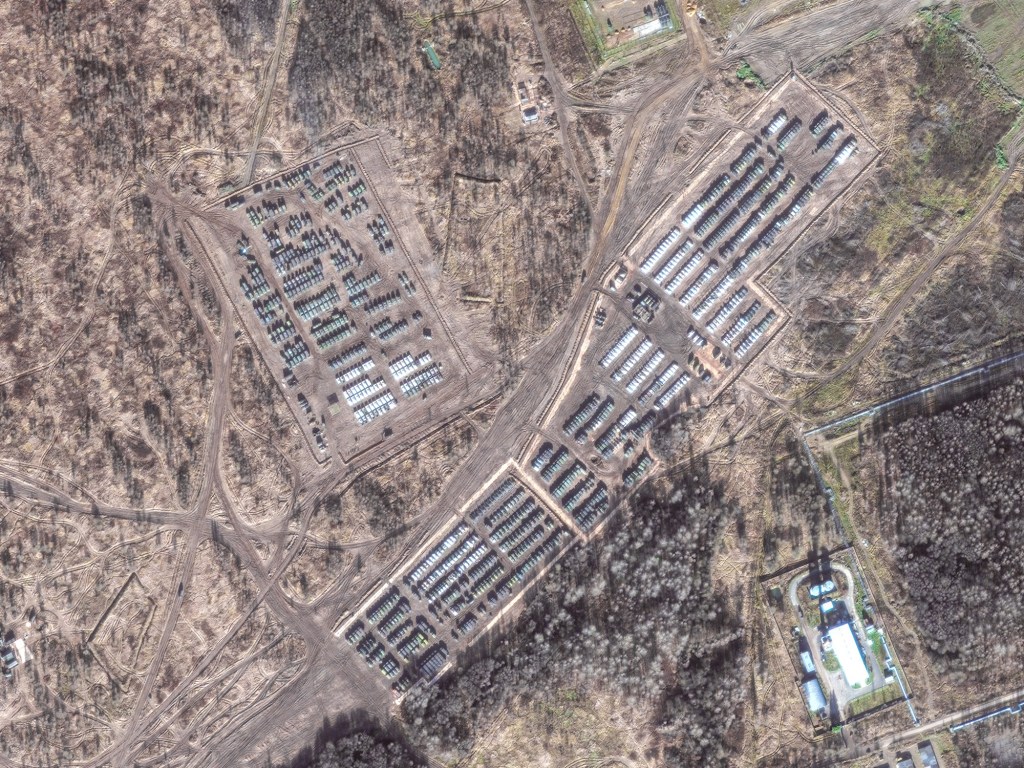
Source/Credit: Satellite imagery showing the military buildup in Yelnya, Russia as of November 1, 2021 from Maxar Technologies/Getty Images.

Politico reported this week that Russia has asked that next week’s discussion at the United Nations (U.N.) about arms in space be delayed. It is possible the Russians are busy preparing for war in Ukraine and have little time to look up. But it should be possible to resolve matters here on the surface and in space.

The  U.N. Committee on Disarmament established a working group after seeking member input on the “…development and implementation of norms, rules and principles of responsible behaviours and on the reduction of the risks of misunderstanding and miscalculations with respect to outer space.” Sounds like a good idea to me. You can find the report with the members’ input here.

Here is part of what the United States submitted in its response to the U.N. query:

Some States are developing, operationalizing, and stockpiling a variety of [anti-satellite] weapons that could be used to, or have the potential to, deny, disrupt, degrade, or destroy civil, commercial, or national security space capabilities and services. Some of these anti-satellite weapons could be used to deny or disrupt space services temporarily, while others are designed to permanently degrade or destroy satellites.

These threats against satellites and their supporting systems can generally be divided into four categories: 1) ground-space; 2) space-space; 3) ground-ground; and 4) space-ground. Within these categories, the threats can be described as 1) reversible, which include temporary effects such as interference with radiofrequency signals or dazzling of remote sensing systems, or 2) irreversible, which include measures that degrade or destroy a satellite. The consequences of all categories of threats could include loss of mission data; decreased lifespan or capability of space systems or constellations; the loss of positive control of space vehicles, potentially resulting in collisions that could impair systems or generate harmful orbital debris; or damage to or destruction of the space system.

The working group should have plenty to discuss if it can get everyone together. Let’s hope the Ukrainian matter can be resolved peacefully to allow work to start on a stable peace in space as well.

Note: The dates on the article and U.N. schedule do not align, but the main point about the Russians being too busy to worry about a space war remains the same.

Chinese Space Debris Clean-up or Something Else?

Source/Credit: Chinese Shijian-21satellite from Asia Times.

Phys.org reported the success of a Chinese mission to retrieve a dead satellite, a hopeful sign given the increasing number of satellites and related debris in orbit. The story, “A Chinese space tug just grappled a dead satellite,” discusses how the Chinese spacecraft, Shijian-21, retrieved a dead navigation satellite belonging to the Chinese CompassG2 network. The story also included a video from ExoAnalytic Solutions demonstrating the retrieval and eventual release of the CompassG2 satellite into a graveyard orbit.

Of course, every pro comes with a con. Is this just a maintenance spacecraft or could it be part of a future offensive strategy to take other non-Chinese satellites out of orbit? The media in India were skeptical, as you can see from this headline: “China Preparing for War in Space?” Not that China is alone should it be looking for an anti-satellite spacecraft. Other countries, including the US, have similar dual-use spacecraft.

According to the Phys.org article, the Chinese have been silent, so the whole operation is somewhat opaque. Given the various attempts by other nations to solve the debris problem, it benefits each nation to share information on debris mitigation efforts so everyone can learn from them. Greater transparency from China would be nice.

Follow-Up: SpaceX and Others Impacting the Night Sky

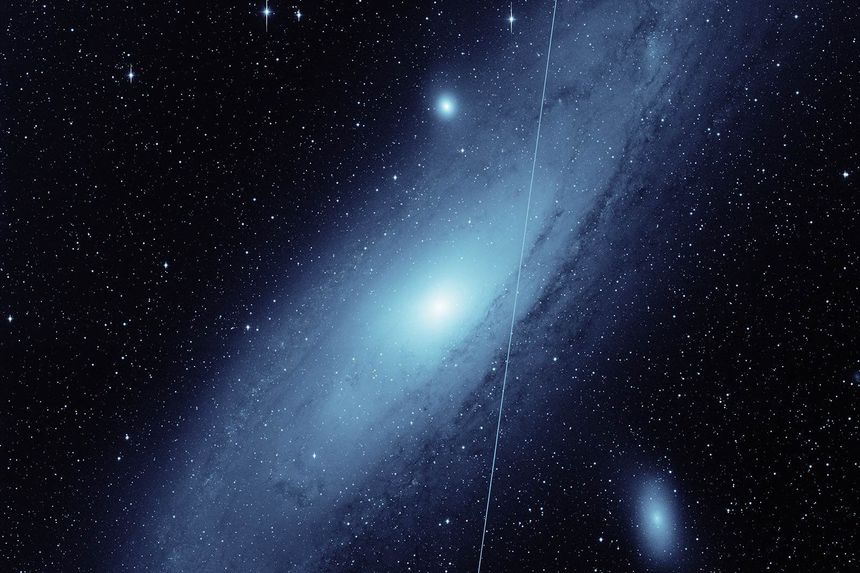
Source/Credit: Starlink satellite streak in an image of the Andromeda galaxy from CALTECH Optical Observatories/IPAC.

In an earlier post I discussed Elon Musk’s belief that low Earth orbit (LEO) can host billions of satellites, but don’t tell that to astronomers. The satellites already in orbit are corrupting telescope images, so the problem can only get worse. And should we really put up tens of thousands more (forget billions), we may not only find greater corruption, but even greater difficulties detecting dangerous asteroids threatening the Earth.

A Wall Street Journal article, “SpaceX Satellites Distort Astronomy Images, Study Finds,” highlights a January 14th study in the Astrophysical Journal Letters, “Impact of the SpaceX Starlink Satellites on the Zwicky Transient Facility Survey Observations” that found:

…researchers examined the effects of [SpaceX] Starlink satellites on about 300,000 images taken by an instrument at the Palomar Observatory in Southern California. Between November 2019 and September 2021, they noted a 35-fold increase in the number of corrupted images.

The Journal summary provided more details as well as a partial solution:

We find that the number of affected images is increasing with time as SpaceX deploys more satellites. Twilight observations are particularly affected—a fraction of streaked images taken during twilight has increased from less than 0.5% in late 2019 to 18% in 2021 August. We estimate that once the size of the Starlink constellation reaches 10,000, essentially all ZTF images taken during twilight may be affected. However, despite the increase in satellite streaks observed during the analyzed period, the current science operations of ZTF are not yet strongly affected. We also find that redesigning Starlink satellites (by installing visors intended to block sunlight from reaching the satellite antennas to prevent reflection) reduces their brightness by a factor of 4.6 ± 0.1 with respect to the original design in g, r, and i bands.

It appears SpaceX is aware of these issues and looking into the brightness of its satellites.

A separate paper from last September, “Visibility Predictions for Near-Future Satellite Megaconstellations: Latitudes near 50 Degrees will Experience the Worst Light Pollution,” stated the following concerns:

Megaconstellations of thousands to tens of thousands of artificial satellites (satcons) are rapidly being developed and launched. These satcons will have negative consequences for observational astronomy research, and are poised to drastically interfere with naked-eye stargazing worldwide should mitigation efforts be unsuccessful. Here we provide predictions for the optical brightnesses and on-sky distributions of several satcons, including Starlink, OneWeb, Kuiper, and StarNet/GW, for a total of 65,000 satellites on their filed or predicted orbits. We develop a simple model of satellite reflectivity, which is calibrated using published Starlink observations. We use this model to estimate the visible magnitudes and on-sky distributions for these satellites as seen from different places on Earth, in different seasons, and different times of night. For latitudes near 50 degrees North and South, satcon satellites make up a few percent of all visible point sources all night long near the summer solstice, as well as near sunrise and sunset on the equinoxes. Altering the satellites’ altitudes only changes the specific impacts of the problem. Without drastic reduction of the reflectivities, or significantly fewer total satellites in orbit, satcons will significantly change the night sky worldwide.

Again, without a satellite solution or fewer satellites, these craft will “significantly change the night sky worldwide.” And the scientists are now looking to the United Nations for help. So it may be in the interest of the satellite industry (four companies were named in the second study above) to come up with some quick solutions or face new restrictions. We should be able to solve this.

Source/Credit: Elon Musk and a Starlink satellite from Pascal Le Segretain/Getty; Samantha Lee/Insider.

Update: SpaceX lost about 40 of the 49 Starlink satellites launched on February 3, 2022 due to a geomagnetic storm.

Follow-up: Other Anti-Satellite Tests

Source: Indian Space Research Organization.

In an earlier posting, I pointed out that both China and Russia have left debris in orbit after conducting anti-satellite tests. To be fair, they are not alone. Back in March 2019, India also blew up one of its satellites with a ground-based missile, spreading debris and jeopardizing its own space program as well as that of others. Luckily, the explosion happened at a height that does not threaten the International Space Station or the majority of satellites in orbit. Moreover, most of the pieces of debris were expected to burn up and disappear quickly.

There have been other such anti-satellite missions as well, with the U.S, Russia, and China in the lead. So who started all of this, you may ask. The same Forbes story cited above makes it clear that the U.S. began this space arms race more than 60 years ago:

The U.S. tested its first anti-satellite missile in 1959, when the space lanes were mostly empty. Russia followed suit in the late 1960s and early 1970s, but after the end of the Cold War, space warfare mostly fell off the defense policy radar. 

The radar is active again given the continuing series of destructive anti-satellite missions in Earth’s orbit. You can add to this the various other secret spacecraft believed to already be in orbit to enhance each nation’s ability to kill another nation’s satellites. Things are pretty ugly on the ground these days, and the heavens above seem to be fair game as well.

Chinese Satellite Close Call

Source: China’s Space Debris Monitoring and Application Center tracking of the satellite and debris – provided by CNN.

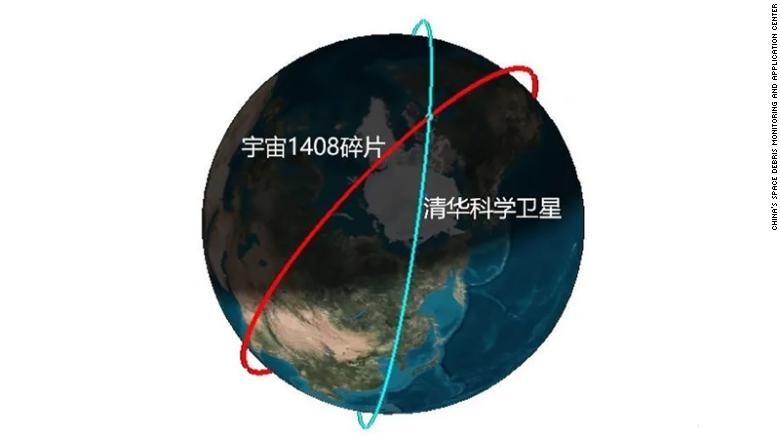
Orbiting the Earth is complicated enough without the Russians and other creating new obstacles. China recently learned about these hazards when one of its science satellites came close to colliding with debris created last November from a Russian anti-satellite test. China’s satellite missed the debris by about 48 feet, which the Chinese government called “extremely dangerous.” No kidding.

That same debris has threatened the International Space Station as well, which Russia also funds and occupies. It is not clear why Russia would endanger its own cosmonauts residing on the station.

That said, it is interesting that China is upset with Russia after similarly creating space debris back in 2007 part of its own anti-satellite experiments. The space community was similarly frustrated with the impact on orbiting spacecraft. In fact, the ISS had to dodge that debris as well last November.

Everyone’s spacecraft are at risk when we test weapons in space. We have to decide if we want to conduct science or simply give way to orbiting debris forevermore.