ISS Crew-8 Will be Back on Earth Friday

Image (Credit): SpaceX Dragon capsule docked to the ISS. (NASA)

The International Space Station’s (ISS) Crew-8 has departed the station.

NASA astronauts Matt Dominick, Mike Barratt, and Jeanette Epps, as well as Roscosmos cosmonaut Alexander Grebenkin, undocked from the station today at 5:05 PM ET.

They are now traveling towards Earth in a Dragon capsule and should be back on solid ground Friday morning.

Everyone is happy that the hurricanes are gone and NASA can return to normal operations – for now. Hurricane season officially ends November 30, so the weather folks will remain on the lookout.

In the meantime, we wish Crew-8 a safe landing on Friday.

Space Stories: Starliner Not on the Schedule, More Questions About Artemis, and the Origin of Most Meteorites

Image (Credit): The International Space Station. (NASA)

Here are some recent stories of interest.

Space NewsNASA Further Delays First Operational Starliner Flight

NASA will use SpaceX’s Crew Dragon for its two crew rotation missions to the International Space Station in 2025 as it continues to evaluate if it will require Boeing to perform another test flight of its Starliner spacecraft. In an Oct. 15 statement, NASA said it will use Crew Dragon for both the Crew-10 mission to the ISS, scheduled for no earlier than February 2025, and the Crew-11 mission scheduled for no earlier than July. Crew-10 will fly NASA astronauts Anne McClain and Nichole Ayers along with astronaut Takuya Onishi from the Japanese space agency JAXA and Roscosmos cosmonaut Kirill Peskov. NASA has not yet announced the crew for the Crew-11 mission.

BloombergNASA’s $100 Billion Moon Mission Is Going Nowhere

There are government boondoggles, and then there’s NASA’s Artemis program. More than a half century after Neil Armstrong’s giant leap for mankind, Artemis was intended to land astronauts back on the moon. It has so far spent nearly $100 billion without anyone getting off the ground, yet its complexity and outrageous waste are still spiraling upward. The next US president should rethink the program in its entirety.

CNRSThe Origin of Most Meteorites Finally Revealed

An international team led by three researchers from the CNRS1 , the European Southern Observatory (ESO, Europe), and Charles University (Czech Republic) has successfully demonstrated that 70% of all known meteorite falls originate from just three young asteroid families. These families were produced by three recent collisions that occurred in the main asteroid belt 5.8, 7.5, and about 40 million years ago. The team also revealed the sources of other types of meteorites; with this research, the origin of more than 90% of meteorites has now been identified. This discovery is detailed in three papers, a first published on 13 September 2024 in the journal Astronomy and Astrophysics, and two new papers published on 16 October 2024 in Nature.

NASA 2025 Calendar and More

Credit: NASA

If you are looking for a colorful calendar or simply some amazing images and art, you cannot go wrong downloading NASA’s 2025 calendar. For example, the graphics shown above and below are just two examples of the pages you can find in this 32-page calendar. It shows the number of NASA-led or supported space missions throughout our solar system. It is a numbing number of missions.

Have you heard of ESCAPADE mission, which stands for the Escape and Plasma Acceleration and Dynamics Explorers? Checking the NASA site, I learned that this mission was a dual-spacecraft mission to study ion and sputtered escape from Mars, and it was supposed to be launched this week but it was put back on the shelf. Here is more on the mission:

The planned launch on the Blue Origin New Glenn booster from Cape Canaveral, originally scheduled for October 13, 2024, has been delayed indefinitely. The science goals of the mission are to: understand the processes controlling the structure of Mars’ hybrid magnetosphere and how it guides ion flows; understand how energy and momentum are transported from the solar wind through Mars’ magnetosphere; and understand the processes controlling the flow of energy and matter into and out of the collisional atmosphere. EscaPADE is part of the NASA Small Innovative Missions for Planetary Exploration (SIMPLEx) program.

I am learning about it just in time to find out it is going nowhere for the moment.

Of course, there are many more on the list that you can look up for yourself. For instance, Google the European Space Agency’s BepiColombo.

Image (Credit): Second part of the Science Fleet – Operating & Future Missions. (NASA)

Return of the SpaceX Crew-8 Delayed

Yes, another delay due to weather. This time it’s the International Space Station crew returning to Earth. The SpaceX Crew-8 was supposed to return yesterday (after being delayed from October 7 because of Hurricane Milton), but it has been delayed until Friday due to ongoing weather issues in Florida. The returning crew consists of NASA astronauts Matthew DominickMike Barratt, and Jeanette Epps, and Roscosmos cosmonaut Alexander Grebenkin, who have been on the station since March.

Scheduling anything in Florida during hurricane season is questionable, but at least the Europa Clipper mission was able to get into the air quickly after the latest hurricane.

Update: The return of Crew-8 has been delayed again until Monday, October 21.

Second Update: The return date has been moved once more to Wednesday, October 23.

The Europa Clipper Mission Has Begun

Image (Credit): View of SpaceX’s Falcon Heavy second stage engine as it completes its burn after launching the Europa Clipper spacecraft. (NASA)

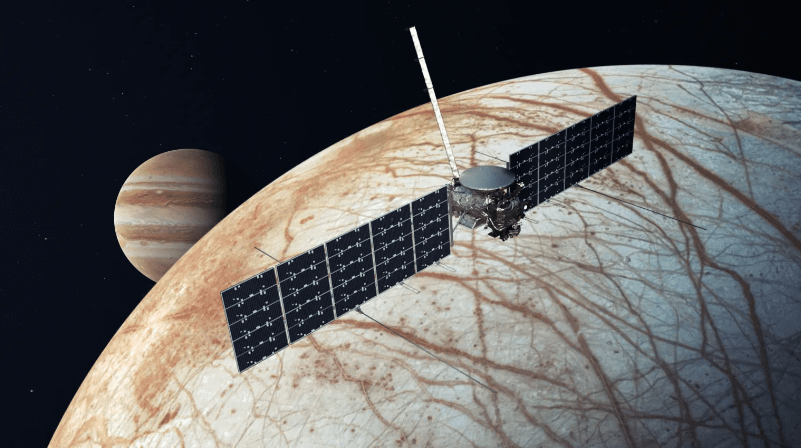
Earlier today, the Europa Clipper spacecraft was launched from Kennedy Space Center for its 2030 rendezvous with the Jovian moon Europa. It can then begin to analyze the moon’s salt water ocean and look for any signs of life.

The mission is expected to last for three years, maybe longer should the spacecraft prove to be durable and ready for more scientific work. After that, it will plummet down into the Jovian moon Ganymede.

Scientists believe Europa may contain more water than is found here on Earth. That is interesting in terms of what may lie below the surface in terms of potential life. It also offers mankind a priceless resource should we ever find ourselves living in that region.

Europa Clipper Project Scientist Robert Pappalardo stated:

We know of our Earth as an ocean world, but Europa is representative of a new class of ocean worlds, icy worlds in the distant outer solar system where saltwater oceans might exist under their icy surfaces…In fact, icy ocean worlds could be the most common habitat for life, not just in our solar system, but throughout the universe.

You can follow the status of the mission here.