Space Quote: The End of Ingenuity on Mars

Image (Credit): JPL’s most likely scenario for the unsuccessful landing of NASAs Ingenuity Mars Helicopter on Jan. 18, 2024. (NASA/JPL-Caltech)

“When running an accident investigation from 100 million miles away, you don’t have any black boxes or eyewitnesses…While multiple scenarios are viable with the available data, we have one we believe is most likely: Lack of surface texture gave the navigation system too little information to work with.”

-Statement by Ingenuity’s first pilot, Håvard Grip of JPL, in a Jet Propulsion Laboratory (JPL) publication explaining the final flight of the Ingenuity Mars Helicopter on Jan. 18, 2024. The helicopter flew 72 times over the Martian surface, far surpassing NASA’s expectations.

ISS Successfully Resupplied by Russian Mission

Image (Credit): Russia’s MS-19 Mission approaching the ISS yesterday. (NASA)

The International Space Station (ISS) had another visitor on Saturday morning – this time a Russian Soyuz capsule bringing about three tons of food, fuel, and supplies to the station as part of its Progress MS-29 mission (Progress 90 mission to NASA).

The Russian News Agency provided a list of items delivered to the ISS and also noted that the resupply mission also included Christmas gifts for the crew.

Here are the items delivered:

…869 kg of refueling propellant, 420 liters of potable water and 43 kg of pressurized nitrogen, and also 1,155 kg of material and equipment in the dry cargo hold, in particular, for experiments dubbed Vampire (growing crystals in an electric vacuum furnace), BTN-Neutron-2 (studying the neutron spectrum) and 3D Print (3D printing of polymer materials).

It nice that the Russians took the time to assist Santa with his gift giving.

Of course, the U.S. Department of Defense’s North American Aerospace Defense Command (NORAD) will be tracking the actions of Santa here on Earth this year, so be sure to visit the site closer to Christmas next month.
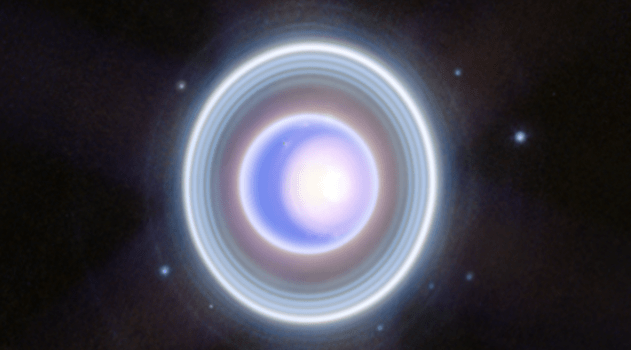
Space Stories: Potential Life on Uranus, a Sick ISS Astronaut, and a Feasting Black Hole

Image (Credit): Uranus captured the James Webb Telescope’s Near-Infrared Camera (NIRCam). This Webb image also shows 9 of the planet’s 27 moons. (NASA, ESA, CSA, STScI)

—BBC: “New Study on Moons of Uranus Raises Chance of Life“

The Voyager 2 observations had suggested that its two largest moons — Titania and Oberon — often orbit outside the magnetosphere. However, the new study indicates they tend to stay inside the protective bubble, making it easier for scientists to magnetically detect potential subsurface oceans. “Both are thought to be prime candidates for hosting liquid water oceans in the Uranian system due to their large size relative to the other major moons,” Jet Propulsion Laboratory planetary scientist and study co-author Corey Cochrane said.

—Scotsman: “Nasa Astronauts Tight-lipped on Who was Ill After Long Space Station Mission“

Three Nasa astronauts whose prolonged space station mission ended with a trip to hospital last month have declined to say which one of them was sick. Astronauts Matthew Dominick, Michael Barratt and Jeanette Epps publicly discussed their spaceflight for the first time since returning from the International Space Station on October 25.

—NOIRLab: “NSF NOIRLab Astronomers Discover the Fastest-Feeding Black Hole in the Early Universe“

Supermassive black holes exist at the center of most galaxies, and modern telescopes continue to observe them at surprisingly early times in the Universe’s evolution. It’s difficult to understand how these black holes were able to grow so big so rapidly. But with the discovery of a low-mass supermassive black hole feasting on material at an extreme rate, seen just 1.5 billion years after the Big Bang, astronomers now have valuable new insights into the mechanisms of rapidly growing black holes in the early Universe.

Pic of the Week: CRS-31 Capsule Approaches the ISS

Image (Credit): The Dragon capsule approaching the ISS earlier this week with Argentina in the background. (NASA)

This week’s image from NASA shows the uncrewed Dragon capsule approaching the International Space Station (ISS) on Tuesday, November 5th. Once connected with the station, the crew removed the cargo that included new scientific gear. You can read more about the ongoing operations on the ISS here.

Artemis and More Under a New Administration

Credit: The Planetary Society.

Will NASA be pulled in a new direction under a Trump administration? The Planetary Society does not think so, as noted in a recent article, “Space in the 2024 Elections: A Space Advocate’s Guide to the U.S. Presidential Election.“

The graphic above highlights the party platforms on space, showing a lot of similarity between the two parties. If you also consider the fact that the Artemis program was started under the first Trump Administration, as well as the close association between Trump and Elon Musk (at the moment), then one sees an even stronger indication that the Moon and Mars will remain a large part of the new administration’s focus.

The article notes:

For former President Trump, maintaining U.S. preeminence is a major component of his campaign rhetoric. To that end, a second Trump Administration would likely view space as a key arena for competition with China, and would therefore prioritize initiatives aimed at maintaining American dominance in the space domain. This could include bolstering programs that accelerate the development of commercial space capabilities, like Artemis and the Commercial Lunar Payload Services program. Mars Sample Return is an example of a program that offers an opportunity to leverage the burgeoning commercial space industry to accomplish something that no other nation has: returning scientifically significant samples from another planet.

All of this should offer some protection for NASA in a new administration that is already talking about downsizing government and eliminating at least one department. Besides, I doubt a cost-cutting panel headed by Mr. Musk will cut off the hand that feeds him. NASA has been good to SpaceX, and that is likely to continue.

We will see many more papers and opinion pieces on potential changes in the days and weeks to come.