Space Quote: India Invited to the Moon

“The 9th meeting of the India-U.S. Civil Space Joint Working Group (CSJWG) was hosted by India on 5-6 August 2026 at the headquarters of the Indian Space Research Organisation (ISRO) in Bengaluru…NASA invited ISRO to join its Moon Base program, building on the two countries’ partnership under the Artemis Accords.  The two sides also agreed to advance discussions for cooperation on open scientific data sharing under the Accords.“

-Statement issued by the US Embassy in India on August 11, 2026 pertaining to NASA’s ongoing Moon Base program. India was the fourth nation to successfully land on the Moon back in 2023 with its Chandrayaan-3 mission. With that landing, it was also the first country to successfully land at the Moon’s South Pole.

Space Quote: LINK May Still Be in the Game

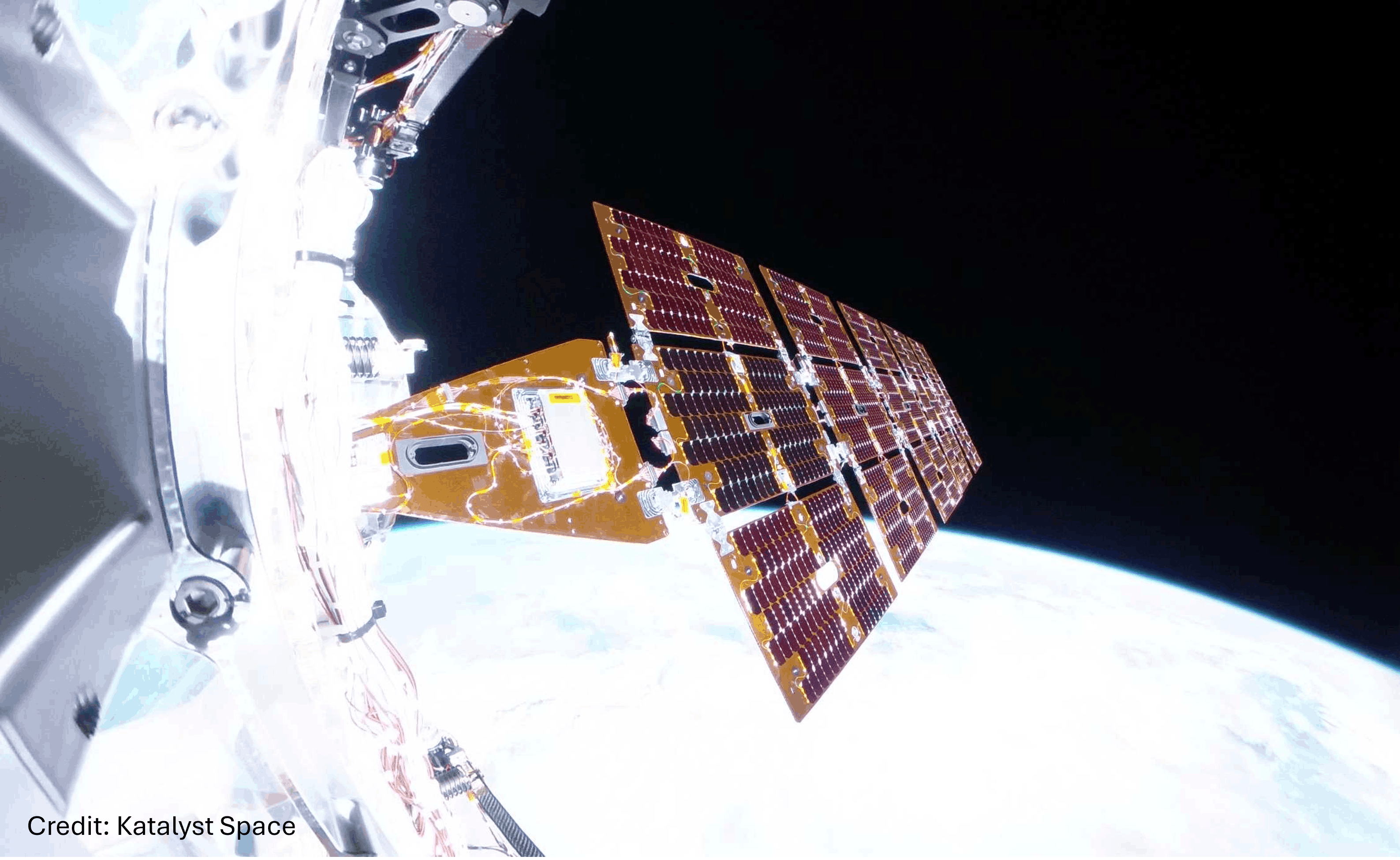
Image (Credit): The LINK spacecraft with a deployed solar array in Earth orbit. (Katalyst Space)

“LINK originally was in a multi-axis spin rotating at about 9 degrees per second, which resulted in sporadic communications and impeded LINK’s progress toward Swift. Using a series of burns from one of LINK’s electric propulsion thrusters, the Katalyst team now has slowed that spin to about 1.47 degrees per second. Katalyst plans to keep LINK at that spin rate as it proceeds with next steps for the mission. This includes uploading a flight software update in the coming days with new attitude controllers designed to maintain LINK’s stability in its current configuration. These updates would allow LINK to begin maneuvering to align with Swift’s orbit.”

-Statement by NASA on August 6, 2026 regarding efforts to resolve issues with the LINK spacecraft sent to boost the Neil Gehrels Swift Observatory to a higher orbital altitude. Launched on July 3, the spacecraft began to spin in space around July 25, which led to a temporary loss of contact with the ground crew. If all goes well, LINK could reach the observatory before the end of August.

Space Quote: A Spacecraft is Going to Mars, But Will It Have Any Cargo?

Credit: NASA

“Early cost estimates are approximately $2.1 billion, and NASA will continue refining that figure through the acquisition process.”

-NASA statement quoted by Politico regarding the estimated cost to send a nuclear-powered spacecraft to Mars. These costs would only cover the recently disclosed Space Reactor-1 Freedom spacecraft, but not the payload of three helicopters called SkyFall. This comes at a time when NASA Administrator Jared Isaacman is meeting with Congress and stating the agency does not need any additional funds at this time. Congress has been good at restoring funds the White House has tried to cut, so maybe Mr. Isaacman feels lucky he has what he has and does not want to seem ungrateful. It appears Congress is making a trip to Mars possible and not the White House, no matter what the president might say on stage about the importance of America’s space program.

Space Quote: The Taikonauts Are Coming!

Image (Credit): The crew of the latest mission to China’s Tiangong space station – the Shenzhou 23 mission. (CMSA/CCTV)

“Well, I would just say, first, it’s not arguably like there- we are very much in a space race right now, and the Chinese are moving at incredible speeds, and they are certainly capable of doing what the Soviets were not during the- the first space race. The Chinese will land their taikonauts on the moon. There’s no question. The question is, will the United States return before them, and will we do so in a different way this time, when we build a base, establish that enduring presence? I think the answer is yes.“

-Statement by NASA Administrator Jared Isaacman on CBS’s Face the Nation this past Sunday. The interview addresses other issues in addition to the Artemis mission to the Moon, including efforts to save the Swift space telescope as well as the status of Blue Origin’s efforts to recover from the recent explosion of its New Glenn rocket.

Space Quote: That’s All We Need in This Year’s Election

Image (Credit): Solar flares on the Sun spilling radiation into the solar system. (NASA)

“In 2003, during a local Belgian election, a candidate received over 4,000 extra votes on a computerized voting machine — more than was physically possible, triggering an investigation…The leading explanation for each of these events is what’s known as a bit flip: an electronic glitch caused by radiation from space. Although uncommon, they can have significant consequences. And as our reliance on electronics continues to increase, so does our vulnerability to bit flips.“

-Quote from a recent article from Astronomy magazine titled “Our Planet’s Electronic Vulnerability.” The article goes on to explain how high-energy radiation from the Sun as well as deep space can cause a “bit flip” that is difficult to detect. Given the use of electronic voting machines in US elections, we can only hope that this radiation issue does not come up in the fall election. Asking the voters to “wait for the science” before jumping to conclusions is not a viable option.