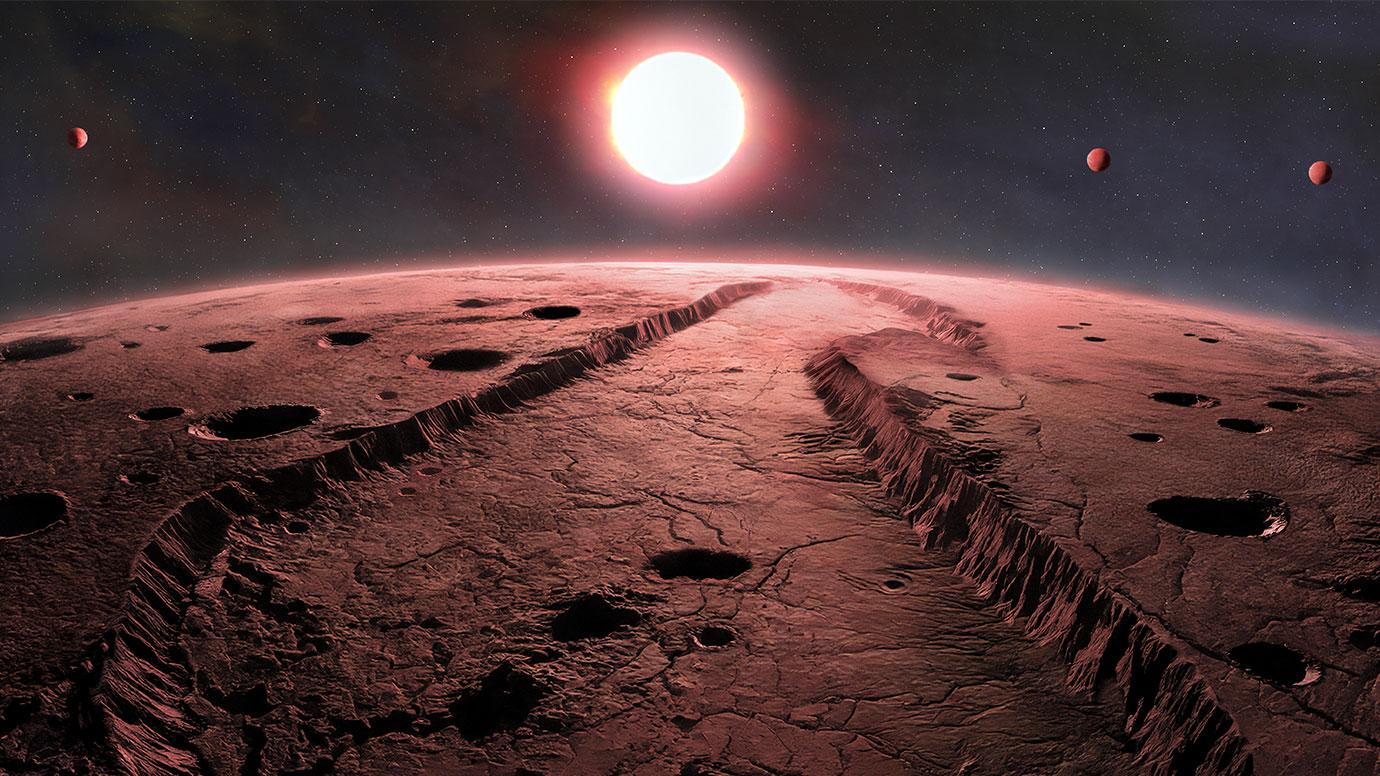
Image (Credit): Conceptual art showing Barnard’s Star from the surface of one of its four orbiting planets. (Illustration by International Gemini Observatory/NOIRLab/NSF/AURA/R. Proctor/J. Pollard)
The Astrophysical Journal Letters abstract of the study findings:
Barnard’s Star is an old, single M dwarf star that comprises the second-closest extrasolar system. It has a long history of claimed planet detections from both radial velocities and astrometry. However, none of these claimed detections have so far withstood further scrutiny. Continuing this story, extreme precision radial velocity measurements from the ESPRESSO instrument have recently been used to identify four new sub-Earth-mass planet candidates around Barnard’s Star. We present here 112 radial velocities of Barnard’s Star from the MAROON-X instrument that were obtained independently to search for planets around this compelling object.
Citation: Ritvik Basant et al. Four sub-Earth planets orbiting Barnard’s Star from MAROON-X and ESPRESSO. ApJL982 L1 (2025). https://doi.org/10.3847/2041-8213/adb8d5
Evaporation or freezing of water-rich fluids with dilute concentrations of dissolved salts can produce brines, as observed in closed basins on Earth and detected by remote sensing on icy bodies in the outer Solar System. The mineralogical evolution of these brines is well understood in regard to terrestrial environments, but poorly constrained for extraterrestrial systems owing to a lack of direct sampling. Here we report the occurrence of salt minerals in samples of the asteroid (101955) Bennu returned by the OSIRIS-REx mission. These include sodium-bearing phosphates and sodium-rich carbonates, sulfates, chlorides and fluorides formed during evaporation of a late-stage brine that existed early in the history of Bennu’s parent body. Discovery of diverse salts would not be possible without mission sample return and careful curation and storage, because these decompose with prolonged exposure to Earth’s atmosphere. Similar brines probably still occur in the interior of icy bodies Ceres and Enceladus, as indicated by spectra or measurement of sodium carbonate on the surface or in plumes.
Citation: McCoy, T.J., Russell, S.S., Zega, T.J. et al. An evaporite sequence from ancient brine recorded in Bennu samples. Nature637, 1072–1077 (2025). https://doi.org/10.1038/s41586-024-08495-6
Charon, Pluto’s largest moon, has been extensively studied, with research focusing on its primitive composition and changes due to radiation and photolysis. However, spectral data have so far been limited to wavelengths below 2.5 μm, leaving key aspects unresolved. Here we present the detection of carbon dioxide (CO2) and hydrogen peroxide (H2O2) on the surface of Charon’s northern hemisphere, using JWST data. These detections add to the known chemical inventory that includes crystalline water ice, ammonia-bearing species, and tholin-like darkening constituents previously revealed by ground- and space-based observations. The H2O2 presence indicates active radiolytic/photolytic processing of the water ice-rich surface by solar ultraviolet and interplanetary medium Lyman-α photons, solar wind, and galactic cosmic rays. Through spectral modeling of the surface, we show that the CO2 is present in pure crystalline form and, possibly, in intimately mixed states on the surface. Endogenically sourced subsurface CO2 exposed on the surface is likely the primary source of this component, with possible contributions from irradiation of hydrocarbons mixed with water ice, interfacial radiolysis between carbon deposits and water ice, and the implantation of energetic carbon ions from the solar wind and solar energetic particles.
Citation: Protopapa, S., Raut, U., Wong, I. et al. Detection of carbon dioxide and hydrogen peroxide on the stratified surface of Charon with JWST. Nat Commun15, 8247 (2024). https://doi.org/10.1038/s41467-024-51826-4
The canonical theory for planet formation in circumstellar disks proposes that planets are grown from initially much smaller seeds. The long-considered alternative theory proposes that giant protoplanets can be formed directly from collapsing fragments of vast spiral arms induced by gravitational instability—if the disk is gravitationally unstable. For this to be possible, the disk must be massive compared with the central star: a disk-to-star mass ratio of 1:10 is widely held as the rough threshold for triggering gravitational instability, inciting substantial non-Keplerian dynamics and generating prominent spiral arms. Although estimating disk masses has historically been challenging, the motion of the gas can reveal the presence of gravitational instability through its effect on the disk-velocity structure. Here we present kinematic evidence of gravitational instability in the disk around AB Aurigae, using deep observations of 13CO and C18O line emission with the Atacama Large Millimeter/submillimeter Array (ALMA). The observed kinematic signals strongly resemble predictions from simulations and analytic modelling. From quantitative comparisons, we infer a disk mass of up to a third of the stellar mass enclosed within 1″ to 5″ on the sky.
Citation: Speedie, J., Dong, R., Hall, C. et al. Gravitational instability in a planet-forming disk. Nature 633, 58–62 (2024). https://doi.org/10.1038/s41586-024-07877-0
New observations by the James Webb Space Telescope suggest that an icy moon around Uranus may have an underground liquid ocean. Ariel is one of 27 moons around Uranus, the seventh planet from the sun and the third largest planet in the solar system. It’s one of four moons that scientists have long been interested in as part of a search for water across the solar system, the others being Umbriel, Titania and Oberon.
The object that smashed into Earth and kick-started the extinction that wiped out almost all dinosaurs 66 million years ago was an asteroid that originally formed beyond the orbit of Jupiter, according to geochemical evidence from the impact site in Chicxulub, Mexico. The findings, published on 15 August in Science, suggest that the mass extinction was the result of a train of events that began during the birth of the Solar System. Scientists had long suspected that the Chicxulub impactor, as it is known, was an asteroid from the outer Solar System, and these observations bolster the case.
The Polaris Program, focused on testing and developing new spaceflight technology, is preparing to launch its first mission, Polaris Dawn, aboard SpaceX’s Falcon 9 rocket on Monday, August 26, 2024. This mission marks a significant step forward in commercial space exploration. Key objectives include testing a next-generation spacesuit during the first commercial spacewalk, attempting to achieve the highest altitude for a human spaceflight since the Apollo missions, and evaluating a new communication system through Starlink.