Space Stories: Potential Life on Uranus, a Sick ISS Astronaut, and a Feasting Black Hole

Image (Credit): Uranus captured the James Webb Telescope’s Near-Infrared Camera (NIRCam). This Webb image also shows 9 of the planet’s 27 moons. (NASA, ESA, CSA, STScI)

BBC: New Study on Moons of Uranus Raises Chance of Life

The Voyager 2 observations had suggested that its two largest moons — Titania and Oberon — often orbit outside the magnetosphere. However, the new study indicates they tend to stay inside the protective bubble, making it easier for scientists to magnetically detect potential subsurface oceans. “Both are thought to be prime candidates for hosting liquid water oceans in the Uranian system due to their large size relative to the other major moons,” Jet Propulsion Laboratory planetary scientist and study co-author Corey Cochrane said.

ScotsmanNasa Astronauts Tight-lipped on Who was Ill After Long Space Station Mission

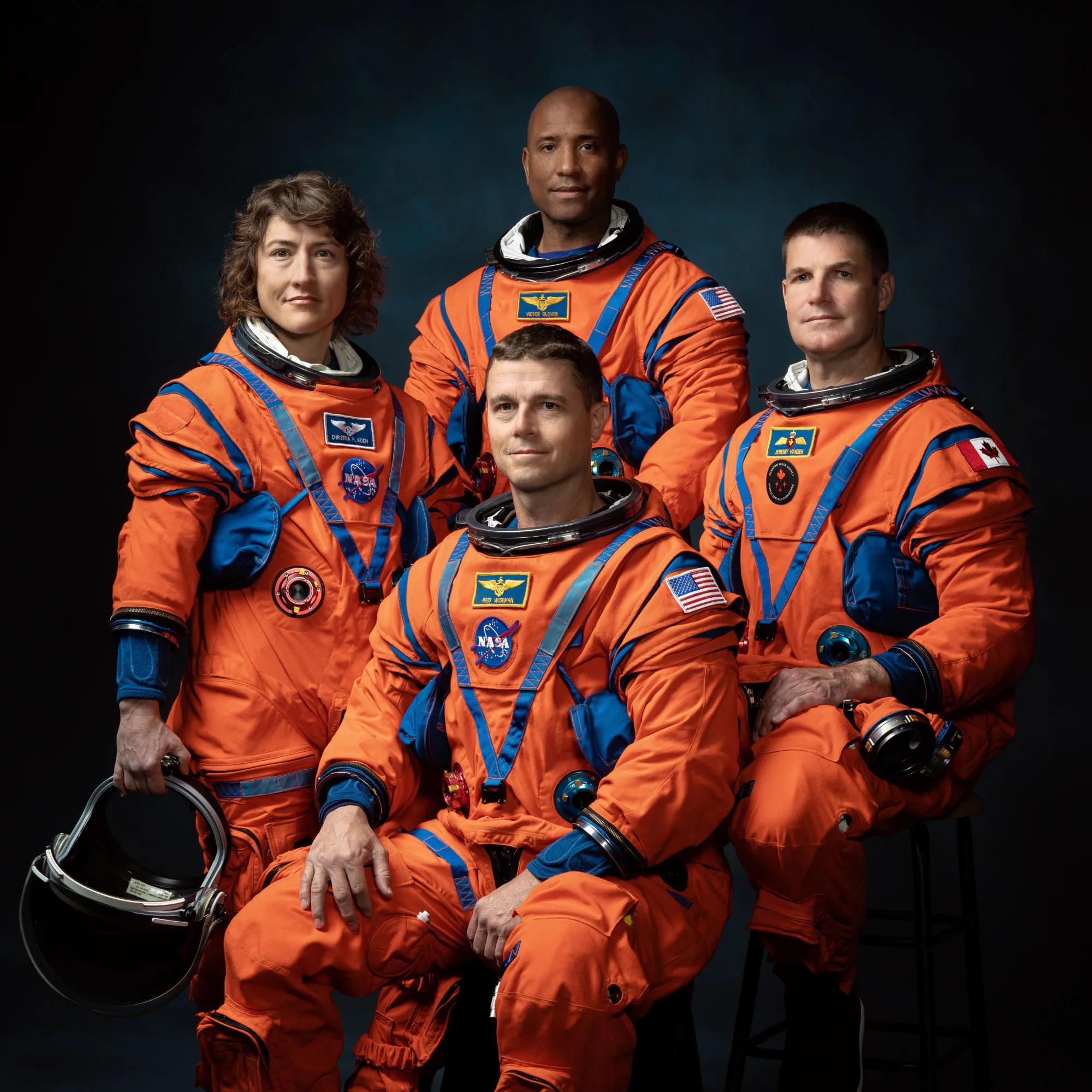
Three Nasa astronauts whose prolonged space station mission ended with a trip to hospital last month have declined to say which one of them was sick. Astronauts Matthew Dominick, Michael Barratt and Jeanette Epps publicly discussed their spaceflight for the first time since returning from the International Space Station on October 25.

NOIRLabNSF NOIRLab Astronomers Discover the Fastest-Feeding Black Hole in the Early Universe

Supermassive black holes exist at the center of most galaxies, and modern telescopes continue to observe them at surprisingly early times in the Universe’s evolution. It’s difficult to understand how these black holes were able to grow so big so rapidly. But with the discovery of a low-mass supermassive black hole feasting on material at an extreme rate, seen just 1.5 billion years after the Big Bang, astronomers now have valuable new insights into the mechanisms of rapidly growing black holes in the early Universe.

Profile: The SkAI Institute?

Image (Credit): Three astrophysics research areas to be undertaken by the SkAI Institute. (SkAI Institute)

The SkAI Institute is an abbreviation for the NSF-Simons AI Institute for the Sky. It is a new initiative funded by the National Science Foundation (NSF) and Simons Foundation to integrate artificial intelligence (AI) into astronomy.

According to the SkAI Institute’s website, the vision of this new organization is to bring together about 25 partner organization to:

  1. Confront the challenges posed by transformative multi-wavelength and multi-messenger surveys.
  2. Develop innovative, trustworthy AI tools for the research community.
  3. Seed and nurture a diverse generation of interdisciplinary leaders in science and engineering to ethically apply and extend AI within and beyond academia.

The Institute’s initial focus will be (1) Stars, Compact Objects and their Transients, (2) Galaxy Formation and Evolution, and (3) Cosmology and the Early Universe.

In discussing the new institute, NSF Director Sethuraman Panchanathan, stated:

The massive amount of data that will be gathered in the coming years by the NSF-DOE Vera C. Rubin Observatory and other large-scale astronomical projects is simply too vast and rich to be fully explored with existing methods…With reliable and trustworthy AI in their toolbox, everyone from students to senior researchers will have exciting new ways to gain valuable insights leading to amazing discoveries that might otherwise remain hidden in the data.

Given the mixed press on recent AI initiatives, it is nice to see AI being directed at a clear need in the field of astronomy. You can learn more about the work of the new Institute by visiting its website.

Russia Assists Iranian Space Program

Image (Credit): Russia’s launch of the Kowsar and Hodhod satellites from Vostochny launch-pad in far eastern Russia. (Roscosmos)

While Americans are contemplating this week’s election, the Russians were up to more mischief this week. I am not talking about North Korean soldiers being used to attack Ukraine. I am referring to the Russians launching two Iranian satellites via a Soyuz rocket on Tuesday (yes, the same date as the US election).

One of the satellites is the Kowsar, a high-resolution imaging satellite, and the second the Hodhod, which is a small communications satellite. Both are said to be private sector cubic satellites, representing the first private sector Iranian satellites to be launched to date. Tehran Times states that both satellites are being used for agricultural purposes.

Hassan Salarieh, the head of the Iranian Space Agency stated:

Achieving significant goals in this field is unattainable without robust participation from private enterprises. We believe that the private sector should enter this field in a competitive environment, considering market criteria.

The partnership between Russia and Iran regarding potentially dual-use space technology, at a time when both nations are involved in military actions against their neighbors, is not good news for peace.

Space Quote: Mars is Humanity’s Dream and Destiny

Credit: NASA/JPL-Caltech

“The age-old dream of endowing human minds and hands access to the cosmos does not belong to Donald Trump, nor should it be considered the exclusive possession of any particular political party. It belongs to humanity. It is essential that we make that clear, because the fortunes of political war are always changing. Should the Mars project come to be regarded as the mere hobby horse of a controversial politician, business leader, or partisan faction, it would surely face cancellation the next time the winds of power shift. We cannot let that happen. Precisely because we are not followers of Mr. Trump, we need to step up and help explain why all Americans, regardless of party, should support this initiative.”

Statement by Mars Society President Dr. Robert Zubrin regarding the election of Donald Trump.

Pic of the Week: CRS-31 Capsule Approaches the ISS

Image (Credit): The Dragon capsule approaching the ISS earlier this week with Argentina in the background. (NASA)

This week’s image from NASA shows the uncrewed Dragon capsule approaching the International Space Station (ISS) on Tuesday, November 5th. Once connected with the station, the crew removed the cargo that included new scientific gear. You can read more about the ongoing operations on the ISS here.