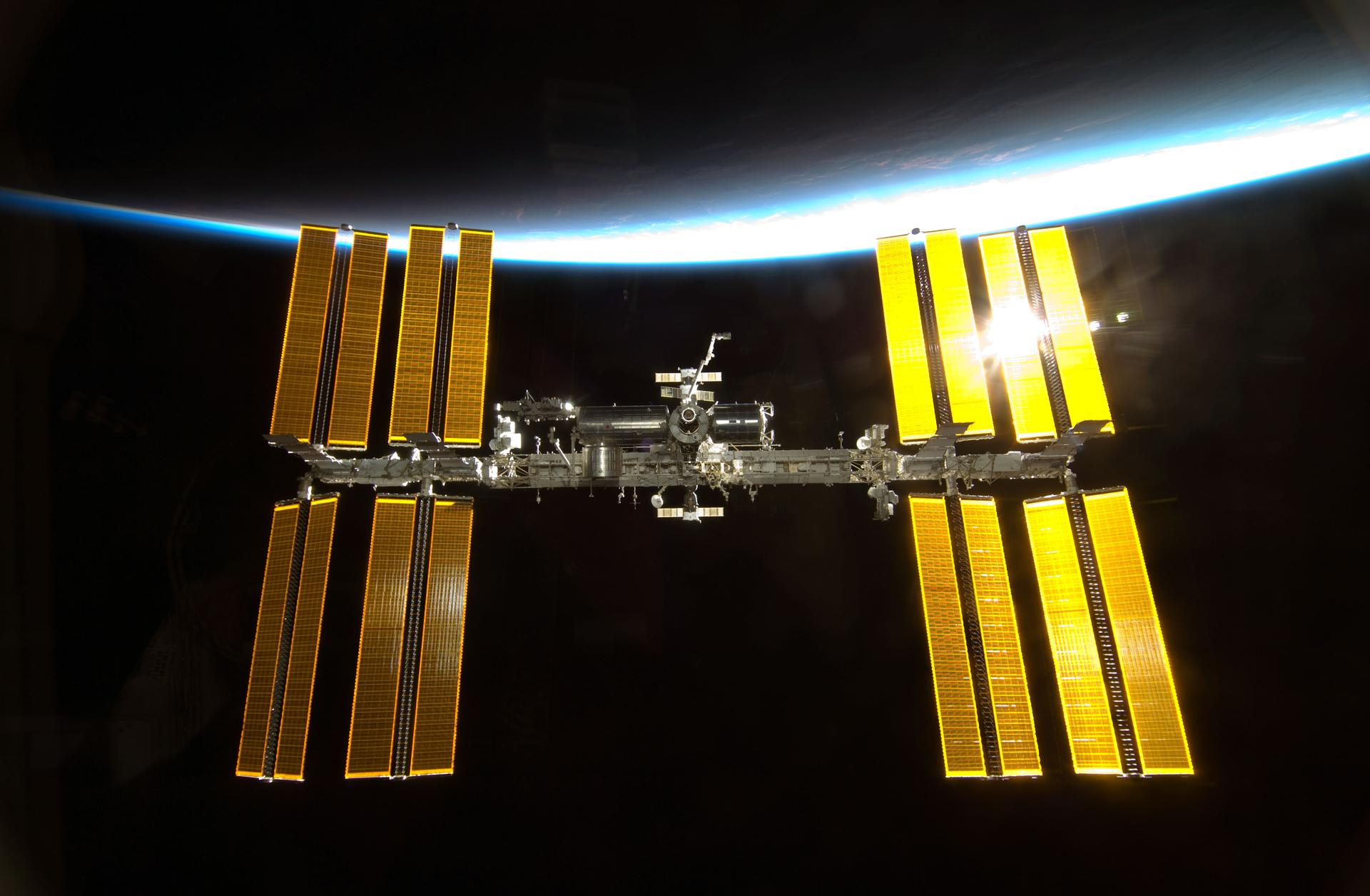
NASA astronauts Matt Dominick, Mike Barratt, and Jeanette Epps, as well as Roscosmos cosmonaut Alexander Grebenkin, undocked from the station today at 5:05 PM ET.
They are now traveling towards Earth in a Dragon capsule and should be back on solid ground Friday morning.
Everyone is happy that the hurricanes are gone and NASA can return to normal operations – for now. Hurricane season officially ends November 30, so the weather folks will remain on the lookout.
In the meantime, we wish Crew-8 a safe landing on Friday.
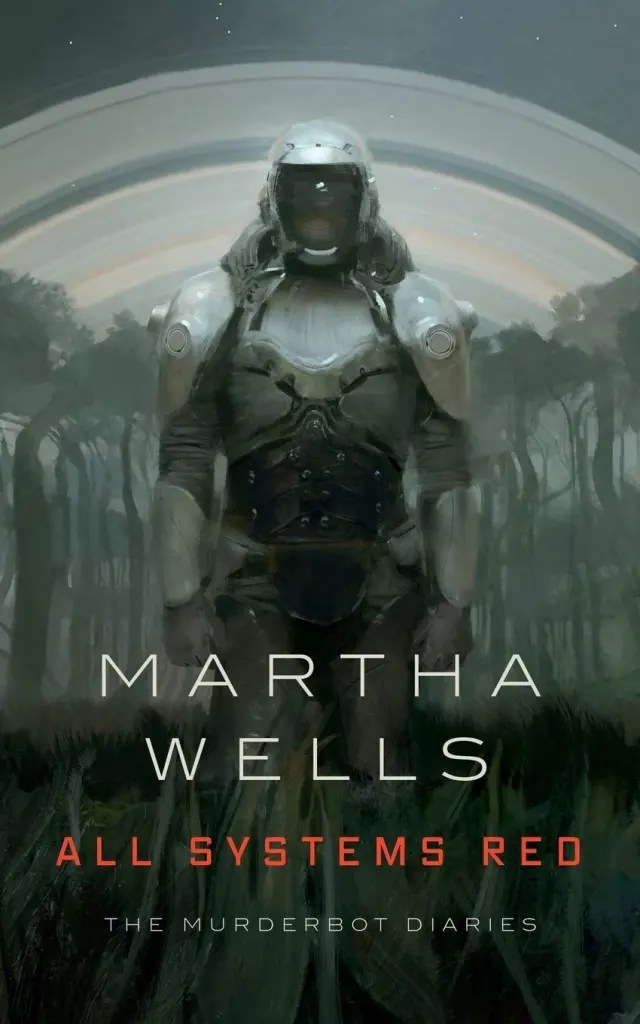
I am a big fan of Martha Wells’ The Murderbot Diaries, having read all seven in the series and looking forward to the eighth. So I was pleased to read late last year that the series will be coming to television.
If you are not familiar with the series, the best way to describe it is the tale of a security “construct” that has escaped its corporate tether and now needs to make its way in a human world. It starts its freedom acting like a petulant teenager more interested in old media adventures than humans, but it finds its way as the series continues, saving plenty of humans along the way from greedy corporations. It is just a fun read.
So in terms of television, Apple TV+ is working on a 10-episode first season, which includes Alexander Skarsgård (Succession) in the title role. Given that the main character, or Murderbot, is technically genderless and not interested in the topic of sex in the stories, I am surprised Skarsgårdis was given this type of role. You can read about some of the other actors in the series here.
Much of the story takes place within Murderbot’s head as it throws out sarcastic comments, so getting this onto the screen should prove interesting. Apple TV+ took great liberties with the Foundation series, but I hope that will not be necessary here.
I have yet to see a premiere date, so we are talking sometime in 2025.
Stay tuned.
Note: Apple TV+ is advertising a separate movie called Murderbot about a female robot gone crazy. You can ignore it.
On this day in 1929, Ursula K. Le Guin was born in Berkeley, California. She would gain her masters degree in French only to later become a well known author of many fantasy and science fiction stories, including the Earthsea series and stories set in a Hainish universe of her making. She would go on to win eight Hugo Awards and six Nebula Awards.
Her style was different from many other authors of her period, focusing more on planetary culture than spacecraft hardware. When asked about her style, she stated the following:
The “hard”–science fiction writers dismiss everything except, well, physics, astronomy, and maybe chemistry. Biology, sociology, anthropology—that’s not science to them, that’s soft stuff. They’re not that interested in what human beings do, really. But I am. I draw on the social sciences a great deal. I get a lot of ideas from them, particularly from anthropology. When I create another planet, another world, with a society on it, I try to hint at the complexity of the society I’m creating, instead of just referring to an empire or something like that.
Given that her mother an anthropologist, it is not surprising that she saw a different way of telling story.
Her books represented a unique part of the science fiction genre that has only expanded over time as the writing community has expanded.
If you need an entry point to her work, you cannot go wrong starting with the short story “The Ones Who Walk Away from Omelas.” However, one of my favorite short stories is “The Island of the Immortals,” which you can find here.
I doubt you will be able to stop with one short story.
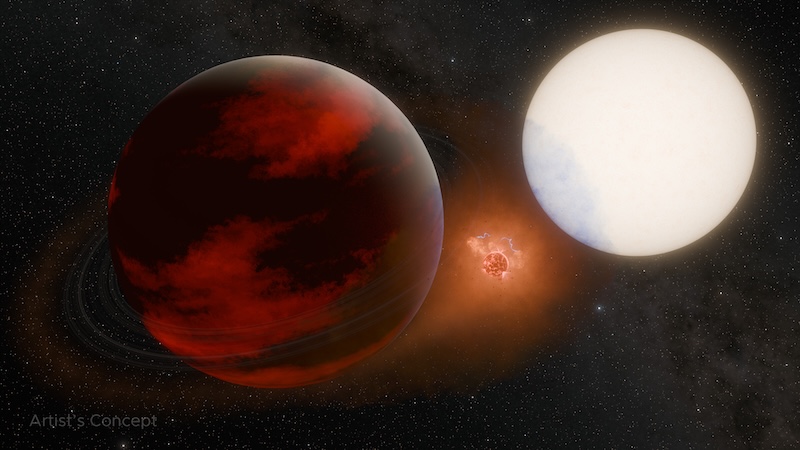
Image (Credit): An artist’s rendering of a volcanic moon orbiting WASP-49 b. (NASA/ JPL-Caltech)
The search for new exoplanets in our galaxy continues, but now it may include the first exomoon. This was something that was expected to occur at some point as the detection methods became better over time.
The exomoon in question is believed to be a volcanic moon orbiting a giant planet about 635 light-years away. Detected using the European Southern Observatory’s Very Large Telescope in Chile, the exomoon is discussed in a paper written by researchers with NASA’s Jet Propulsion Laboratory and Caltech in California. The clue was a cloud of sodium that did not appear to come from the host exoplanet.
The new discovery is being compared to Jupiter’s volcanic moon Io, which is the most volcanically active world in the solar system.
If you want to learn more about exomoons, I recommend a Cool Worlds video narrated by Assistant Professor of Astronomy David Kipping who provides five reasons that the study of exomoons is so important.
NASA will use SpaceX’s Crew Dragon for its two crew rotation missions to the International Space Station in 2025 as it continues to evaluate if it will require Boeing to perform another test flight of its Starliner spacecraft. In an Oct. 15 statement, NASA said it will use Crew Dragon for both the Crew-10 mission to the ISS, scheduled for no earlier than February 2025, and the Crew-11 mission scheduled for no earlier than July. Crew-10 will fly NASA astronauts Anne McClain and Nichole Ayers along with astronaut Takuya Onishi from the Japanese space agency JAXA and Roscosmos cosmonaut Kirill Peskov. NASA has not yet announced the crew for the Crew-11 mission.
There are government boondoggles, and then there’s NASA’s Artemis program. More than a half century after Neil Armstrong’s giant leap for mankind, Artemis was intended to land astronauts back on the moon. It has so far spent nearly $100 billion without anyone getting off the ground, yet its complexity and outrageous waste are still spiraling upward. The next US president should rethink the program in its entirety.
An international team led by three researchers from the CNRS1 , the European Southern Observatory (ESO, Europe), and Charles University (Czech Republic) has successfully demonstrated that 70% of all known meteorite falls originate from just three young asteroid families. These families were produced by three recent collisions that occurred in the main asteroid belt 5.8, 7.5, and about 40 million years ago. The team also revealed the sources of other types of meteorites; with this research, the origin of more than 90% of meteorites has now been identified. This discovery is detailed in three papers, a first published on 13 September 2024 in the journal Astronomy and Astrophysics, and two new papers published on 16 October 2024 in Nature.



 Our Awesome Universe