If you have yet to see the latest trailer for the upcoming HBO Max series Dune: Prophesy, I recommend you take a look. It provides plenty of information on the battle to come starting November 17th.
The initial images are impressive, though it does not appear we will have the out-of-this-world music we experienced with the first two Dune movies.
Maybe I have seen too many of these series now, but this latest story seems to be a cross between HBO’s Game of Thrones and Apple TV+’s Foundation. Not that I am complaining.
See for yourself, and stay tuned for what looks to be another success from the world called Dune.
Note: For a breakdown of the trailer, visit Secrets of Dune on Youtube. The narrator does a nice job tying the the new series into the two earlier movies.
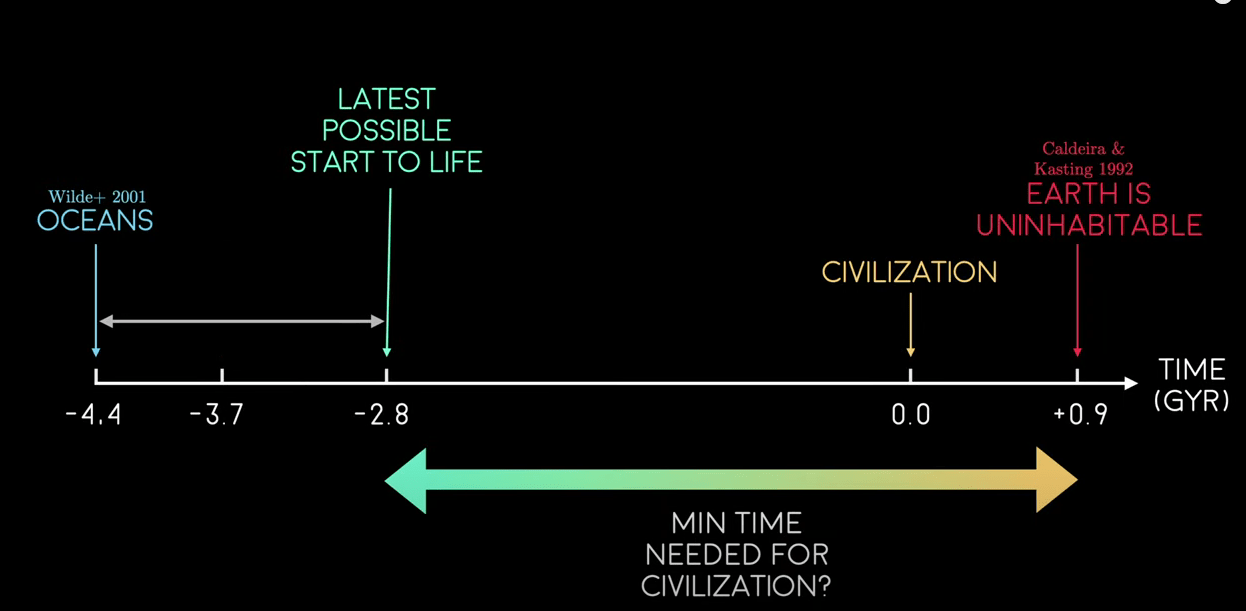
Image (Credit): One of the graphics from the video discussing the progress of life leading to civilization here on the Earth. (Cool Worlds)
Earlier today, a new Cool Worlds video was posted to Youtube titled “The Odds of Life – THIS CHANGED MY MIND.” Its an interesting piece narrated by Professor David Kipping regarding whether life is common in the universe. You will see that Professor Kipping is excited to share his results as he walks you through various papers before concluding that simple life may be more common than he believed earlier, making the chance of an advanced civilization a little more likely.
If an industrial civilization had existed on Earth many millions of years prior to our own era, what traces would it have left and would they be detectable today? We summarize the likely geological fingerprint of the Anthropocene, and demonstrate that while clear, it will not differ greatly in many respects from other known events in the geological record. We then propose tests that could plausibly distinguish an industrial cause from an otherwise naturally occurring climate event.
Professor Kipping said he hoped to create another video to discuss this idea about earlier civilizations. In the meantime, you may want to take a look at the paper.
It was not a good week for the US space industry. One major US space company is looking to exit the business while the head of another US space company is holding secret talks with Putin.
In the first case, Boeing’s bleak finances may be pushing it to consider the sale of its space business, which includes the troubled Starliner capsule most recently stuck at the International Space Station.
Fortune magazine highlighted comments by Boeing’s new CEO, Kelly Ortber, at his first earnings conference call on Wednesday, where he stated:
We’re better off doing less and doing it better than doing more and not doing it well…What do we want this company to look like five and 10 years from now? And do these things add value to the company or distract us?
This follows rumors that Boeing has been talking with Blue Origin about handing off some of its NASA-related portfolio.
It would appear that Boeing, which has been with NASA since the Apollo program, is having some second thoughts about its role in the space program as it deals with Starliner troubles, airplane manufacturing issues, and an ongoing worker strike.
And then we read about Elon Musk having help secret talks with Russia’s Vladimir Putin since at least 2022. You may remember Mr. Musk raised concerns in Washington when it was learned that he turned off his Starlink system when the Ukranians were planning an attack against invading Russian.
Some in Congress are already calling for an investigation into these discussions, given the role of SpaceX in critical Department of Defense contracts. Rep. Adam Smith (D-WA), the House Armed Services Committee’s top Democrat, stated:
We should investigate what Elon Musk is up to to make sure that it is not to the detriment of the national security of the United States.
NASA Administrator Bill Nelson also has some questions, stating:
I don’t know that that story is true. I think it should be investigated…If the story is true that there have been multiple conversations between Elon Musk and the president of Russia, then I think that would be concerning, particularly for NASA, for the Department of Defense, for some of the intelligence agencies.
It has become increasingly apparent that Mr. Musk’s excellence in creating companies will always be trumped by his bone-headed ego. He cannot help but be the center of attention rather than the competent engineer. He should really stay away from social media and social relationships until he can get his ego under control.
As I said, it was not a good week for the US space industry.
“A reasonable individual can look at a situation such as that of a very wealthy individual who has government contracts coming into the government where he would be put in a position where he could influence current and future contracts and regulations of his businesses.”
-Statement by John P. Pelissero, the director of government ethics at the Markkula Center for Applied Ethics at Santa Clara University, as quoted by The Hill. The reference is to Elon Musk and his potential role leading a new “government efficiency commission” should Donald Trump become president. Mr. Musk, who has received billions in government contracts, is currently attending Trump rallies and spending millions of his own funds to support the Trump campaign. In the same article, former Federal Communications Commission Chair Tom Wheeler stated,
If he is that dependent on the decisions of government, he either needs to totally divest in order to do anything in government, or not take the kind of positions that have been promised or been suggested.
Image (Credit): The R Aquarii binary star system. (NASA, ESA, Matthias Stute , Margarita Karovska , Davide De Martin (ESA/Hubble), Mahdi Zamani (ESA/Hubble))
This week’s image is from the Hubble Space Telescope. It shows a brilliant pattern in the sky about 700 light-years away. It is the product of an odd dance between two symbiotic stars, one red and the other white.
Here is more information about the image from the Hubblesite:
Located approximately 700 light-years away, a binary star system called R Aquarii undergoes violent eruptions that blast out huge filaments of glowing gas. The twisted stellar outflows make the region look like a lawn sprinkler gone berserk. This dramatically demonstrates how the universe redistributes the products of nuclear energy that form deep inside stars and jet back into space.
R Aquarii belongs to a class of double stars called symbiotic stars. The primary star is an aging red giant and its companion is a compact burned-out star known as a white dwarf. The red giant primary star is classified as a Mira variable that is over 400 times larger than our Sun. The bloated monster star pulsates, changes temperature, and varies in brightness by a factor of 750 times over a roughly 390-day period. At its peak the star is blinding at nearly 5,000 times our Sun’s brightness.
When the white dwarf star swings closest to the red giant along its 44-year orbital period, it gravitationally siphons off hydrogen gas. This material accumulates on the dwarf star’s surface until it undergoes spontaneous nuclear fusion, making that surface explode like a gigantic hydrogen bomb. After the outburst, the fueling cycle begins again.
This outburst ejects geyser-like filaments shooting out from the core, forming weird loops and trails as the plasma emerges in streamers. The plasma is twisted by the force of the explosion and channeled upwards and outwards by strong magnetic fields. The outflow appears to bend back on itself into a spiral pattern. The plasma is shooting into space over 1 million miles per hour – fast enough to travel from Earth to the Moon in 15 minutes! The filaments are glowing in visible light because they are energized by blistering radiation from the stellar duo.




 Our Awesome Universe