If you are planning your next vacation, keep the Smithsonian Museums in Washington, DC in mind, particularly the National Air and Space Museum. The updated museum has plenty of impressive exhibits to keep you and your family busy and informed. You can also travel to the Steven F. Udvar-Hazy Center in Chantilly, Virginia for even more great exhibits.
Here is a list some of the upcoming exhibits related to the space program:
- Boeing Milestones of Flight Hall: The Boeing Milestones of Flight Hall will showcase some of the museum’s most iconic objects. With artifacts arrayed along walls and suspended from the ceiling—and interpretive displays that provide background and context—this central gallery of the National Mall building will invite visitors to explore the diverse and rich collections that make up the rest of the Museum’s exhibits, both in Washington, D.C., and at the Steven F. Udvar-Hazy Center in Chantilly, Virginia. Banners featuring important individuals in aviation and spaceflight, as well as a large media screen, will help bring these historic figures to life. (Opening in Spring 2024)
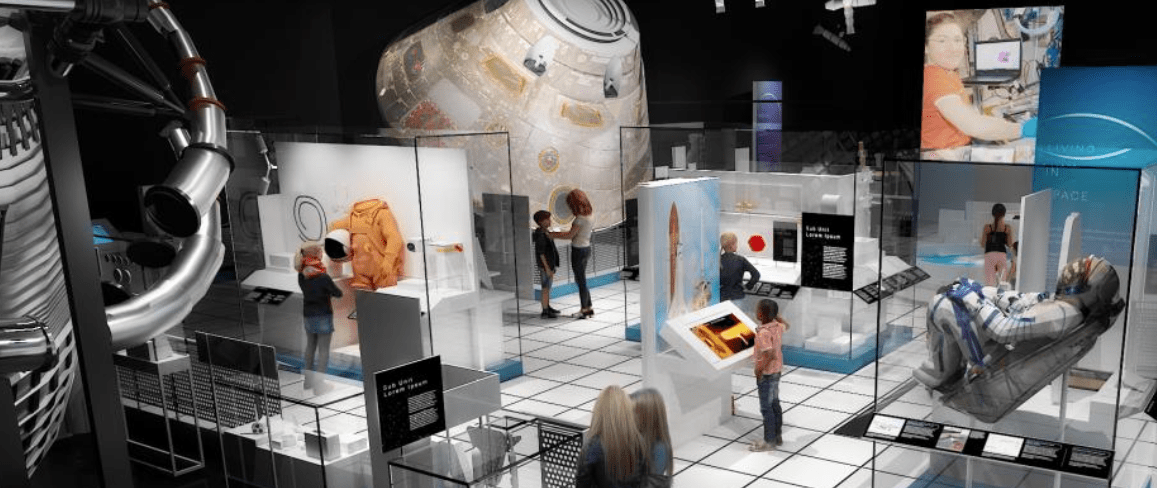
- At Home in Space: An immersive, highly interactive exhibition, At Home in Space takes visitors along a 40+ year journey of learning how humans can live and work in space continuously and venture beyond Earth orbit. (Opening by 2026)
- Futures in Space: The Futures in Space exhibition will explore the potential near- and long-term futures that may emerge with advances in space exploration technology and enterprise. The gallery will feature developing technologies that bring down the cost of space, aim to inaugurate the era of commercial and tourist spaceflight, expand robotic planetary exploration and resource extraction, and keep humans alive in new environments. Futures in Space will also explore the as-yet unanswered social, political, and economic questions that emerge along with these new activities: Who decides who goes to space? Why do we go? And what will we do when we get there? (Opening by 2026)
- National Science Foundation Discovering Our Universe: Discover the history of modern astronomy and where the field is headed. Explore how we find answers in astronomy, how that process has changed over time, and how those answers tend to raise deeper questions. (Opening by 2026)
- RTX Living in the Space Age Hall: The RTX Living in the Space Age Hall will provide insight into space technologies and infrastructure that are largely invisible to the public but have a profound impact on our daily lives. The exhibition will cover topics from the beginning of the Space Age in the mid-20th century to the present and beyond. Visitors can explore these stories through Space Age objects and the people who build, maintain, and use them. The content will include the development of rocket technology that has enabled access to space, missile development, space systems for Earth observation, communication, and navigation, and the threats to these systems. (Opening by 2026)