Uncle Sam is starting up a new website so the public can report UFOs, or Unidentified Anomalous Phenomena (UAP) to use the politically correct term. The Pentagon’s All-domain Anomaly Resolution Office (AARO) is building the website, which notes:
AARO will be accepting reports from current or former U.S. Government employees, service members, or contractors with direct knowledge of U.S. Government programs or activities related to UAP dating back to 1945. These reports will be used to inform AARO’s congressionally directed Historical Record Report.
You can already find some of the UAP data trends on the AARO website, such as the graphic below.
And what type of information is the government collecting on these UAPs? This page summarizes some of the reporting criteria. Once the website is up, the specific reporting criteria will be shared.
Keep looking up, and keep a notebook by your side.
Image (Credit): Reported-UAP hot spots per published statistics as of April 17, 2023. (AARO)
Image (Credit): SpaceX’s Starbase in Boca Chica, Texas. (SpaceX)
“The final mishap investigation report cited a total of sixty-three (63) corrective actions for SpaceX to implement. These included actions to address redesigns of vehicle hardware to prevent leaks and fires, redesign of the launch pad to increase its robustness, incorporation of additional reviews in the design process, additional analysis and testing of safety critical systems and components including the Autonomous Flight Safety System (AFSS), and the application of additional change control practices.”
-Statement in a September 7, 2023 letter from the Federal Aviation Administration to SpaceX regarding its April 20, 2023 Starship launch from Boca Chica, Texas. These correction actions are expected to be implemented before the next launch can proceed. No date for the next Starship launch has been shared to date.
Nearly a year ago, NASA successfully smashed an asteroid for the first time, in a landmark test to see whether we could divert a killer space rock before disaster — but now, the asteroid in question is behaving strangely. As New Scientist reports, a schoolteacher and his pupils seem to have discovered that the orbit of Dimorphos, the space rock socked by the Double Asteroid Redirection Test (DART) last September, has apparently continued slowing down, unexpectedly, in the year since the refrigerator-sized craft smashed into it.
Researchers from Japan predict, based on computer simulations, the likely existence of an Earth-like planet in the distant Kuiper Belt. There are many unexplained anomalies in the orbits and distribution of trans-Neptunian objects, small celestial bodies located at the outer reaches of the solar system. Now, based on detailed computer simulations of the early outer solar system, researchers from Japan predict the possibility of an undiscovered Earth-like planet beyond Neptune orbiting the Sun. Should this prediction come true, it could revolutionize our understanding of the history of the solar system.
The Japan Aerospace Exploration Agency’s (JAXA) X-Ray Imaging and Spectroscopy Mission (XRISM) lifted off on a H-IIA rocket from the Tanegashima Space Center in Japan at 08:42 JST / 00:42 BST / 01:42 CEST on 7 September 2023. The successful launch marks the beginning of an ambitious mission to explore the growth of galaxy clusters, the chemical make-up of the Universe, and the extremes of spacetime. XRISM is a collaboration between JAXA and NASA, with significant participation from ESA.
Image (Credit): Photo of the Vikram lander, which put the Pragyan rover on the Moon. (ISRO via AP/Alamy)
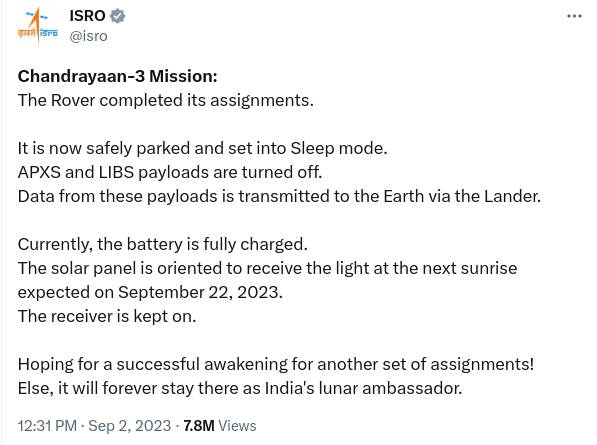
After a few weeks of work, India’s Pragyan rover on the Moon’s south pole was put to sleep last weekend to sit out the long lunar evening. It accomplished all of its goals, according to a Tweet from the Indian Space Research Organisation (ISRO):
We shall know in a few weeks whether the little lander is ready for more work.
Nature magazine noted some of the findings from the rover’s primary mission, including:
ions and electrons swirling near the lunar pole;
variations in soil temperature;
a moonquake; and
presence of sulfur and other elements.
Whatever happens, the Indian rover has been a great success.
Image (Credit): NGC 6530 as captured by the NASA/ESA Hubble Space Telescope. (ESA/Hubble & NASA, ESO, O. De Marco)
This week’s image is from the Hubble Space Telescope. It shows a fantastic array of colors from a portion of NGC 6530, which is about 4,350 light-years from Earth.
A portion of the open cluster NGC 6530 appears as a roiling wall of smoke studded with stars in this image from the NASA/ESA Hubble Space Telescope…The cluster is set within the larger Lagoon Nebula, a gigantic interstellar cloud of gas and dust. It is the nebula that gives this image its distinctly smokey appearance; clouds of interstellar gas and dust stretch from one side of this image to the other.
You can also watch this short video that pans over the cluster.






 Our Awesome Universe