If you don’t understand the research title, you are not alone. The abstract is even worse:
The cluster mass–richness relation (MRR) is an observationally efficient and potentially powerful cosmological tool for constraining the matter density Ωm and the amplitude of fluctuations σ8 using the cluster abundance technique. We derive the MRR relation using GalWCat19, a publicly available galaxy cluster catalog we created from the Sloan Digital Sky Survey-DR13 spectroscopic data set. In the MRR, cluster mass scales with richness as  . We find that the MRR we derive is consistent with both the IllustrisTNG and mini-Uchuu cosmological numerical simulations, with a slope of β ≈ 1. We use the MRR we derived to estimate cluster masses from the GalWCat19 catalog, which we then use to set constraints on Ωm and σ8. Utilizing the all-member MRR, we obtain constraints of Ωm =
  and σ8 =
  , and utilizing the red member MRR only, we obtain Ωm =
  and σ8 =
  . Our constraints on Ωm and σ8 are consistent and very competitive with the Planck 2018 results.
Where is Carl Sagan when you need him? I know these are scientific journals, but plain language abstracts should be possible.
Luckily, the university released a press release on the study findings. Here is the bottom line:
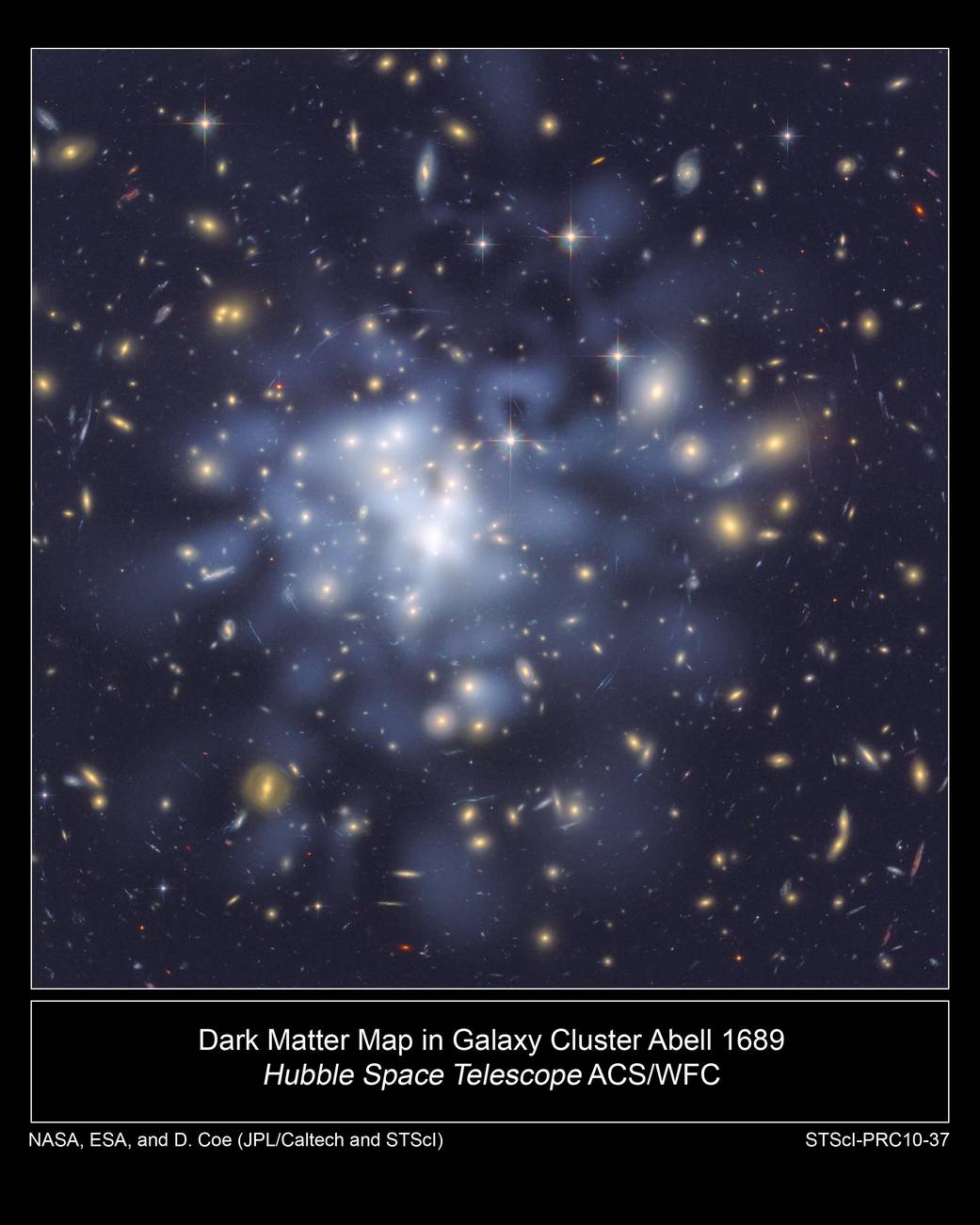
A UC Merced researcher and her teammates around the world have succeeded in measuring the total amount of matter in the universe for the second time. A new paper in the Astrophysical Journal, titled “Constraining Cosmological Parameters using the Cluster Mass-Richness Relation,” shows that matter makes up 31% of the universe, with the remainder consisting of dark energy — answering one of the most interesting and important questions in cosmology.
Now that wasn’t too hard. If you want to read the paper itself, you can find the details here.
Good luck.