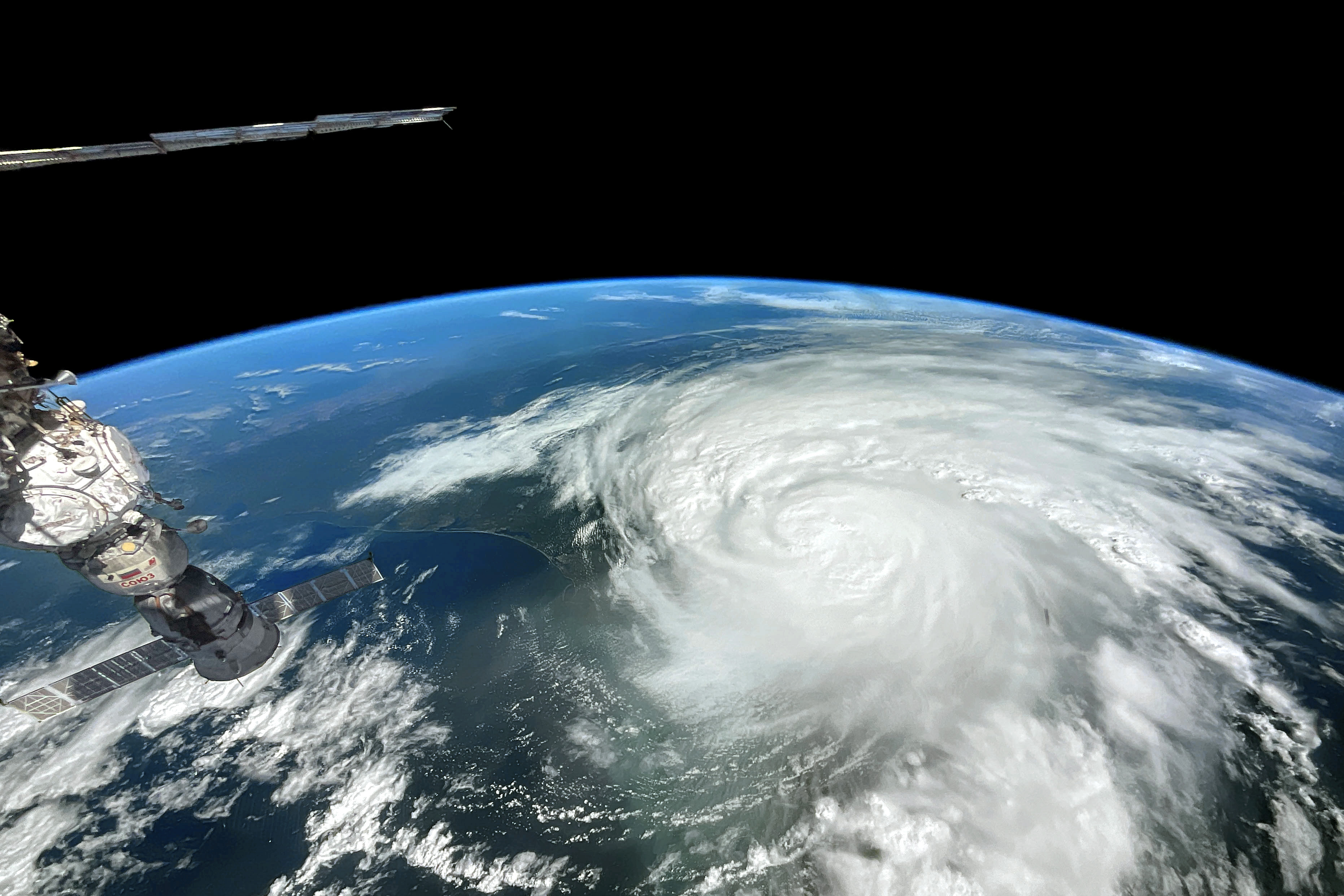
Image (Credit): Hurricane Idalia as it travels over Florida. (NASA)
The image above showing Idalia hitting Florida was captured from the International Space Station on August 30, 2023.
Here is the full explanation about the image from the site:
An astronaut on the International Space Station used a handheld camera to capture the second photo (below) at 10:44 a.m. Eastern Time (14:44 Universal Time) on August 30, several hours after landfall. Idalia had weakened to a category 1 storm by this time with sustained winds of 150 kilometers (90 miles) per hour. It continued to weaken as it moved northeast over Georgia, South Carolina, and then offshore over the Atlantic Ocean on August 31.
If you are wondering where the James Webb Space Telescope (JWST) will be looking in the future, some of that is known and some has yet to be determined. The approved targets of the space telescope can be found at the Programmatic Categories of JWST Science Observations site.
The site breaks the approved targets into these six categories:
General Observer (GO) Programs: Observations and archival research proposed by the community and selected by peer review.
Guaranteed Time Observations (GTO) Programs: Observations defined by members of the instrument and telescope science teams, as well as a number of interdisciplinary scientists.
Director’s Discretionary Time (DDT): Time-critical observations that cannot be scheduled for a regular proposal cycle.
Director’s Discretionary Early Release Science (DD-ERS) Programs: Observations to be executed within the first five months of science operations and immediately released to the community.
Calibration Programs: Observations used to calibrate the science instruments in support of all the other science programs.
First Image Observations: The first observations following commissioning to demonstrate the observatory’s capabilities.
The GO Programs have been decided through Cycle 2. Earlier this month, the Space Telescope Science Institute put out a call for Cycle 3 Call for Proposals for the GO Programs. Proposals are due by October 25, 2023 and selected proposals will be announced in February 2024.
Take a look at the existing list and you will find plenty of interesting areas of study. For instance, under the Cycle 3 GTO Programs you have areas such as:
Image (Credit): Earlier SN10 Starship prototype bursting into flames and exploding soon after landing. (NASASpaceflight)
Last week, The Wall Street Journal had a good story on Elon Musk titled “Elon Musk’s Latest Antics Have Some Asking: Is He Out of Touch?” It discuses his frat-like behavior challenging Meta’s Mark Zuckerberg to a fight, his strange behavior at Twitter, and the shrinking set of friends and colleagues able to keep him from going adrift in his own bubble. The story notes:
Such antics are leading some Musk supporters to worry aloud that he has lost touch, saying he is ensconced in a distorted reality that is warping his perspective and threatening his businesses at a time when he is trying to oversee multiple companies in different industries.
Of course, one of those companies is SpaceX, which has become the backbone of NASA and the US satellite industry. SpaceX also runs Starlink, which is now a key part of the battle against Russia as it supplies Internet services to the Ukrainian military.
Musk has styled himself as the Trump of Technology – breaking established rules, failing to pay his bills, attacking critics (in-house, as well), and generally seeing what he can get away with before it all collapses.
Can one distracted man manage all of these companies? Should one distracted man manage all of these companies? And should our government be so reliant on him in the space and defense arenas? Or is SpaceX becoming the next Wagner Group, a government-funded satellite that is starting to think it is smarter than its paymaster? We all know how that ended.
We’re talking about Elon – again – but this time we’re looking at the big picture: the tech titan’s “unprecedented power” over our the federal government and national security, as encapsulated in Pulitzer Prize-winning reporter Ronan Farrow’s latest New Yorker profile. William Cohan, a financial journalist and founding partner of Puck News, also joins to break down the varying fortunes of SpaceX, Tesla and Twitter, and the sustainability of those companies under a leader that is ambitious, but capricious. Stay til the end to hear Kara tell Nayeema why, despite his shenanigans, she still has empathy for Elon Musk.
You should also check out Ronan Farrow’s The New Yorker article, “Elon Musk’s Shadow Rule.” While acknowledging that some industrialists have had inordinate influence over US politics in the past, the piece notes:
But Musk’s influence is more brazen and expansive. There is little precedent for a civilian’s becoming the arbiter of a war between nations in such a granular way, or for the degree of dependency that the U.S. now has on Musk in a variety of fields, from the future of energy and transportation to the exploration of space.
This really doesn’t sound all that sustainable, or wise. I hope Uncle Sam has a Plan B should Musk run it all into the ground or walks away with all of his marbles (assuming has has any left).
With its budget being trimmed for 2024, NASA is making some weighty decisions… and one includes drastically trimming New Horizons funds by replacing the current science staff with a new team in an effort to save about $3 million—a rounding error in terms of the planetary science budget...As it stands, New Horizons will exit the Kuiper Belt around 2028 and should continue operating until 2050.
Using ESO’s Very Large Telescope (VLT), astronomers have observed a large dark spot in Neptune’s atmosphere, with an unexpected smaller bright spot adjacent to it. This is the first time a dark spot on the planet has ever been observed with a telescope on Earth. These occasional features in the blue background of Neptune’s atmosphere are a mystery to astronomers, and the new results provide further clues as to their nature and origin.
We will soon have more than 10,000 worlds where life might be able to survive. It’s an amazing idea, but with so many exoplanets we don’t have the resources to search for life on all of them. So how do we prioritize our search? That’s the focus of a recent paper on the pre-print server arxiv. In it, the team strives to identify the “best in class” candidates for exoplanets that could be further studied by the spectroscopic cameras of the James Webb Space Telescope (JWST). Their list could not only help astronomers find evidence of life but also help us understand the range of atmospheres exoplanets have.
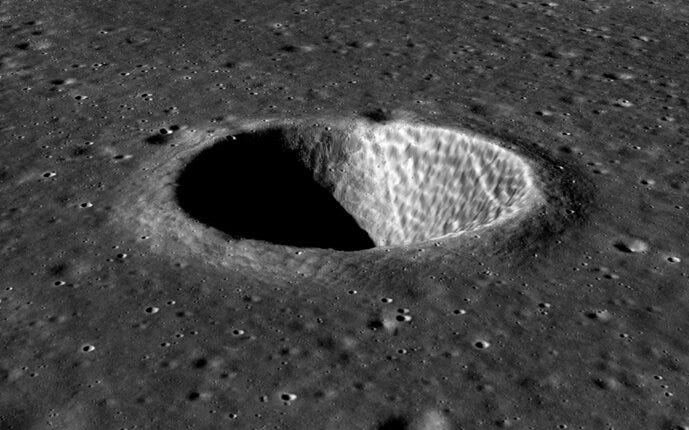
Image (Credit): 3D view of a crater on the Moon generated from images captured by Chandrayaan 2 orbiter’s Terrain Mapping Camera in 2019. (ISRO)
“…a comparison with India is illuminating: India’s economy was about half the size of Russia’s when the Berlin Wall came down in 1989. Today, India’s economy is 50 percent bigger than Russia’s. Forget about keeping pace with the United States: Russia can’t keep up with India.”