
Take a look at the image above. Can you determine where this image originated? Take a guess and then check your answer by going to the menu and selecting the “Where is This?” The Answer Sheet page.

Take a look at the image above. Can you determine where this image originated? Take a guess and then check your answer by going to the menu and selecting the “Where is This?” The Answer Sheet page.
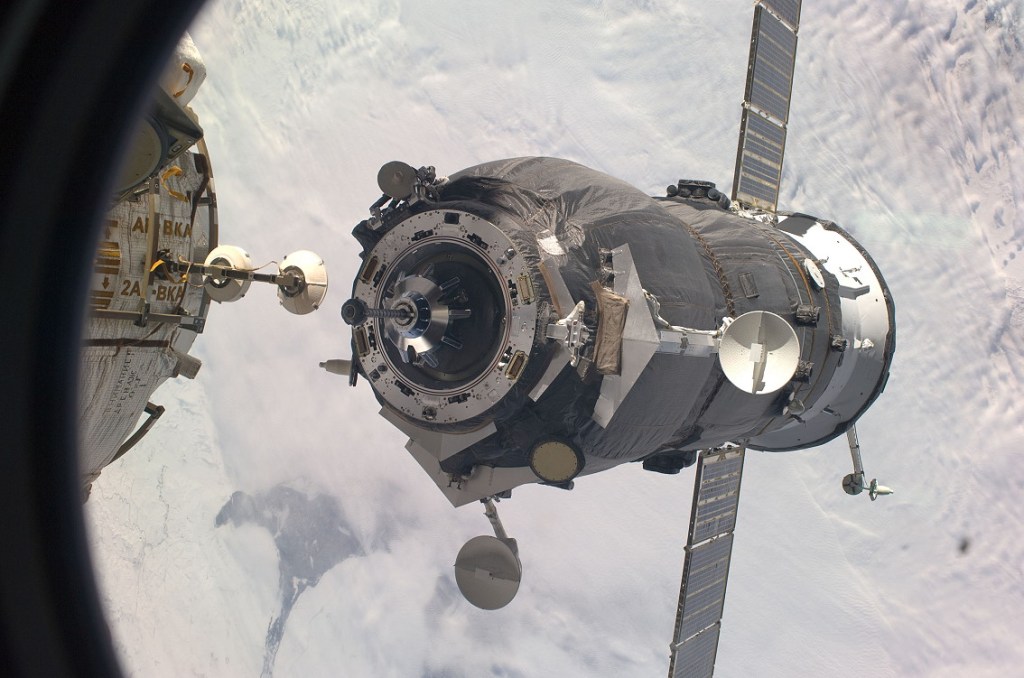
Fortunately, we now know the source of the leak in the extra Soyuz Crew Return Vehicle attached to the International Space Station (ISS). However, we do not know the cause of this radiator coolant leak, which creates risk should the capsule be used early next year to bring two cosmonauts and an astronaut back to Earth. Hence, it may be better to bring another capsule up to the ISS for the change in crew and send the damaged one back empty for repairs.
The ISS doesn’t technically have an escape pod. Instead, a Crew Return Vehicle more or less serves this purpose. It has been used more than once to host astronauts and cosmonauts fleeing space junk, so maybe it’s time to think over these procedures again. You would think a $100 billion orbiting space station could ensure the survival of its passengers.
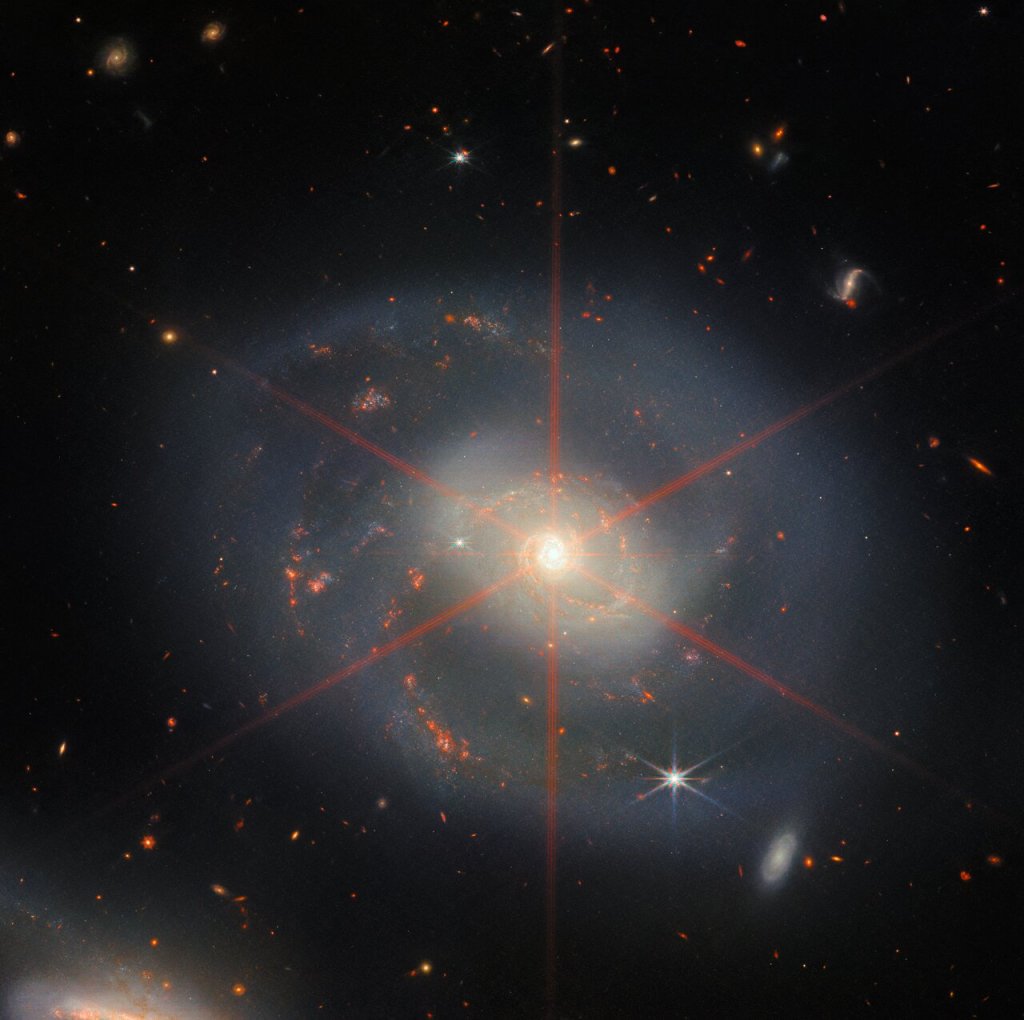
This week’s image is from the James Webb Space Telescope (JWST). It is a face-on view of wreath-like spiral galaxy NGC 7469, which is about 220 million light-years from Earth.
Here is a little more from the European Space Agency on the image:
While NGC 7469 is one of the best studied AGNs in the sky, the compact nature of this system and the presence of a great deal of dust have made it difficult for scientists to achieve both the resolution and sensitivity needed to study this relationship in the infrared. Now, with Webb, astronomers can explore the galaxy’s starburst ring, the central AGN, and the gas and dust in between. Using Webb’s MIRI, NIRCam and NIRspec instruments to obtain images and spectra of NGC 7469 in unprecedented detail, the GOALS team has uncovered a number of details about the object. This includes very young star-forming clusters never seen before, as well as pockets of very warm, turbulent molecular gas, and direct evidence for the destruction of small dust grains within a few hundred light-years of the nucleus — proving that the AGN is impacting the surrounding interstellar medium. Furthermore, highly ionised, diffuse atomic gas seems to be exiting the nucleus at roughly 6.4 million kilometres per hour — part of a galactic outflow that had previously been identified, but is now revealed in stunning detail with Webb. With analysis of the rich Webb datasets still underway, additional secrets of this local AGN and starburst laboratory are sure to be revealed.
A prominent feature of this image is the striking six-pointed star that perfectly aligns with the heart of NGC 7469. Unlike the galaxy, this is not a real celestial object, but an imaging artifact known as a diffraction spike, caused by the bright, unresolved AGN. Diffraction spikes are patterns produced as light bends around the sharp edges of a telescope. Webb’s primary mirror is composed of hexagonal segments that each contain edges for light to diffract against, giving six bright spikes. There are also two shorter, fainter spikes, which are created by diffraction from the vertical strut that helps support Webb’s secondary mirror.
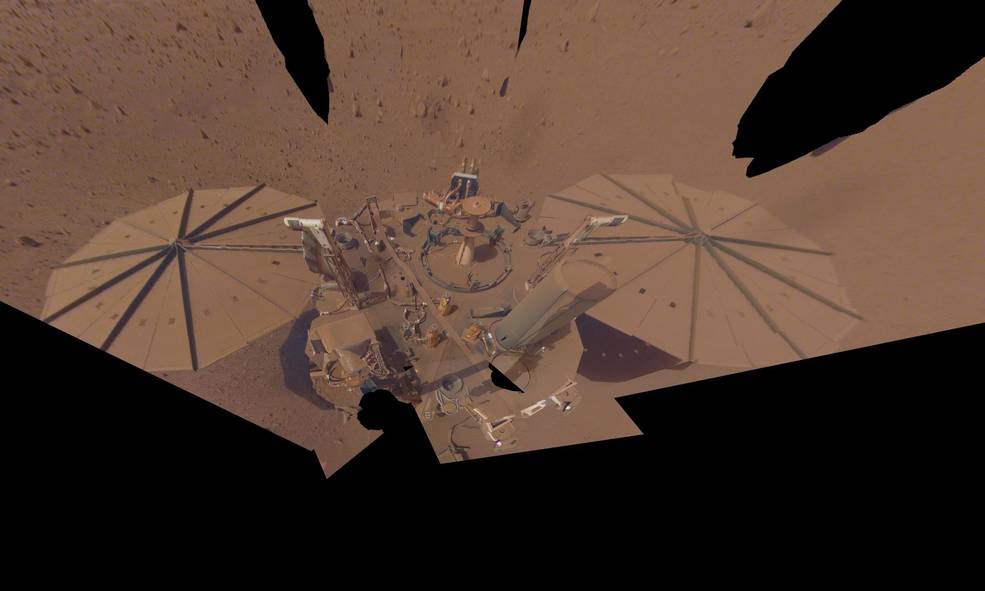
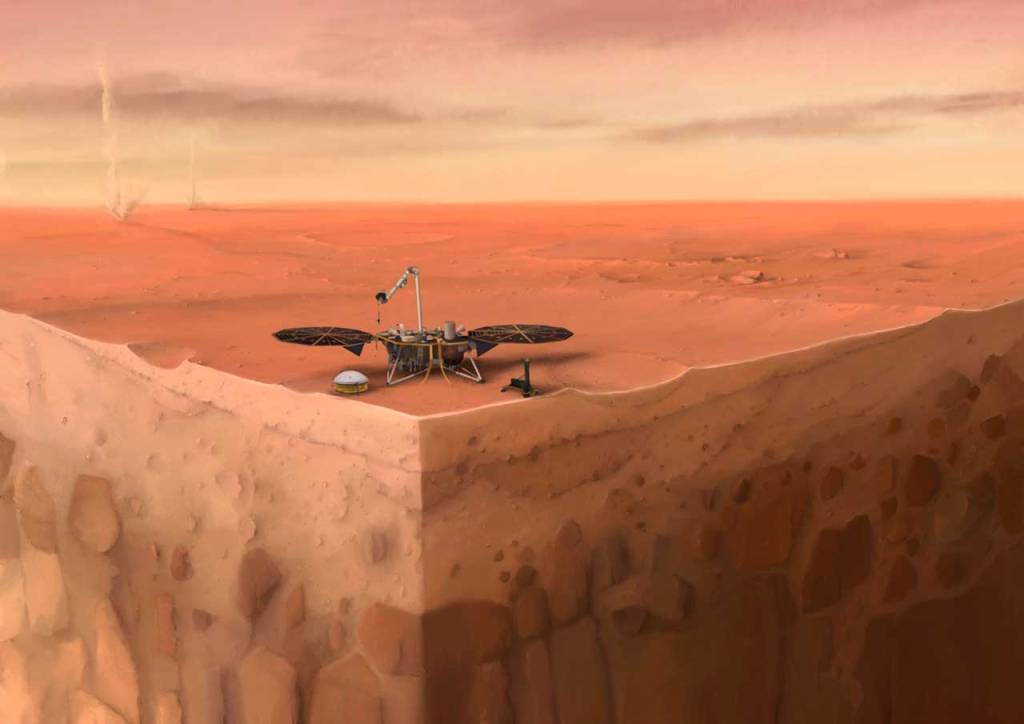
NASA’s Jet Propulsion Laboratory (JPL) is no longer able to contact the Interior Exploration using Seismic Investigations, Geodesy and Heat Transport (InSight) Mars lander, which has been hard at work on the Red Planet for the past four years detecting more than 1,300 marsquakes. However, the accumulation of dust on the lander’s solar panels has ended its ability to power itself. The last communication from InSight was December 15.
Philippe Lognonné of Institut de Physique du Globe de Paris, principal investigator of InSight’s seismometer, stated:
With InSight, seismology was the focus of a mission beyond Earth for the first time since the Apollo missions, when astronauts brought seismometers to the Moon…We broke new ground, and our science team can be proud of all that we’ve learned along the way.
You can read more about the InSight Mar lander’s findings here.

“Say hello to the entire American team. They proved themselves to be very worthy in this situation and lent us a helping hand…You set an example for the whole world on how to work together in the most challenging and difficult situation. Let many politicians learn from you.“
-Statement by Yuri Borisov, head of Russian space agency Roscosmos, on Tuesday praising Russia-U.S. cooperation at the International Space Station (ISS) following a major coolant leak from a Soyuz crew capsule. The transcript was quoted in The Moscow Times. The ISS remains one of the limited areas where the U.S. and Russia are still cooperating given the situation in Ukraine.

