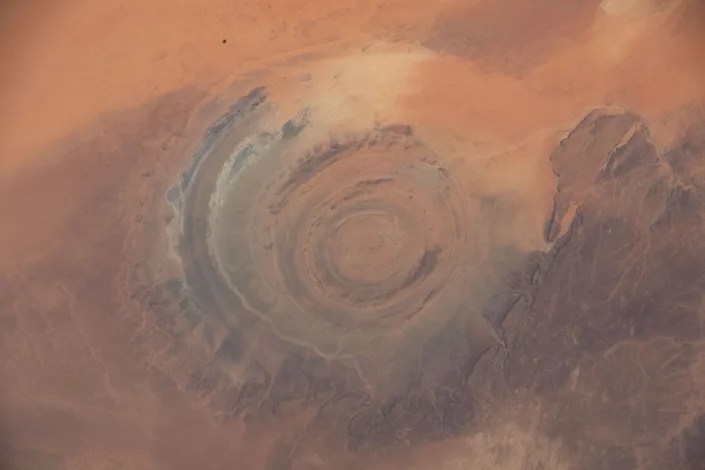
Take a look at the image above. Can you determine where this image originated? Take a guess and then check your answer by going to the menu and selecting the “Where is This? The Answer Sheet” page.

Take a look at the image above. Can you determine where this image originated? Take a guess and then check your answer by going to the menu and selecting the “Where is This? The Answer Sheet” page.

While the Biden Administration appears to have its issues with Saudi Arabia, this is not stopping the visit of two Saudi Arabian private astronauts to the International Space Station (ISS). Space News reports that NASA has confirmed that a male and female astronaut from Saudi Arabia will travel to the ISS next spring aboard a SpaceX rocket as part of the privately-run Axiom Space. Plans for this mission were reported back in September.
This will be the second Axiom Space mission to the ISS. Other missions are being planned involving additional countries, including astronauts from Turkey, Hungary, Canada, and the United Arab Emirates. Mission participants need to be approved by a NASA-chaired panel that includes the countries involved with the ISS program.
Axiom Space will send four crew members to the ISS for 12 days. Here is the pitch for the second mission, or Ax-2:
The Axiom Mission 2 (Ax-2) astronauts are part of the latest class of space explorers and Axiom’s next crew to advance a new method of access to the International Space Station (ISS) and low-Earth orbit. Aboard the orbiting laboratory, the four-person, multinational crew will conduct extensive research, investigate novel technologies, and engage with audiences around the world as champions of science, technology, engineering, mathematics, and the arts. Their efforts will continue to lay the groundwork and establish key capabilities for the future Axiom Station, the world’s first commercial space station.
You may recall that Saudi Arabia also signed onto the Artemis Accords over the summer. The Accords were established in 2020 to affirm each signatory’s commitment to sustainable space exploration “guided by a common set of principles that promote the beneficial use of space for all of humanity.”
All of this shows that space still remains a realm that does not need to be militarized or abused even if we have yet to figure out to resolve these issues here on Earth. Whatever problems with have with our neighbors, it’s good to see we are building some things together.
As noted earlier, even if the press on this Ax-2 mission demonstrates some unity, let’s just hope these “astronauts” are there for more than a joy ride. I am not convinced that space tourism is what we need. But given that Axiom Space is considering its own commercial space station, maybe there is some interest in real work in space by these parties.

Back on October 13th we lost another Apollo astronaut. James McDivitt, age 93, passed away in his sleep.
Mr. McDivitt, a veteran fighter pilot from the Korean War, was a key part of the Gemini and Apollo missions. Part of NASA’s second class of astronauts, he was commander of the Gemini IV mission in June 1965, which conducted the first U.S. space walk, as well as the commander of Apollo 9, which set the stage for astronauts to land on the Moon.
As Andy Weir, author of The Martian, stated, “Astronauts are inherently insane. And really noble.” We should all remember the noble work of Mr. McDivitt and his peers in the early space program.
For more on Mr. McDivitt’s life, you can visit this NASA press release as well as this Washington Examiner obituary.
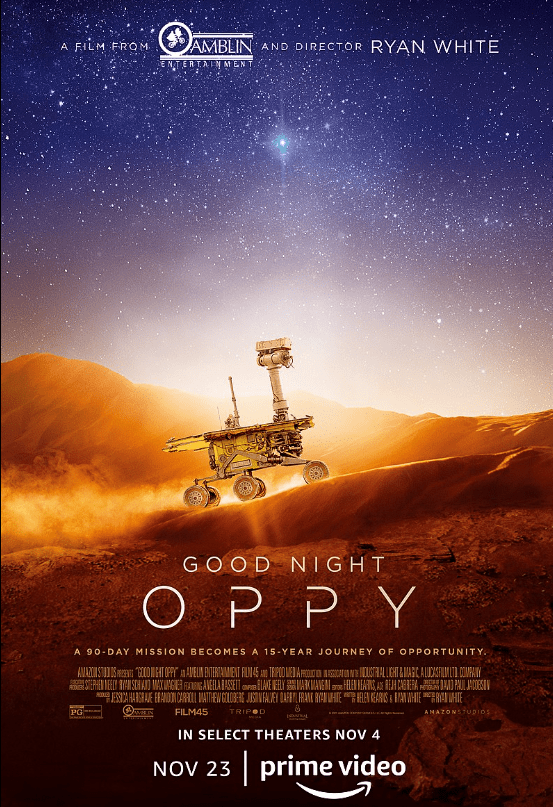
Here is a new space movie that should keep the crowds happy, and it is based on a true success – our mission to Mars. Good Night Oppy, produced by Amazon Studios, is the story of NASA’s Opportunity Mars rover. You can watch a preview here.
Amazon Studies has this preview:
Good Night Oppy tells the inspirational true story of Opportunity, a rover that was sent to Mars for a 90-day mission but ended up surviving for 15 years. The film follows Opportunity’s groundbreaking journey on Mars and the remarkable bond forged between a robot and her humans millions of miles away.
The film, narrated by Angela Bassett, has the same feel as the 1985 film The Dream is Alive, which was narrated by Walter Cronkite and covered the space shuttle missions. While one might claim these are simple feel good movies, I say spread the word about the space missions far and wide. We should be proud of what we have done as well as where we plan to go.
The film will be available in selected theaters today and on Amazon Prime November 23, 2022.
You can learn more about the Opportunity rover here, and its sister rover Spirit here.


This week’s image is from earlier this year when NASA’s Perseverance Mars rover captured whirling dust on the Red Planet’s surface. Here is more on the dust devils from NASA:
During its first couple hundred days in Jezero Crater, NASA’s Perseverance Mars rover saw some of the most intense dust activity ever witnessed by a mission sent to the Red Planet’s surface. Not only did the rover detect hundreds of dust-bearing whirlwinds called dust devils, Perseverance captured the first video ever recorded of wind gusts lifting a massive Martian dust cloud.
A paper recently published in Science Advances chronicles the trove of weather phenomena observed in the first 216 Martian days, or sols. The new findings enable scientists to better understand dust processes on Mars and contribute to a body of knowledge that could one day help them predict the dust storms that Mars is famous for – and that pose a threat to future robotic and human explorers.
“Every time we land in a new place on Mars, it’s an opportunity to better understand the planet’s weather,” said the paper’s lead author, Claire Newman of Aeolis Research, a research company focused on planetary atmospheres. She added there may be more exciting weather on the way: “We had a regional dust storm right on top of us in January, but we’re still in the middle of dust season, so we’re very likely to see more dust storms.”

