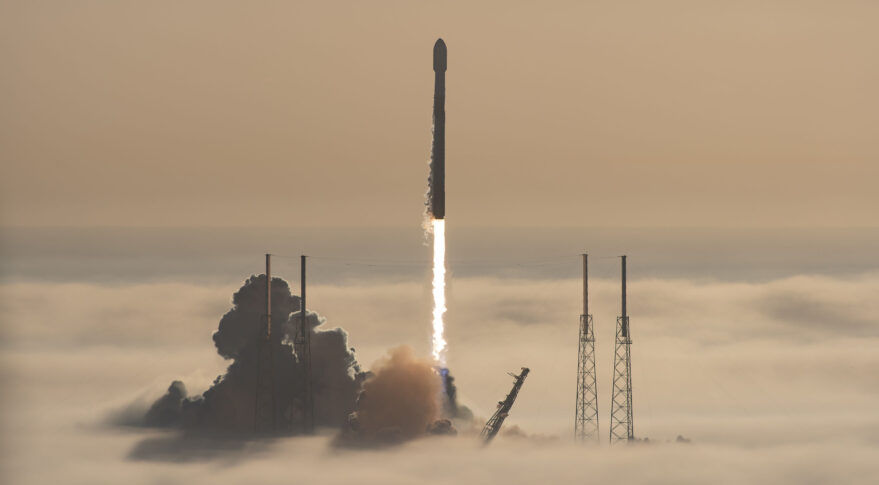
Image (Credit): November 13, 2021 SpaceX launch of 53 Starlink satellites. (SpaceX)
“Quasi-civilian infrastructure may be a legitimate target for a retaliatory strike.”
-Statement to the United Nations by Russian senior foreign ministry official Konstantin Vorontsov in reference to attacking SpaceX’s Starlink satellites being used by the Ukrainian military as it pushes back the Russian invasion. In a Reuters article, “Russia’s Anti-satellite Threat Tests Laws of War in Space,” Iridium chief executive Matt Desch stated, “If somebody starts shooting satellites in space, I’d imagine it would quickly make space unusable.”
Image (Credit): JWST deep field view of the cosmos. (NASA, ESA, CSA, STScI)
This week we have another recent image from the James Webb Space Telescope (JWST) showing a thousands of galaxies, some of which have images distorted by the gravity of other galaxies. It is quite a collection of distant worlds.
Thousands of galaxies flood this near-infrared image of galaxy cluster SMACS 0723. High-resolution imaging from NASA’s James Webb Space Telescope combined with a natural effect known as gravitational lensing made this finely detailed image possible.
First, focus on the galaxies responsible for the lensing: the bright white elliptical galaxy at the center of the image and smaller white galaxies throughout the image. Bound together by gravity in a galaxy cluster, they are bending the light from galaxies that appear in the vast distances behind them. The combined mass of the galaxies and dark matter act as a cosmic telescope, creating magnified, contorted, and sometimes mirrored images of individual galaxies.
Clear examples of mirroring are found in the prominent orange arcs to the left and right of the brightest cluster galaxy. These are lensed galaxies – each individual galaxy is shown twice in one arc. Webb’s image has fully revealed their bright cores, which are filled with stars, along with orange star clusters along their edges.
Not all galaxies in this field are mirrored – some are stretched. Others appear scattered by interactions with other galaxies, leaving trails of stars behind them.
Image (Credit): Image from NASA’s Lucy spacecraft showing the Earth and Moon from 890,000 miles away (look closely – the moon on the left is a very pale dot). (NASA/Goddard/SwRI)
On October 13, 2022, NASA’s Lucy spacecraft captured [the above] image of the Earth and the Moon from a distance of 890,000 miles (1.4 million km). The image was taken as part of an instrument calibration sequence as the spacecraft approached Earth for its first of three Earth gravity assists. These Earth flybys provide Lucy with the speed required to reach the Trojan asteroids — small bodies that orbit the Sun at the same distance as Jupiter. On its 12 year journey, Lucy will fly by a record breaking number of asteroids and survey their diversity, looking for clues to better understand the formation of the solar system.
The Chinese Academy of Sciences is considering potential missions including a Ceres orbiter and a huge telescope to hunt for clues about the nature of dark matter.More than 20 candidates are vying for funding for further study under the Chinese Academy of Sciences Strategic Priority Program on Space Science, also known as the New Horizon Program, and are currently undergoing evaluation.
One of Earth’s toughest microbes could survive on Mars, lying dormant beneath the surface, for 280 million years, new research has shown. The findings increase the probability that microbial life could still exist on the Red Planet. Deinococcus radiodurans, nicknamed “Conan the Bacterium,” is one of the world’s toughest microbes, capable of surviving in radiation strong enough to kill any other known life-form. Experiments have now shown that if Conan the Bacterium or a similar microbe existed on Mars, it could survive 33 feet (10 meters) beneath the surface, frozen and dried out, for 280 million years.
[China’s] Chang’E-5 (CE5) mission has demonstrated that lunar volcanism was still active until two billion years ago, much younger than the previous isotopically dated lunar basalts. How the small Moon retained enough heat to drive such late volcanism is unknown, particularly as the CE5 mantle source was anhydrous and depleted in heat-producing elements. We conduct fractional crystallization and mantle melting simulations that show that mantle melting point depression by the presence of fusible, easily melted components could trigger young volcanism. Enriched in calcium oxide and titanium dioxide compared to older Apollo magmas, the young CE5 magma was, thus, sourced from the overturn of the late-stage fusible cumulates of the lunar magma ocean. Mantle melting point depression is the first mechanism to account for young volcanism on the Moon that is consistent with the newly returned CE5 basalts.
Citation: Su, B., Yuan, J., Chen, Y., et al. Fusible mantle cumulates trigger young mare volcanism on the cooling Moon. Science Advances (2022). https://doi.org/10.1126/sciadv.abn2103
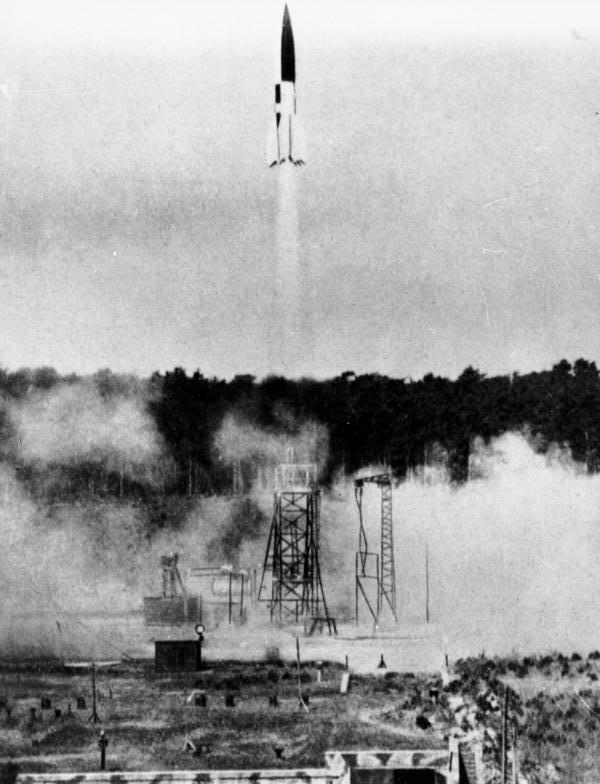
On this day in 1946, we saw the Earth from space for the first time in history, and the sub-orbital motion pictures were captured by a V-2 rocket, a deadly German weapon that was finally put to good use. The U.S. launched the missile from the White Sands Missile Range in New Mexico. The rocket went as high as 65 miles, providing the best view of Earth up to that point. You can watch a short film on YouTube about the space trip here.
If you want learn more about the man who created the V-2 rocket for the Nazis, Wernher von Braun, then I recommend you check out Moonrise, a podcast I highlighted in an earlier post.
While the V-2 was a useful step into the space age, it was less useful as a weapon to the Germans. More people died making the rocket than died as a result of being a target of it. But today, the V-2 is both the source of space exploration as well as intercontinental ballistic missiles that could end humanity once and for all.