Image (Credit): Lightening striking the Artemis I launch pad on August 27, 2022. (NASA)
Even after thunderstorms threatened the Artemis I launchpad over the weekend, everything is still a go for tomorrow’s scheduled launch at 8:33 am EDT of NASA’s Space Launch System rocket.
This NASA video shows you the entire plan for the Artemis I unmanned mission around the Moon. A few mission facts from the NASA site are also provided below.
Mission Facts:
Launch date: Aug. 29, 2022
Mission duration: 42 days, 3 hours, 20 minutes
Total distance traveled: 1.3 million miles
Re-entry speed: 24,500 mph (Mach 32)
Splashdown: Oct. 10, 2022
Now all we can do it await the new day.
Update: Given some engine problems Monday morning, it appears we will need to wait a little longer for this launch. The next window is September 2nd if NASA is ready. We have waited this long, so a few more days will not matter too much. I think the dummies on board are pretty patient.
With the Artemis I mission ready to go on Monday, it is worth taking a moment to remember the Kennedy Space Center’s (KSC) 60th anniversary. As shown in the NASA graphic below, the KSC has been very busy over the years and has much more to do. This NASA site has more information and memories. This video also highlights some key moments in space history as well as some dreams about the future.
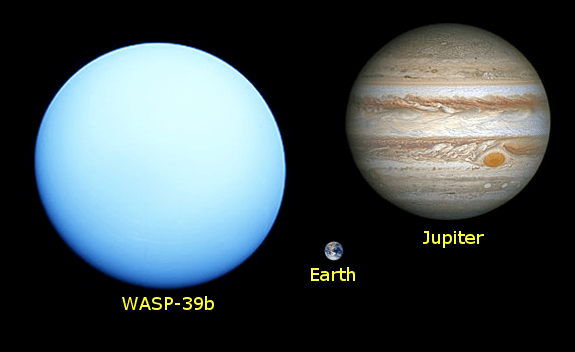
Image (Credit): Comparison of exoplanet WASP-39b to Earth and Jupiter. (wasp-planets.net)
Yesterday, the University of Maryland reported that the James Webb Space Telescope (JWST) has detected carbon dioxide in the atmosphere of exoplanet WASP-39b, a gas giant about 700 light-years away. This is the first time carbon dioxide has been detected on a planet outside of our solar system.
Eliza Kempton, an associate professor of astronomy at the University of Maryland, stated:
The reason we hadn’t been able to definitively identify CO2 in the atmosphere of WASP-39 b previously was that we never had a telescope that could produce spectra across the right wavelength range…This discovery shows us that Webb is delivering on its promise of being a transformational facility for astronomical observations.
Natalie Batalha of the University of California at Santa Cruz, who leads the team, added:
Detecting such a clear signal of carbon dioxide on WASP-39 b bodes well for the detection of atmospheres on smaller, terrestrial-sized planets.
Again, the JWST is showing it is worth its weight in gold (see note below) as it peers through the universe and quickly observes things we only speculated about earlier.
Note: In fact, the JWST weights 14,300 lbs here on Earth, or 228,800 ounces. Today, gold costs $1,763.00 per ounce. So if the JWST was made of solid gold, it would cost about $403 million. Given that the JWST actually costed $10 billion to build and launch, in weight it is 25 times more valuable than gold.
Image (Credit): Jupiter as captured by the JWST. (NASA, ESA, CSA, Jupiter ERS Team; image processing by Ricardo Hueso (UPV/EHU) and Judy Schmidt)
This week’s image once again comes from the new James Webb Space Telescope (JWST), but instead of peering outside of our solar system, it is looking around closer to home. The image above of Jupiter is an amazing shot that shows the planet in all its glory – violent storms, glowing auroras, delicate rings, and orbiting moons. The particulars are labeled in the same image below.
The image came from the JWST’s Near-Infrared Camera (NIRCam), which NASA notes has:
…three specialized infrared filters that showcase details of the planet. Since infrared light is invisible to the human eye, the light has been mapped onto the visible spectrum. Generally, the longest wavelengths appear redder and the shortest wavelengths are shown as more blue. Scientists collaborated with citizen scientist Judy Schmidt to translate the Webb data into images.
This is a whole new way to see our neighborhood worlds as well as the worlds many light years away.
Image (Credit): Jupiter as captured by the JWST with all of the key areas labeled. (NASA, ESA, CSA, Jupiter ERS Team; image processing by Ricardo Hueso (UPV/EHU) and Judy Schmidt)
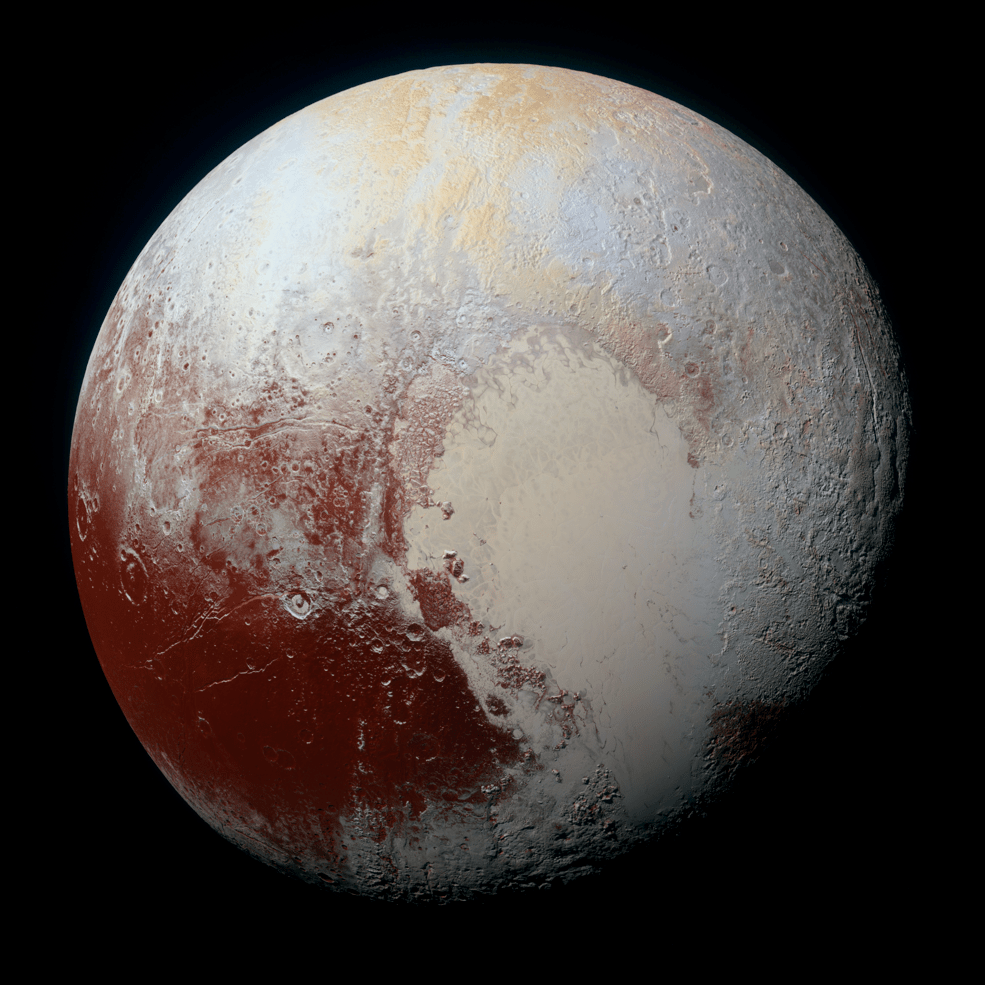
Image (Credit): Pluto as captured by NASA’s New Horizons spacecraft. (NASA/JHUAPL/SwRI)
On this day in 2006, the International Astronomical Union (IAU) approved a new definition of “planet” that excluded Pluto. The vote at the IAU approved the following definition of a planet:
is in orbit around the Sun,
has sufficient mass for its self-gravity to overcome rigid body forces so that it assumes a hydrostatic equilibrium (nearly round) shape, and
has cleared the neighborhood around its orbit.
Pluto fails this last test. In fact, many other objects, including at least one that may be larger (Eris), lie in the same orbit as Pluto around the Sun. However, Pluto does meet the definition of a “dwarf” planet:
is in orbit around the Sun,
has sufficient mass for its self-gravity to overcome rigid body forces so that it assumes a hydrostatic equilibrium (nearly round) shape,
has not cleared the neighborhood around its orbit, and
is not a satellite.
Hence, Pluto meets this definition whereas Europa, which is larger than Pluto, does not because it fails the last two tests – it has not cleared the neighborhood and it is a satellite.
The IAU vote was not popular. As one editorial argued, the third criteria about clearing the neighborhood makes little sense:
That last criterion states that a planet must be the gravitationally dominant object in the area of space in which it orbits. This rule makes sense for somewhere like, say, Earth, which is far more massive that the Moon and anything else along its orbital path. But out in the Kuiper Belt, where neighbouring bodies are far, far more distant than in the inner Solar System, Earth would not necessarily be able to clear its neighbourhood.
He continues:
This argument predates the flyby of Pluto in July 2015 of NASA’s New Horizons spacecraft, but the images returned by that spacecraft really help make the case: Pluto is an enigmatic world with towering ice mountains, vast glaciers of nitrogen ice, a tenuous atmosphere, a thick, outer icy carapace and a probably liquid water ocean below, all atop a huge rocky interior. By any geological measure – including the fact that there are surface processes acting on Pluto today – Pluto is a planet.
This will get more interesting once we throw in the exoplanets. Stay tuned.
Image (Credit): Some of the known dwarf planets. (Socratic.org)