Image (Credit): Russian cosmonaut Yuri Gagarin before his first flight on April 12, 1961. (London Science Museum)
On this day in 1961, Russian cosmonaut Yuri Gagarin became the first human to go into outer space. He was launched into orbit aboard the Soviet Vostok 1 spacecraft. He orbited the Earth for 108 minutes before landing in Kazakstan. He did not come down in the capsule, but instead landed separately using a parachute.
Yuri Gagarin was later quoted as saying:
When I orbited the Earth in a spaceship, I saw for the first time how beautiful our planet is. Mankind, let us preserve and increase this beauty, and not destroy it!
It was his only flight into space. He died in 1968 in a training flight accident.
The following month, on May 5, 1961, Alan B. Shepard became the first American in space. He was aboard a Mercury capsule named Freedom 7.
Image (Credit): Reentry capsule of the Vostok 1 with charring and its parachute on the ground after landing in Kazakhstan. (European Space Agency)
Image (Credit): Matt Damon on Mars in the film The Martian. (20th Century Fox)
Back in a November 2020 article, Science News discussed the difficulties of farming on Mars, noting it was not as easy as Matt Damon’s character made it seem in the film The Martian. In fact, toxins discovered in the Martian soil has proven that growing potatoes with a bit of man-made manure is not possible.
In the article, “Farming on Mars will be a Lot Harder Than ‘The Martian’ Made it Seem,” the author noted that researchers put together a variety of soil samples to match the surface of Mars and determined that the soil that most closely matched the Martian soil was unable to grow vegetation for any length of time. Once that soil was modified to include calcium perchlorate, which makes up about 2 percent of Martian soil, nothing could grow at all. In other words, Matt Damon would have starved if he only had a latrine to support him.
The researchers are testing other possible soil types using materials that can be found on Mars, so Martian potatoes (or at least legumes) may be possible. We will just need to send Mr. Damon back to Mars to test these new approaches.
Extra: The BBC’s Science Focus website posted a more hopeful article around the same time highlighting what can be grown on Mars, but it also outlined a number of problems that will impact Martian farming, including less sunlight, lower temperatures, thinner atmosphere, radiation, and extreme seasonal variations. We don’t always realize how good we have it back here on our home planet.
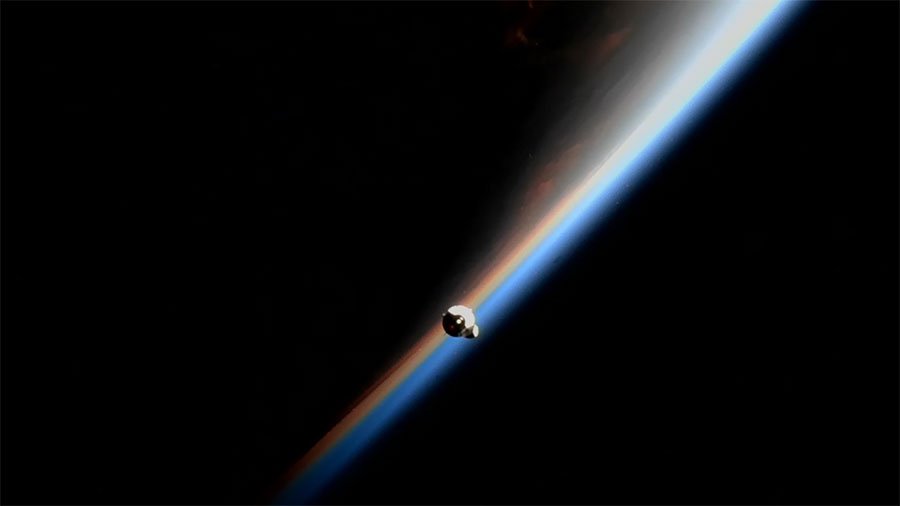
Image (Credit): SpaceX AX-1 mission to the International Space Station. (SpaceX)
“We are not space tourists.”
– Statement by Michael López-Alegría who traveled as a private citizen (and former NASA astronaut) to the International Space Station (ISS) on Friday as part of SpaceX’s AX-1 mission.
Why does this remind me of the statement “I am not a crook”? Mr. López-Alegría leads the mission carrying three wealthy passengers who spent about $55 million apiece to stay on the ISS for eight days and basically get in the way of working astronauts. I thought Bigelow was working on inflatable space hotels. Wouldn’t that be more appropriate? And maybe that $55 million could go towards STEM classes for students who want to go to space as a career rather than a joyride. Just an idea.
Image (Credit): Artist’s rendering of a Bigelow inflatable space station. (Bigelow Space Ops)
Image (Credit): This timeline illustrates the earliest galaxy candidates as well as the history of the universe.(Harikane et al., NASA, EST and P. Oesch/Yale)
Just recently I posted about the discovery of the farthest star. Well, now astronomers have spotted the farthest galaxy. The Harvard Gazette reports that a galaxy named HD1 appears to be about 13.5 billion light-years away and may contain the universe’s first stars or even the earliest black hole discovered to date. The contents of this galaxy is still being studied (and theorized).
The story quotes Fabio Pacucci, an astronomer at the Center for Astrophysics who was involved in the discovery, who stated:
Answering questions about the nature of a source so far away can be challenging… It’s like guessing the nationality of a ship from the flag it flies, while being faraway ashore, with the vessel in the middle of a gale and dense fog. One can maybe see some colors and shapes of the flag, but not in their entirety. It’s ultimately a long game of analysis and exclusion of implausible scenarios.
More review of the data as well as updated data from the James Webb Space Telescope at some point in the future should help to answer questions related to this galaxy.
Image (Credit): Launch vehicles for Amazon’s Project Kuiper. (Amazon)
Watch out SpaceX, Amazon is getting into the Internet satellite business as well. More importantly, beware astronomers and orbiting spacecraft, because the skies are going to be really crazy, and China has not even started with its massive program.
This week, Amazon announced plans to more forward with Project Kuiper, which will involve about 83 rocket launches involving Arianespace, Blue Origin, and United Launch Alliance. The Project will place 3,236 satellites into low Earth orbit (LEO) over a five-year period.
This is how Amazon describes Project Kuiper:
Project Kuiper aims to provide high-speed, low-latency broadband to a wide range of customers, including individual households, schools, hospitals, businesses, government agencies, disaster relief operations, mobile operators, and other organizations working in places without reliable internet connectivity. Amazon is designing and developing the entire system in-house, combining a constellation of advanced LEO satellites with small, affordable customer terminals and a secure, resilient ground-based communications network.
Of course, this is what SpaceX’s Starlink is already doing as it aims for 42,000 such satellites. In addition, Oneweb aims for about 600 such satellites (to be launched by SpaceX of all firms). And China is considering a similar system of 10,000 LEO satellites. This is just the list to date, which is quite a cluster of problems already.
So let me get this straight. We can get Dish TV cable services to every spot in the US using only 9 satellites, but we will need thousands and thousands of competing satellites crowding LEO and jeopardizing our space stations, weather and intelligence satellites, and astronomy efforts all for Internet services?
Why does it appear we are going backwards. I understand that the Dish satellites are about 22,000 miles away in geosynchronous orbits, but why can’t that be the model going forward rather than the billions of satellites that Mr. Musk thinks is possible? It strikes me as crazy to go down this path. All we need is one bad collision, and the cascading impact of that collision, to doom all of LEO.