Image (Credit): Russian cosmonauts Oleg Artemyev, Denis Matveev and Sergey Korsakov pose with a flag of the self-proclaimed Luhansk People’s Republic on the ISS in a photograph released July 4. (Roscosmos via Reuters)
“[NASA] strongly rebukes using the International Space Station for political purposes to support [the] war against Ukraine, which is fundamentally inconsistent with the station’s primary function among the 15 international participating countries to advance science and develop technology for peaceful purposes.”
-NASA statement, as quoted in the Washington Post, regarding the picture of three Russian cosmonauts on the International Space Station (ISS) holding a flag of the self-proclaimed Luhansk People’s Republic released earlier this month. Russia is probably try to clear up some earlier confusion about the colors worn by these same astronauts back in March (see below). We get it, you represent an aggressive nation preying on its neighbors.
Image (Credit): Russian cosmonauts clothing for their March arrival at the ISS . (Roscosmos)
Take a look at the image above. Can you determine where this image originated? Take a guess and then check your answer by going to the menu and selecting the “Where is this?” page.
Image (Credit): The Hubble Space Telescope. (NASA/ESA)
This week’s image is the Hubble Space Telescope, still going strong after more than 32 years. It left the Space Shuttle Discovery’s cargo bay on April 25, 1990. With all of the attention on the James Webb Space Telescope (JWST), it’s important to remember this dependable space telescope that brought us so many amazing images over the years, including those shown below.
Given the concern over the recent concerns about a micrometeroid impacting the JWST, let’s not forget that the Hubble had a few growing pains as well. Most importantly, it had to deal with a flawed mirror that required astronauts to visit the space telescope so they could add five pairs of corrective mirrors. More than three years had passed before the astronauts could make this correction. So the current issues with the JWST are pretty minor by comparison.
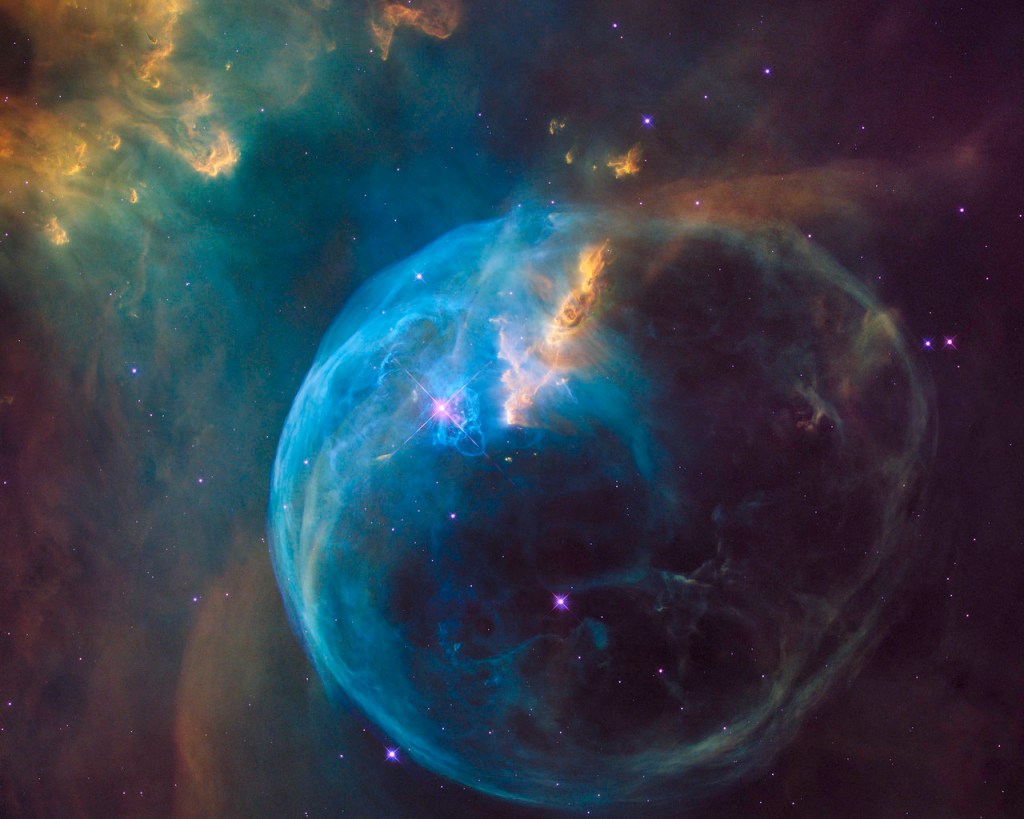
Image (Credit): The Bubble Nebula, also known as NGC 7635, located 8 000 light-years away. (NASA/ESA)
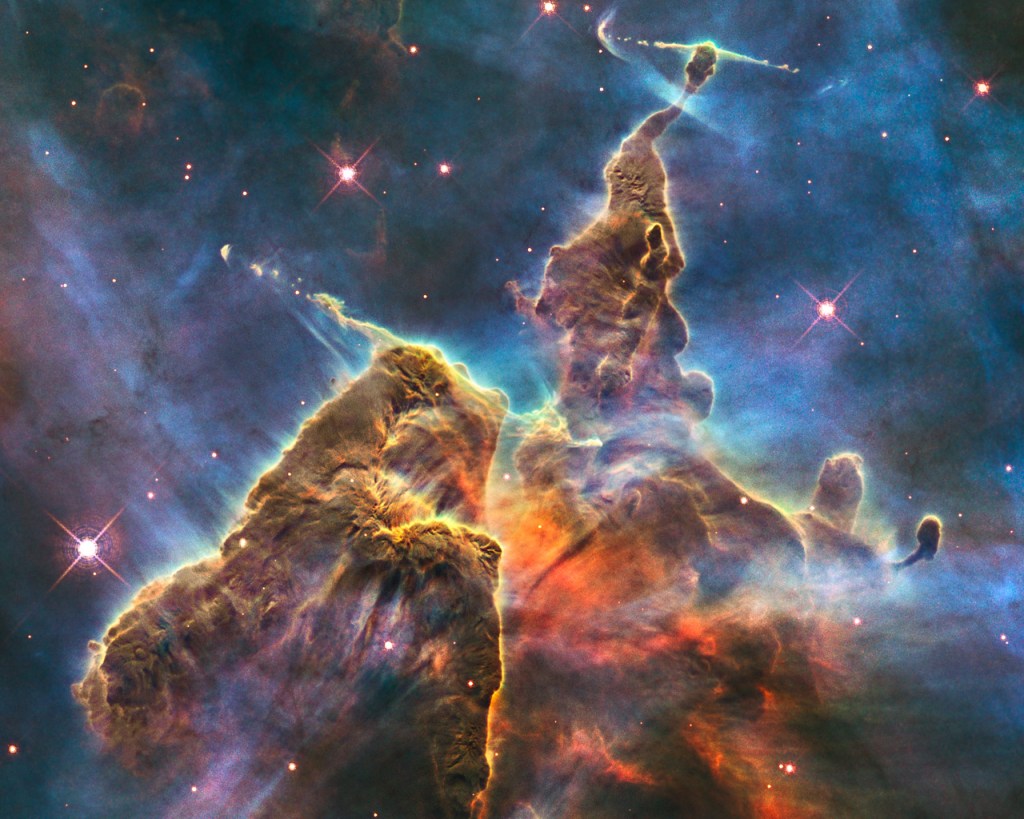
Image (Credit): A pillar of gas and clouds within the stellar nursery called the Carina Nebula, located 7500 light-years away in the southern constellation of Carina. (NASA/ESA).
Image (Credit): The eight plants of our solar system. (NOVA)
If you are looking for space series beyond the Moon, PBS has a few more shows for you. With the James Webb Space Telescope releasing the first photos next week, now is the time to brush up on the mission with a NOVA special. And check out the earlier NOVA piece on the planets as well. Dates and times may vary by region.
How did NASA engineers build and launch the most ambitious telescope of all time? Follow the dramatic story of the James Webb Space Telescope—the most complex machine ever launched into space. If it works, scientists believe that this new eye on the universe will peer deeper back in time and space than ever before to the birth of galaxies, and may even be able to “sniff” the atmospheres of exoplanets as we search for signs of life beyond Earth. But getting it to work is no easy task. The telescope is far bigger than its predecessor, the famous Hubble Space Telescope, and it needs to make its observations a million miles away from Earth—so there will be no chance to go out and fix it. That means there’s no room for error; the most ambitious telescope ever built needs to work perfectly. Meet the engineers making it happen and join them on their high stakes journey to uncover new secrets of the universe.
Among the stars in the night sky wander the eight-plus worlds of our own solar system—each home to truly awe-inspiring sights. Volcanoes three times higher than Everest, geysers erupting with icy plumes, cyclones larger than Earth lasting hundreds of years. Each of our celestial neighbors has a distinct personality and a unique story. In this five-part series, NOVA will explore the awesome beauty of “The Planets,” including Saturn’s 175,000-mile-wide rings, Mars’ ancient waterfalls four times the size of any found on Earth, and Neptune’s winds—12 times stronger than any hurricane felt on our planet. Using unique special effects and extraordinary footage captured by orbiters, landers and rovers, we’ll treat viewers to an up-close look at these faraway worlds. We’ll stand on the dark side of Pluto, lit only by the reflected light of its moons, watch the sun set over an ancient Martian waterfall, and witness a storm twice the size of Earth from high above Saturn. And, we’ll reveal how each of them has affected our own planet: Earth.
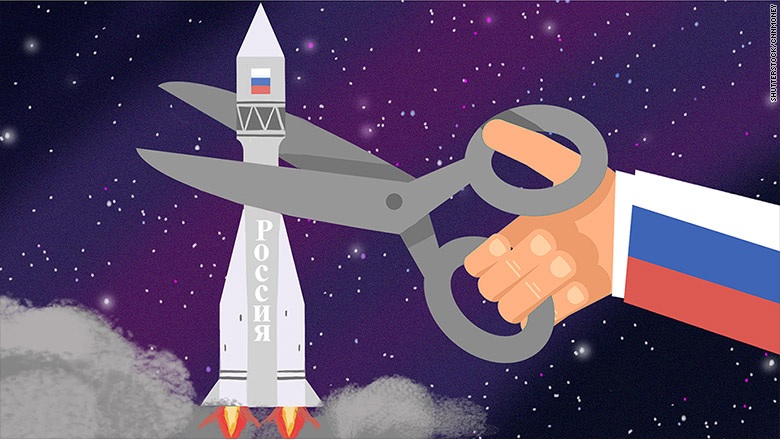
“Every penny should be spent for some purpose and some task…Therefore, we do not just check expenses, we also make sure that the results that were announced in state programs are achieved.”
-Statement by Alexei Kudrin, chairman of Russia’s Accounts Chamber, to Russia’s President Putin regarding the substandard performance of Russia’s space program, as reported in a Newsweek story, “Putin’s Space Chief Clashes With Top Economist Over Russian Space Program.” The invasion of Ukraine and related sanctions have hit the Russian economy and led to the cancellation of various space missions and contracts, and the situation is not expected to get better while Russia spends its time and resources attacking neighbors rather than focusing on its future in space.