Image (Credit): An artist’s rendering of ‘Oumuamua. (European Southern Observatory / Science Photo Library)
“Human history is very often driven by a group of people feeling superior to another group of people. If we find that we are not the smartest kid on the cosmic block, it will give us a different perspective. All the differences between humans will become irrelevant.”
-Harvard University Professor Avi Loeb quoted in the Independent discussing his search for extraterrestrial life and his new effort called The Galileo Project. His book, Extraterrestrial: The First Sign of Intelligent Life Beyond Earth, on the the mysterious object ‘Oumuamua that visited our solar system has caused quite a stir.
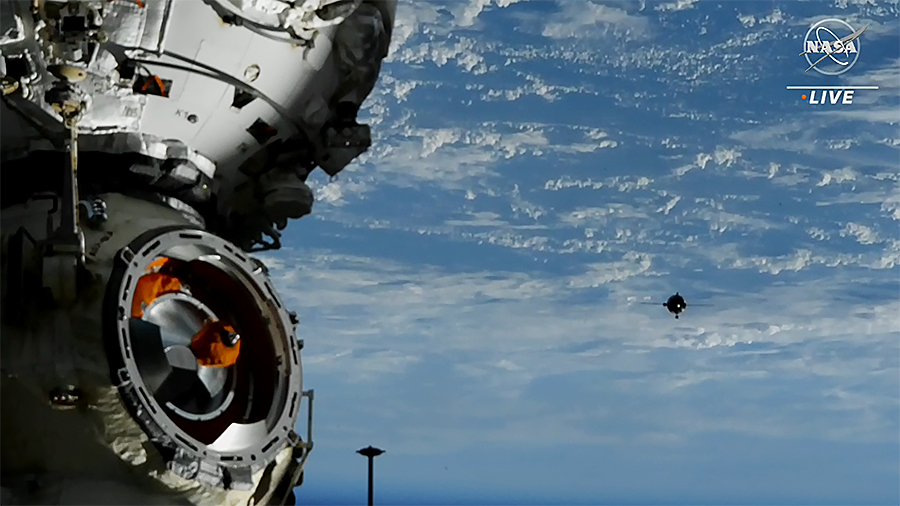
Image (Credit): The Soyuz MS-21 crew ship with three cosmonauts aboard approaches the International Space Station. (NASA)
On Friday, a Soyuz space capsule arrived at the International Space Station (ISS) with three Russian cosmonauts – Oleg Artemyev, Denis Matveev, and Sergey Korsakov. This will bring the ISS crew to 10. On March 30th, three crew members will return to the surface of the Earth – NASA astronaut Mark Vande Hei and Russian cosmonauts Pyotr Dubrov and Anton Shkaplerov. You can read more about the mission here.
With the ongoing disagreements between the Russian and Western governments regarding Ukraine, it is good to see some normal operations related to the ISS. Let’s hope the science can continue in space while discussions continue back here on Earth to end the ongoing war.
Update: The media was abuzz regarding the blue and yellow outfits of the three astronauts arriving at the station. Was it support for Ukraine or their alma mater? One cosmonaut said there was simply an excess of yellow material. Another space mystery.
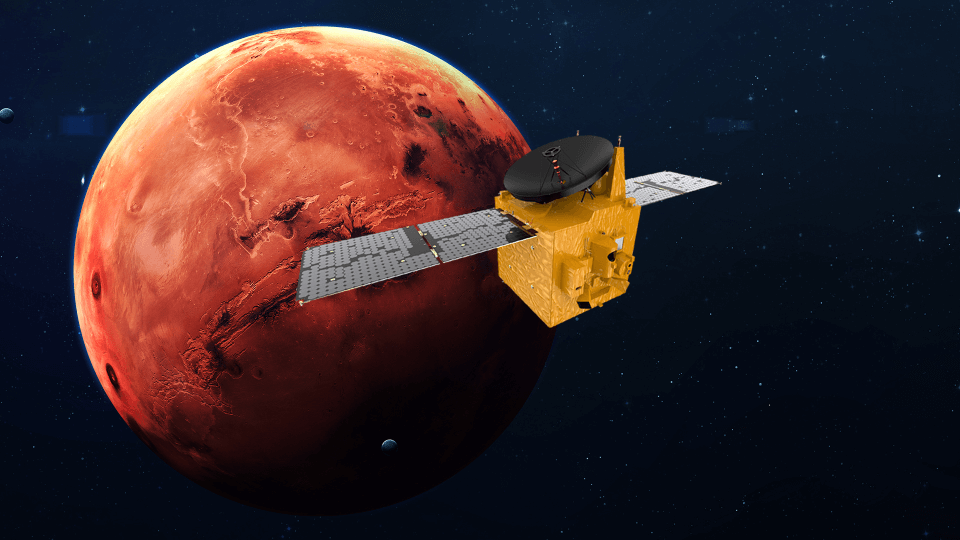
Image (Credit): Artist’s image of UAE’s Hope probe orbiting Mars. (UAE Space Agency)
You may want to visit Time magazine and view the article “The Woman Who Took the UAE to Mars.” It summarizes Sarah Al Amiri’s efforts related to the United Arab Emirates’ mission to Mars as well as her plans for the country’s space agency, which she now heads as Chairwoman.
Prior to becoming Chairwoman, Ms. Amiri was deputy project manager of a mission to map the Martian atmosphere. Her team, which was 80 percent female, developed the Hope probe to accomplish this goal. The probe was launched aboard a Japanese rocket in July 2020 and now orbits Mars. The data obtained from this mission is being shared openly to assist others studying the Martian atmosphere.
Another mission mentioned in the Time article by Chairwoman Amiri is a tour of seven asteroids as well as a flyby of Venus. A UAE space page defines the mission in this way:
The spacecraft will undertake a 3.6 billion-kilometre, five-year journey, which will see it perform gravity assist manoeuvres by orbiting first Venus, then Earth in order to build the velocity required in order to reach the main asteroid belt, located beyond Mars…The mission will study seven main belt asteroids…The mission will make its first close planetary approach orbiting Venus in mid-2028, followed by a close orbit of Earth in mid-2029. It will make its first fly-by of a main asteroid belt object in 2030, going on to observe a total of seven main belt asteroids before its final landing on an asteroid 560 million kilometres from Earth in 2033. This will make the Emirates the fourth nation to land a spacecraft on an asteroid.
What was not mentioned in the story but is available via another UAE government page is plans for several other space endeavors, including:
Sending a rover to the Moon in 2024. The rover’s name is Rashid, named in honor of the late Sheikh Rashid bin Saeed Al Maktoum, former Ruler of Dubai.
Establishing a settlement on Mars by 2117, and building a Mars Science City within the UAE to make this Martian mission possible.
Image (Credit): Artist’s image of MESSENGER orbiting Mercury (NASA).
On this day in 2011, NASA’s MErcury Surface, Space ENvironment, GEochemistry, and Ranging (MESSENGER) probe became the first spacecraft to orbit Mercury. NASA prepared the 10-year summary below explaining MESSENGER’s accomplishments from the time it was launched on August 3, 2004 through August 1, 2014. The probe later impacted the surface of Mercury on April 30, 2015.
NASA issued this high-level summary of the mission:
The MESSENGER spacecraft fundamentally changed our understanding of Mercury during its four-year orbital exploration of the planet, returning nearly 300,000 photographs and a wealth of information from its instruments. The formatted data totaling more than 10 terabytes reside in NASA’s Planetary Data System archive. Among the major findings were that Mercury harbors water ice and organic compounds at its north pole, that volcanism played a major role in shaping the planet’s surface, and that Mercury’s surface materials are more volatile-rich and chemically reduced than expected.
Image (Credit): 10-Year Summary of MESSENGER’s activities as of August 1, 2014. (NASA)
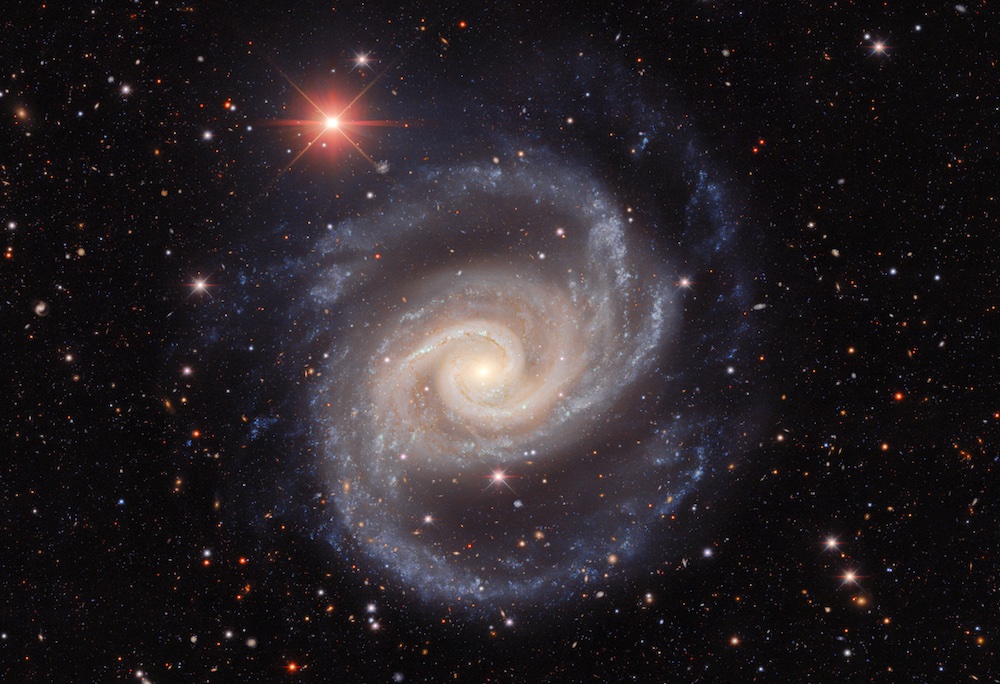
Located in the constellation Dorado and lying around 70 million light-years away, NGC 1566 is a grand-design spiral galaxy with two arms that appear to wind around the galactic core, just like the arms of a dancer as they spin around and around in a furious twirl. This image was taken from Chile at the Cerro Tololo Inter-American Observatory (CTIO), a Program of NSF’s NOIRLab, using the Dark Energy Camera. The galaxy’s face-on view to us, its location, and its composition make it a trove of observational opportunities for astronomers across many fields of astronomy.
NGC 1566 is home to stars at all stages of stellar evolution. In this image, the bright blue color that outlines the arms of the galaxy arises from young, brightly burning stars. Darker spots within these arms are dust lanes. The arms are rich in gas, and form large-scale areas that provide the perfect environment for new stars to form. Closer to the center of the galaxy are cooler, older stars and dust, all evident by the redder color in the image. This galaxy has even been host to an observed stellar end-of-life event, when a supernova, named SN2010el, burst onto the scene in 2010.
The center of NGC 1566 is dominated by a supermassive black hole. The distinct and highly luminous nucleus of the galaxy is known as an active galactic nucleus. The light from the nucleus changes on timescales of only hundreds of days, making its exact classification difficult for astronomers.